
Can articles written by AI sell your product?
Last updated:
You have 2 ways to get posts that sell: let an AI tool write them on its own, or learn Write to Sell and write them yourself. Both give you posts. The difference is where the posts come from, what customers see, and what you have left after a year.
Automated AI writing wins on speed and volume. You feed it a list of keywords, the tool does everything from A to Z, and new posts come out every day. Some posts AI writes are very good, such as analysis pieces, and Google does not ban content made with AI help, as long as it gives readers real value.
Write to Sell is slower. You write yourself, you practice, and at first you have only a few posts. In return, you learn how to talk about your own product, and that skill stays with you.
To choose well, look at each root of the problem, starting with where the content comes from.
Where does content begin?
A post that sells has to grow from a root, and the two ways choose two different roots.
Automated AI writing starts from keywords. You feed in a list of keywords, the tool groups them and writes from them. This works when you already know which keyword is the core and which ones sit around it. When you do not, and you feed in too many loosely related keywords, the site gets watered down and drifts off topic, and the algorithm ranks a site like that low.
The real limit is the product. AI knows only what you tell it: a feature you designed has a reason of its own, but until you say it, AI cannot know it, and a product is not source code you can paste into AI. The rest AI takes from keywords or old content, so whether a post fits your product is never certain.
Write to Sell starts from the product to position your content, and keywords support it later. This way asks you to do the part no tool can do for you: understand where your product stands out, then decide for yourself what to write. Only the person who made the product has that answer.
Where does real value lie?
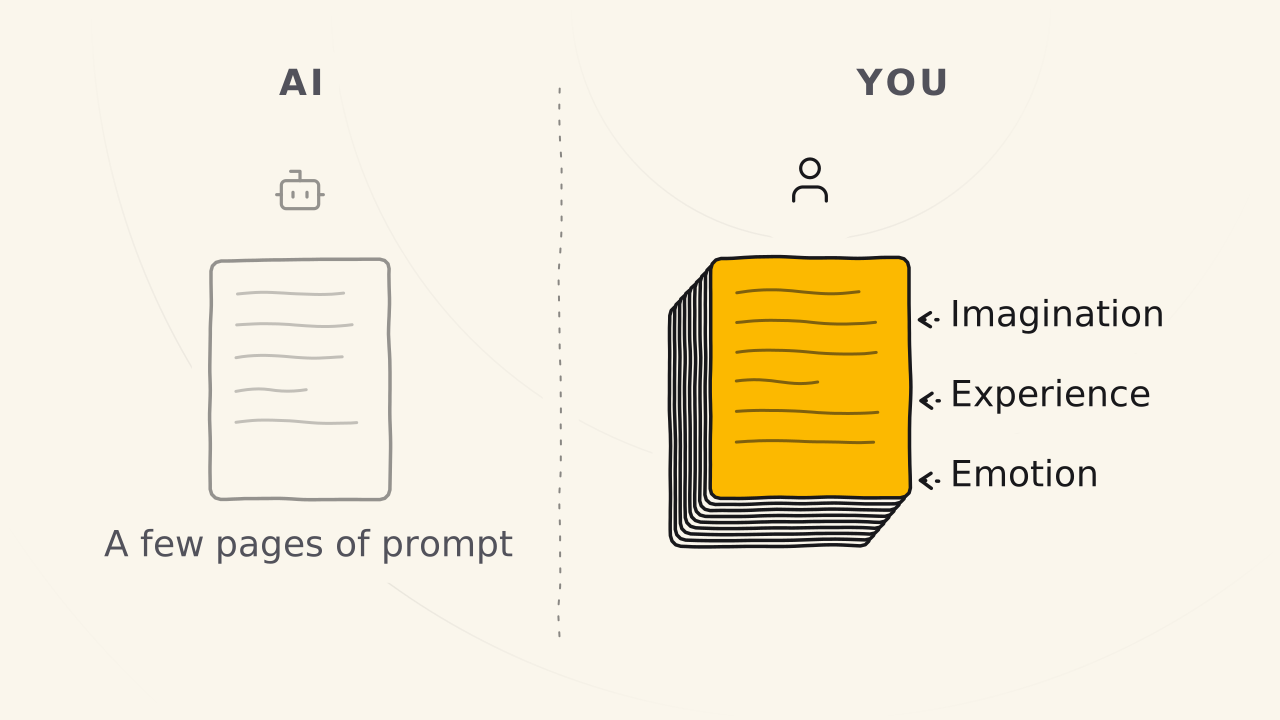
The real value of a post is not in smooth sentences. It is in what the writer has that nobody else has.
Automated AI writing takes its value from the shared data of the internet, gathered and arranged into a post that reads well. For common knowledge, this gives you a readable post very fast. But AI knows you only through what you feed it: a good prompt and a description of your voice a few pages long. The rest of what is in your head, AI cannot reach.
Write to Sell takes its value from 3 things only people have:
- Imagination. Human strength lies in imagination: daring to think what others call crazy. AI does not do that.
- Experience. AI has no memory and feels no pain. When AI tells of a struggle, it is someone else’s story posted online, not yours.
- Emotion. AI only imitates feeling. When you write while sad or while excited, your words change on their own, and readers feel it.
Your life experience, the memories, the stories, everything you have been through, would fill far more than a few pages of prompt. The price of this way is that you have to dig those things out and write them yourself. Nobody does it for you.
Readers are people. They read your story, feel it with you, and take a lesson of their own from it. A post made from shared data reads like a news bulletin: it has information, but little of a lesson to carry home.
Think of hand-pulled noodles. A factory makes every batch taste the same, while the shop of a cook with a recipe of their own is packed. No one out there is like you, so readers remember your brand and respect your effort.
Does volume create customers?
More posts do not turn into more customers on their own. The question is which posts have a job to do.
Automated AI writing wins on volume, and volume does help: more posts means more searchers landing on your site, sometimes an order too. But anyone who pays can buy the same tool. You use AI, others use AI, and however many posts they put out, so do you.
Tools sit on the internet where anyone can find them, so no tool stays secret for long. Google also says it plainly: creating pages in bulk that give readers no value can break its spam policies (opens in a new tab).
Write to Sell chooses quality, and accepts fewer posts that come out more slowly. The only secret is your skill and what has built up in your head.
When you write along the Know - Trust - Love content funnel, you write fewer posts, but each one counts and each has its own place on the map: taking a customer from not knowing you, to trusting you, to loving the person behind the product. No post exists to fill a gap. My Content system was built so you can write less and sell more.
Who stands behind the post?
Customers do not just read a post. They look for who stands behind it.
Automated AI writing does not hide you by itself, but the common way of using it does:
- An anonymous author, no real photo and no real name
- Posts pouring out in bulk that say nothing
Readers notice fast and close the page. A Raptive study (opens in a new tab) of 3,000 Americans in July 2025 found that when readers think a post was written by AI, their trust drops by nearly half. They are also about 14% less willing to buy the product advertised beside it.
Write to Sell puts a person who does the work behind every post. Customers like a creator, a business owner, a seller who makes the effort. When you run a business alone, what you really sell is yourself, so you talk about your product with a passion AI does not have. This way asks you to show yourself: your real name, your real photo, and responsibility for every line you write.
Write to Sell is not ad copy for closing deals. Its spirit is to explain: help customers understand the product, follow what you show them, and come to buy on their own, with no pushing. A customer who loves the person behind the product still buys when the product is not perfect yet, and gives feedback instead of walking away.
Does the brand grow or fade?
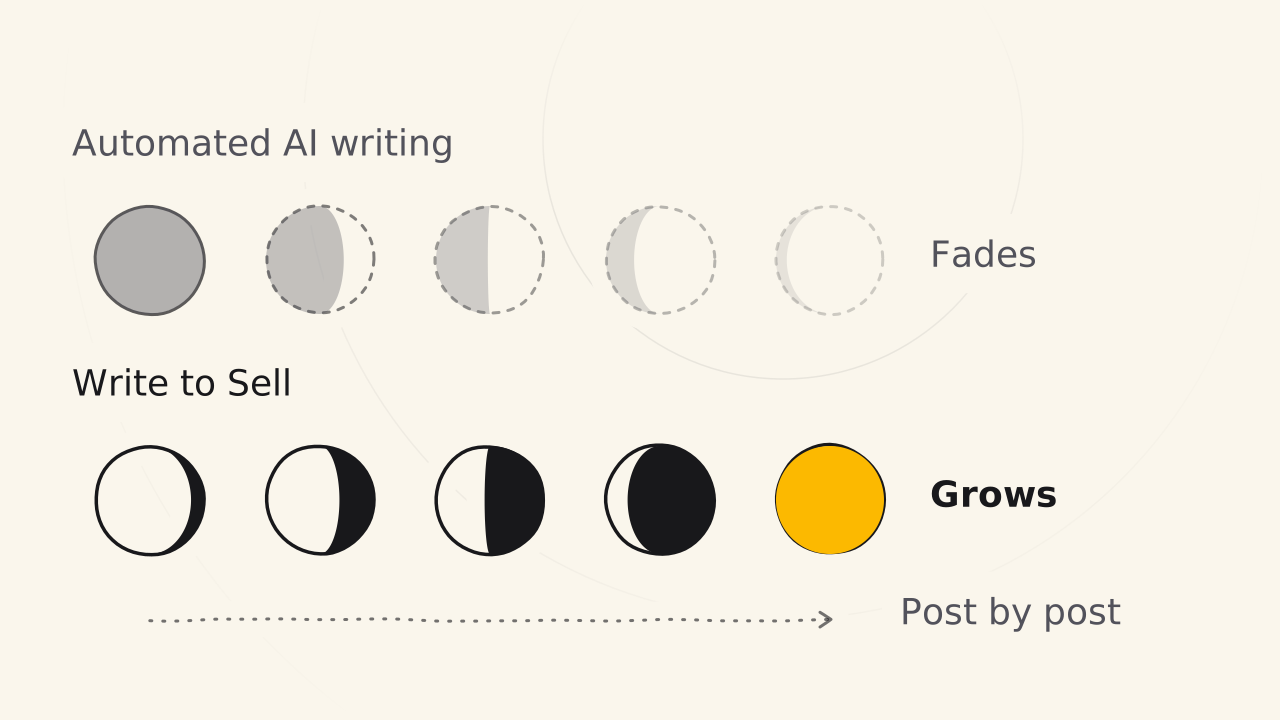
Every post you publish adds to your brand or takes from it.
Automated AI writing does one thing for a brand: posts come out steadily, on schedule. The risk is in posts nobody checks. Big brands have made this mistake:
- CNET used AI to write 77 stories and then had to correct 41 of them (opens in a new tab), more than half.
- Sports Illustrated was caught by the press publishing under fake author names (opens in a new tab), and its parent company had to pull the articles and end its deal with the vendor.
- Duolingo declared itself “AI-first”, and after weeks of backlash its CEO had to explain (opens in a new tab).
- LinkedIn, after months of complaints about AI slop, added a button to report AI posts (opens in a new tab) and dropped its AI rewrite feature.
Meanwhile the companies behind Claude (opens in a new tab) and Gemini (opens in a new tab), and Cloudflare (opens in a new tab) too, all name the real people who write their blogs. What they have in common is that one person always answers for the post.
Hand everything to AI and you hand over control with it. A site whose content you no longer control says nothing of your spirit, and all that is left for you is the bills: the tool, the website, the domain.
Write to Sell builds your brand post by post, slowly, but with you holding it. Content you write yourself builds 2 brands at once: a personal brand full of your own character, and a product brand.
Your style stays the same from one post to the next, because a person cannot write one way in the morning and another way in the afternoon. That makes your personal brand easy to recognize, and readers remember you. In return, every mistake in a post carries your name too.
Whom will AI search cite?
Buyers now often ask AI directly. Google’s AI mode and ChatGPT answer for the searcher, but the answer still has to come from sources, and Google cites the source sites. When ChatGPT meets a question it does not know, it searches the internet too, and the source it finds may be you.
Automated AI writing gives you posts that look like everything else online, because they come from the same shared data, so they are rarely picked as a source to cite.
Write to Sell does not follow the old SEO playbook. It lets AI find you. You write the truth about your product and cover a topic fully, so someone who digs 4-5 questions deep keeps meeting you in the citations, then clicks to see who you are. This takes time: covering a topic fully is not done in a few weeks.
Who decides the content?
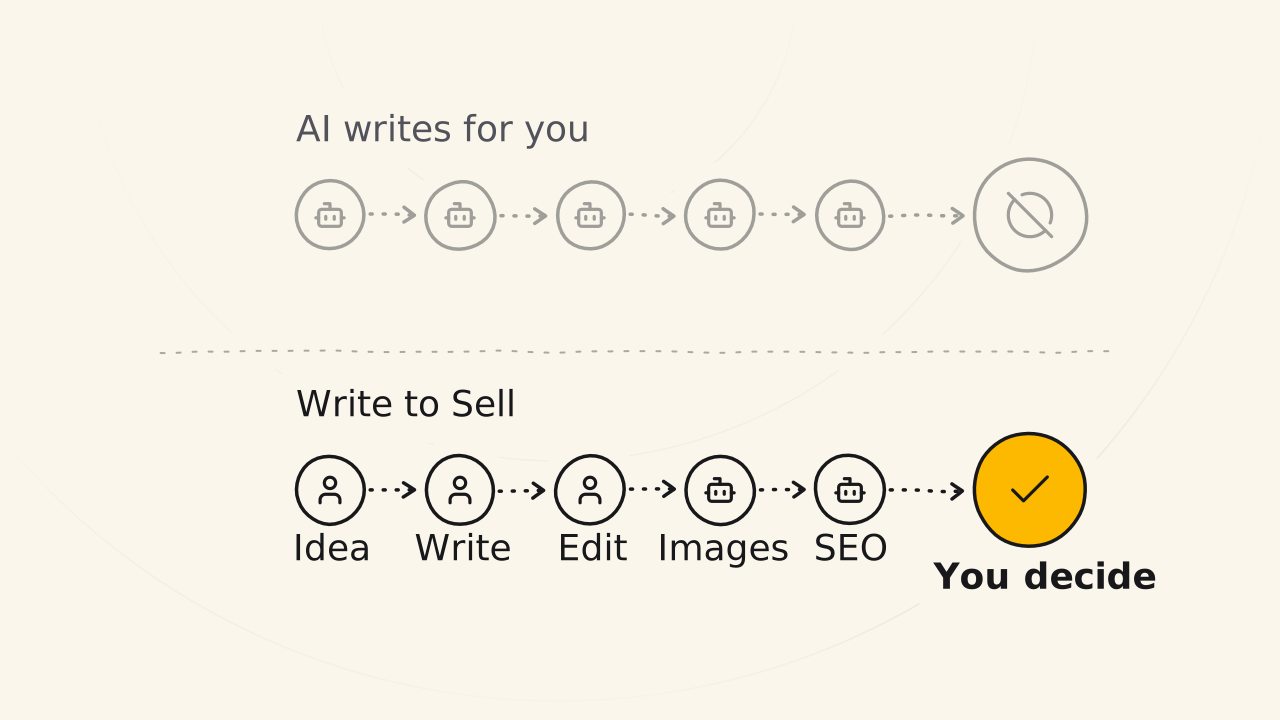
Write to Sell does not reject AI. The rule is simple: AI does what it does best, people do what they do best, and only the 2 together make the post you want. The line is drawn at who decides.
Automated AI writing is AI writing for you:
- The outline and the script
- The writing and the editing
- The competitor and market research
- The images
You only press a button. Fast, but your ideas are no longer in the post.
Splitting the work is not easy either. Split it 90 posts by AI and 10 by hand, and those 90 posts will not match your style, and the quality will be uneven. A reader enjoying your good post clicks to an AI one, loses interest and leaves.
Write to Sell lets AI help you write by taking the repetitive parts:
- Making images
- Analyzing and cross-checking data
- Polishing sentences
- Checking SEO, repeated words and word counts
You still decide, and your ideas always stay. Write to Sell gives you a formula to get off the blank page, such as the Idea - Write - Edit process, and AI only does the side work at each step, as the page AI and prompts shows.
A year on, what do you have left?
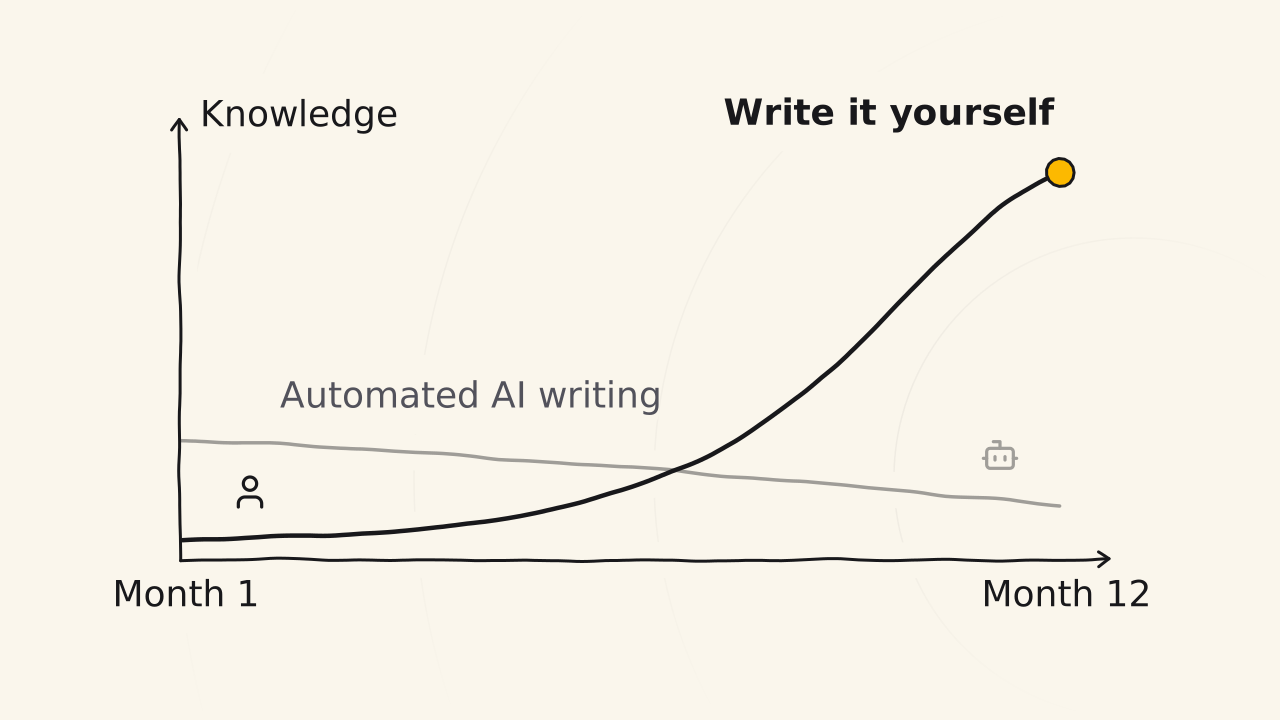
I have watched AI tools since they appeared, and I still choose to write myself. The reason is what is left after a year.
Automated AI writing gives you posts today, but no skill. AI improves daily, you do not practice, and you depend on AI a little more each day. At some point you are no longer a content creator, and you cannot even talk about your own product. On top of that, every AI tool costs money.
Write to Sell makes your knowledge build up, because you write for real, learn for real and do the work for real. Content works the same way. It grows slowly at first, and you cannot have hundreds of posts at once. But every post adds up and changes with the product, because no product is perfect at the start either.
Are you a technical person who dreads writing? Write to Sell is for you too. Building a website is easy, content is the hard part, and it has always been that way.
You need no gift for literature. If you dread writing, talk. Treat a post like code. If you dread both writing and talking, practice. There is no faster road than practice. The moment words appear on your screen, you have already won. At first, do not worry about good or bad. Care about getting better every day.
This way takes more work than pressing a button, and that work is worth it. If you want to stand out, there is no other road than training yourself. The Write to Sell course was built for exactly that: so you can sell with your own real strength, without depending on a tool and without racing one.
Write to Sell
Own a sales machine built from your own words. Turn your posts into sales, 24/7.
I want to Write to Sell