
The Know - Trust - Love content funnel: Write less, sell more
The Know - Trust - Love content funnel, from real practice and your own touch, lets sales posts hit the right pain and lead to a buying decision.

On this page 3,580 words
- Why do you write so much and still not sell?
- The 3 layers of the Know - Trust - Love funnel
- What is a Know post in a content funnel?
- Why are Know posts the hardest to write?
- How to find topics for Know posts
- What is a Trust post in a content funnel?
- What is a Love post in a content funnel?
- Why must a Love post come from you?
- How to build a Know - Trust - Love content funnel
- How to roll out the Know - Trust - Love funnel
- Stage 1. Build the smallest basic funnel
- Stage 2. Expand and grow the funnel
- Internal linking strategy for the posts in a funnel
- Two places to put links
- The SEO edge of a web of links
- Why is a sales page in a content funnel always lean?
- The person who writes the funnel learns the most
- Use the Know - Trust - Love funnel from the idea stage
- The mistake of waiting for a finished product
- Building the funnel creates your product’s history
- Trust that is there before launch
- Why does the Know - Trust - Love funnel help humans beat AI?
- The role of AI in the funnel
- What people are willing to pay for
- Start building your own machine
The Know - Trust - Love content funnel is how I make content, wrapped in one sentence that says write less, sell more.
When you make content for a product without a funnel, you write a lot, but few posts reach the goal of making sales. The Know - Trust - Love funnel fixes exactly that sticking point. It helps you write less but write right, every post has a path to a sale, and writing no longer wears you out.
Why do you write so much and still not sell?
Because you write with no direction. I know this well, because I have been there.
Starting in 2017, I wrote about 300 blog posts. They covered making a website with WordPress, sending email with Mailgun and Amazon SES, signing up for the Stripe payment gateway, free email marketing software… Every post was written for a keyword, for what people were searching for. That was content marketing with no funnel.
In the end, I had readers, but no sales. Readers came in, took the guide, and left. They did not know what I was selling, what topic I focused on, or whether I shared their pain.
When I rebuilt the site, out of about 300 posts, I kept only 11 that people still found and read on Google. More than 96% of the posts had to be deleted.
My energy was split a dozen ways, never poured fully into one thing. Writing one decent post already takes a lot of work. If you love words, deleting posts is a lesson. If you do not, it is torture.
The Know - Trust - Love funnel was born from that very lesson. With a funnel, every post has a direction and a formula, and follows the order the reader needs, which is know, then trust, then love.
The 3 layers of the Know - Trust - Love funnel
The funnel runs in a straight line, which is Know, then Trust, then Love. The Love layer is the one that leads customers to buy your product, so it sits at the bottom of the funnel. Those three states and the six shared principles of the funnel are on the page the Know - Trust - Love philosophy and content funnel.
Each layer gives readers a different feeling.
| Layer | The reader feels | What they do |
|---|---|---|
| Know | “Oh, I learned one more thing today.” | Finds you because their pain was named |
| Trust | “I did it.” | Follows a small guide and gets a result |
| Love | “At last, I see a way forward.” | Comes looking for your product |
- The Know layer is discovery. This is the door into the funnel: readers learn about you, your brand and your product for the first time.
- The Trust layer is action. From that Know, you offer small guides and small tests. Readers follow them, get a result, and trust.
- The Love layer is the light at the end of the tunnel. Once they trust you, readers meet a big solution to their long-running pain: a direction, a way to succeed.
A Know post leads to a Trust post. A Trust post leads to the Love post. The Love post leads to the product.
What is a Know post in a content funnel?
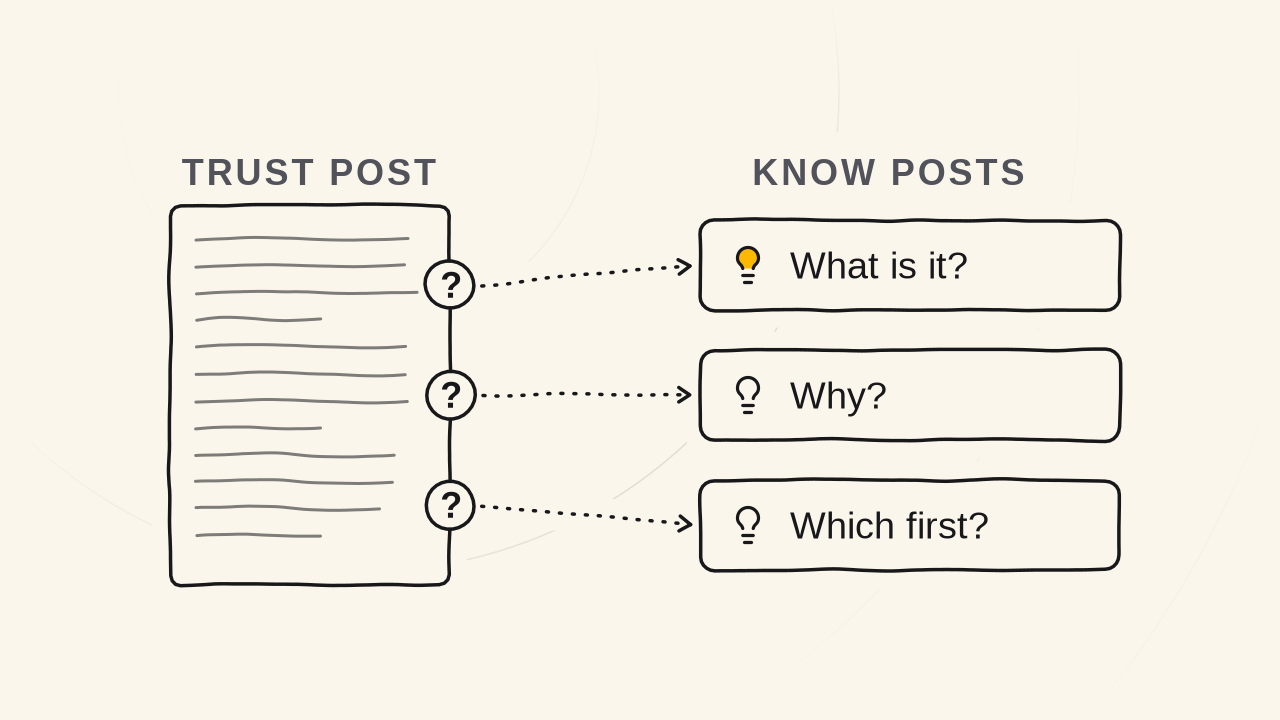
When people read a Know post, they should feel like saying “Aha, today something new clicked for me again!” This is the first place they discover you, learn about your brand, and see their own problem named dead on. A Know post sparks curiosity and is easy to share on social media, and that brings new people into the funnel.
Why are Know posts the hardest to write?
There are more Know posts in the funnel than any other kind, but they are the hardest kind to write.
They are hard because they are the first touch point, where you meet AI on its home field, which is information. On plain information, AI answers much faster than you, even if its answers are not always right. More and more people take their questions about facts to AI. What keeps them reading you is a human point of view, meaning the history you have been through, the things you have really done.
In Trust and Love posts, you have the edge of real practice and real experience. But in a Know post, you need a deep grasp of your customers, a view only you have and a fresh way of saying things. Without those three, the Know post becomes like every other post. Readers ask AI because it is faster, and no one reads on to the Trust post.
How to find topics for Know posts
To find topics for Know posts, start from the questions you hear often when you talk with customers. Above all, Know posts are pulled out of the Trust post itself.
When you write a hands-on guide (a Trust post), you will run into lots of terms and basic questions. They are questions such as “What is this?”, “Why do I have to do this step?”, “Why do this first and that after?”. If you cram every explanation into the Trust post, it gets watered down and gets in the way of the reader taking action.
What is a Trust post in a content funnel?
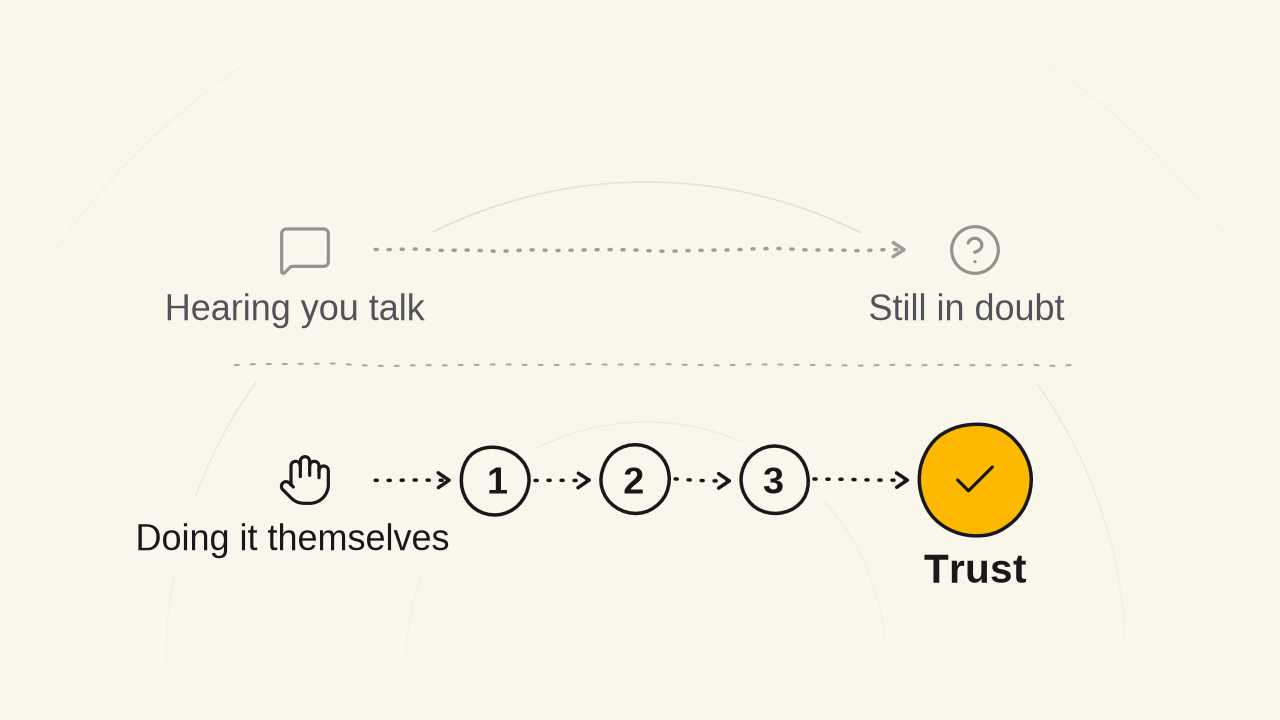
A Trust post picks up from a Know post with small actions, shown step by step. Knowing is not enough, because after reading a Know post, people may see something new, but deep down they still have doubts.
So a Trust post works as a set of small tests. As they read it, their feeling shifts from curiosity to an itch to act. “That’s so easy to follow, I want to try it!” A good Trust post needs:
- A clear promise of a result: follow these steps exactly, and you get this specific result.
- As little friction as possible: each step is detailed and clear enough that the reader gets a result by following it. They do not get stuck at any technical step.
Behind every Trust post is your own real, hands-on work. You cannot ask AI to make up a Trust post, because you have to be the one who is one step ahead of the customer. That means you test it yourself and pay the price yourself. You get a real result, and only then do you wrap it up as a guide.
There are fewer Trust posts than Know posts. Besides leading readers on from a Know post through the funnel, a Trust post is also the best way for you to share value in communities. Readers from groups or search engines can go straight into a Trust post and get a result with their own hands. They trust your skill, and then they go on to the Love post.
What is a Love post in a content funnel?
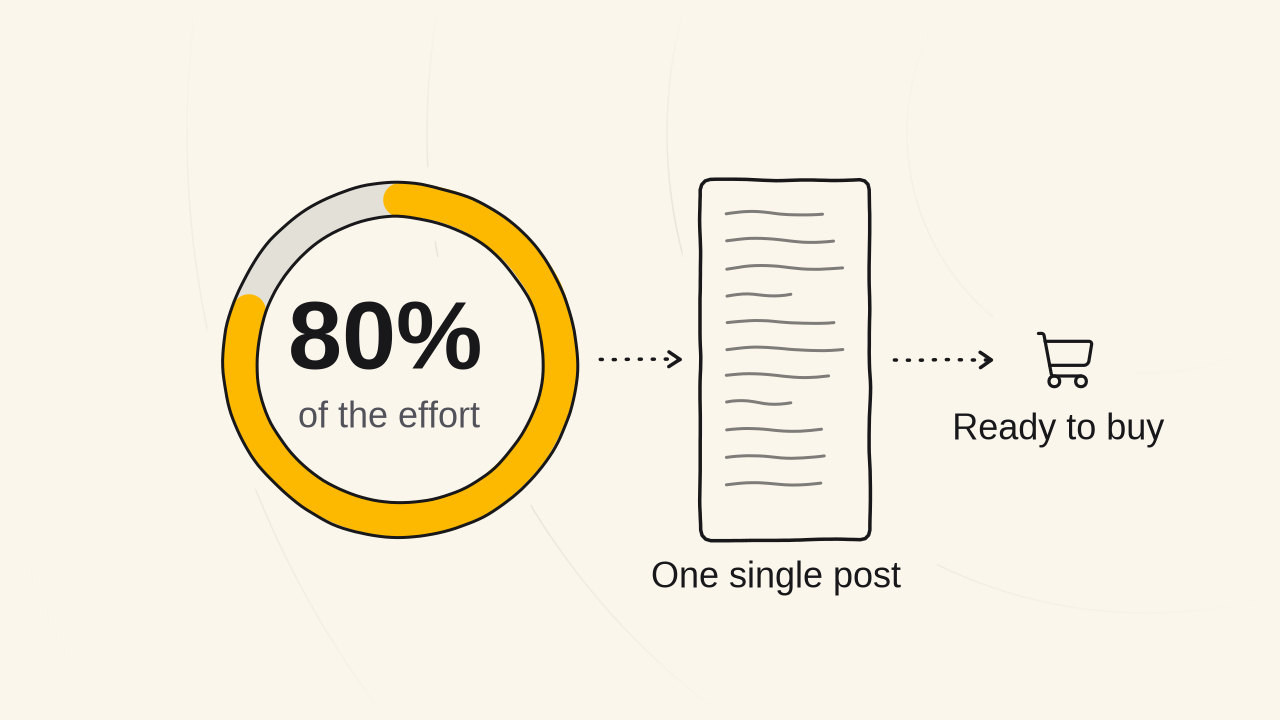
Each funnel has only one Love post, and it is where you pour up to 80% of your effort. The reason is simple. The Love post is the one that makes the sale directly.
If a Trust post helps readers get past each small obstacle on the road, the Love post is the big map of the whole road.
This is a big solution. It cannot be done in a few minutes, a few hours or a few days. It takes a plan, practice, and the patience to repeat. When readers reach the Love post, they almost want to cry. “At last I have found a real road to success.”
Because it is a full solution, the Love post will be very long. It has a true story, deep empathy, a process to guide the way and a clear promise of a result.
The Love post shows readers the whole road, but it does not give them a result right away. That is when your product comes in, as a lever for the solution. It helps readers save time, learn the method more easily, get it done faster, and walk the whole road without quitting halfway.
Once they finish the Love post, customers go on to the sales page in only one frame of mind, and that is ready to buy.
Why must a Love post come from you?
A product that sells well does not need to be better in every way. Customers are not looking for a product that does everything. They just need the right solution for the problem that hurts them. You do not sell to the whole world either, but to one specific group of people you want to serve.
So where does a product’s real edge lie? It lies in the very person who makes it.
You do not need to waste effort digging into product features. What you need to dig into is yourself. A product made by someone who writes books for a living has a whole different soul from one made by a pure marketer. The best points of a product are the points where you are best, which are your own deep expertise, real experience and natural strengths.
The market has lots of look-alike products. When you bring in what is yours alone, the product stands apart from the crowd. Competitors can copy features, but they cannot copy who you are.
That is why a Love post must come from your own personal story, hard-won expertise, and wishes and dreams. A few differences tied to who you are are enough to be the root of the whole funnel.
The Love post is the founder’s heartfelt letter. You cannot hand the Love post off to AI, because AI has no lived experience and no scars from the work. So AI cannot write that honesty for you.
How to build a Know - Trust - Love content funnel
When you build the funnel, you work backwards. When you lead customers, you go forward.
Instead of starting from scattered posts on the outside, you build the funnel from your product outward, in 4 steps:
- Find your edge in yourself: pick the few differences that matter most in your strengths and experience to be the root of the whole funnel.
- Write the Love post to draw the full map: from that edge, write the Love post as a full solution to your customer’s pain. The Love post lays out the whole road the reader has to travel to get the result.
- Write Trust posts to get past the obstacles on each stretch: look at the Love post’s map. Wherever a stretch has a technical difficulty or something that blocks action, write a step-by-step Trust post. Readers do it themselves and see the result right away.
- Pull the Know posts out of the Trust posts: pull the “what is” and “why” questions of a Trust post out into Know posts. That way the Trust post does not get watered down.
You build the funnel from the inside out (Love → Trust → Know). But when readers walk in, they go forward in a natural way. Something new clicks in the Know post, and they get a result with their own hands in the Trust post. When they read the Love post, they are ready to decide to buy.
How to roll out the Know - Trust - Love funnel
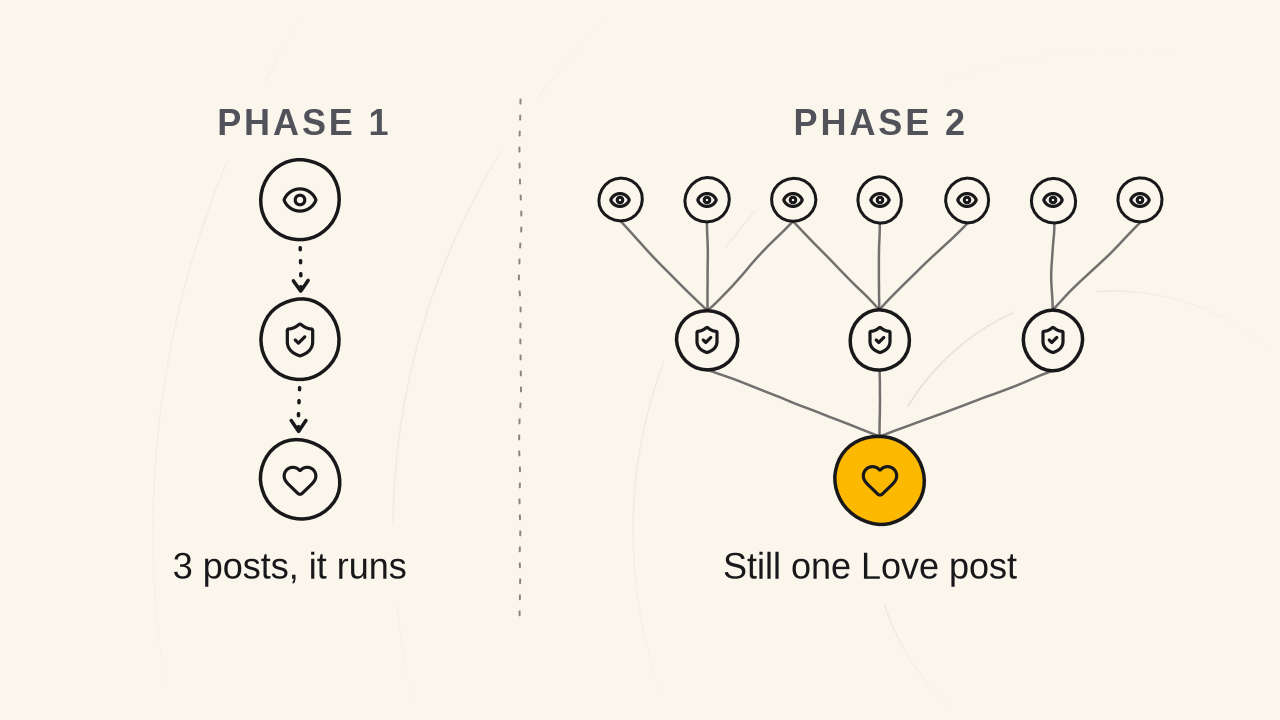
So you do not get swamped and burned out, you roll out the content funnel in two clear stages.
Stage 1. Build the smallest basic funnel
You need just one chain of 3 posts, namely one Know post, one Trust post, and one Love post. The Love post leads straight to the product page. The steps to build this chain are in the guide quickstart: build a three-post Know - Trust - Love funnel.
With just these 3 posts, you already have a funnel that runs from start to finish. Readers have their problem brought to light (Know), get a result with their own hands (Trust), and see the full solution to buy (Love). You do not need to wait until you have written dozens of posts to start selling.
Stage 2. Expand and grow the funnel
Once the basic funnel is running, you expand, but you keep one rule. The rule is that there is only one Love post, and you do not write a new one. Everything you add is only there to bring more readers to the Love post.
- Write in pairs: at first, each new Know post comes with a Trust post. As soon as readers understand, they have a guide to follow right there.
- Link across posts: once you have enough Trust posts, you do not have to write new ones. A new Know post can lead to the best-fitting Trust post you already have.
- Grow the Know layer: after that, focus on writing lots of Know posts to add more touch points. Feel free to use trending topics on social media to pull new readers in. The Trust layer below is solid enough to lead them on.
Once you have a funnel, you drop the habit of writing on a whim, chasing keywords, or rambling about yourself.
Internal linking strategy for the posts in a funnel
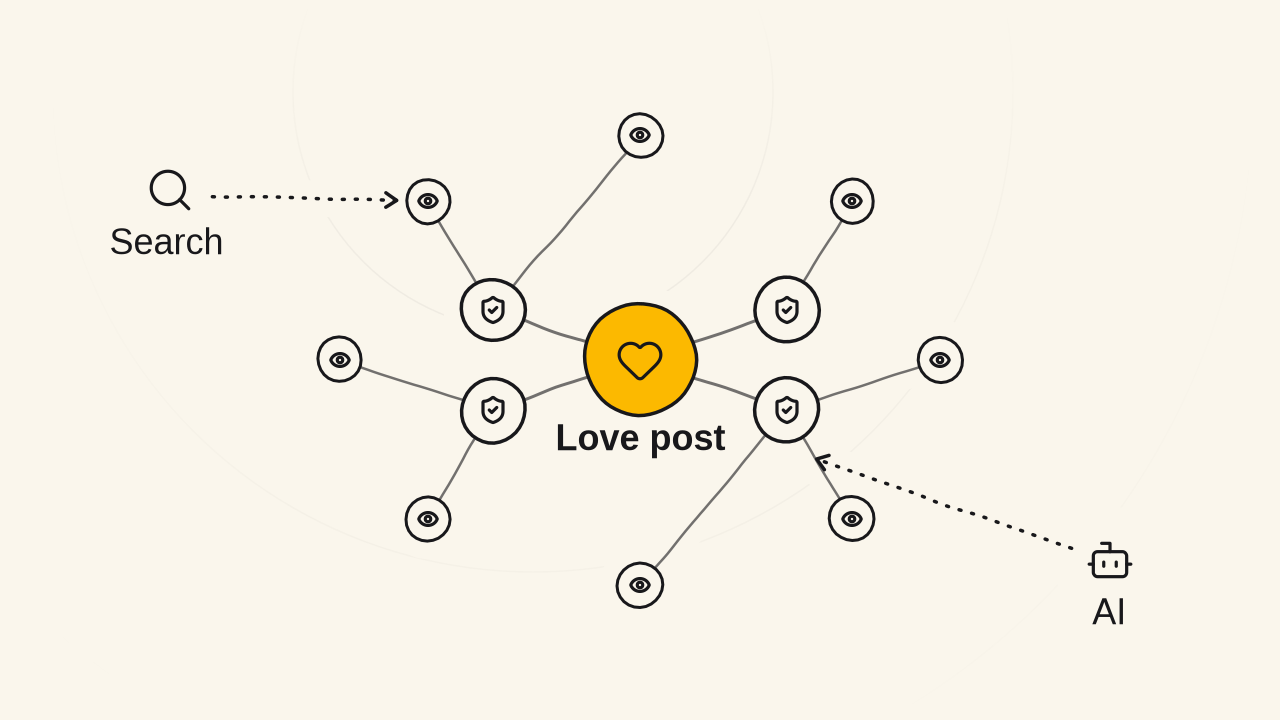
You cannot control which layer readers enter the funnel at. Thanks to search engines and AI, they can cut in sideways. For example, they type a technical question and land right on a Trust post. Or they read one point of view and skip straight ahead to the Love post.
People who land straight on the Love post and need a solution fast can buy right away. People who do not buy yet can go back to the home page or read other posts to get the whole story.
Two places to put links
The way in belongs to the reader, but the way on belongs to you. You lead them through two places to put links:
- Links at the end of a post, to guide people: at the bottom of every post, point to the next step. As the writer, you know what readers will need next after something clicks (in a Know post) or after they finish a step (in a Trust post). Every Trust post leads to the one Love post. Since there is only one Love post, vary your invitation and your angle in each Trust post, so the path always feels natural, never cookie-cutter.
- Links in the body, for the algorithms: as you write the main content, add links to related posts naturally, where the context calls for them.
The SEO edge of a web of links
Writing by the Know - Trust - Love funnel gives you a clear SEO edge. The reason is that all your posts revolve around one topic and link to each other. Thanks to this web of links, Google easily finds all your posts and understands which post relates to which.
Why is a sales page in a content funnel always lean?
Because when readers click through to the sales page, the funnel has already done the hardest part of persuading. They tested your skill in the Trust post and read the whole Love post, so they arrive ready to buy.
Without a funnel, you have to make sales pages that go on and on, crammed with every persuasion trick, because readers walk in on guard.
With a funnel, a short sales page does not need long arguments or praise that lifts the product to the sky. It only needs to do two things well:
- Let readers grasp quickly what the product includes and how they receive it.
- Give them a handy payment button, so customers never get stuck at a technical step.
A content funnel helps you write fewer posts, and you no longer break your back designing complex landing pages. Everything is lean, to save your effort and your customers’ time.
The person who writes the funnel learns the most
When you build the Know - Trust - Love funnel, the one who learns the most is you, not the reader. Writing a lot does not always mean learning a lot, but writing by the funnel makes you dig down to the roots.
Each layer trains you in one skill:
- Know posts teach you to listen: gathering the questions readers ask again and again makes you step outside your own ego. You see the product through the eyes of someone new. You learn where they get stuck and what they really want.
- Trust posts force you into real practice: you have to be one step ahead of the customer, so you learn by doing the work. Real practice is a fast, solid way to learn.
- The Love post trains you to think in systems: you have to string your hands-on process and your customers’ scattered worries into one full solution.
Writing by the funnel also brings you honest feedback. You find that some things you thought were right and brilliant are things customers do not need.
Through those run-ins, you learn your customers’ own language, meaning which words they use and how they describe their pain. Then you speak their language and touch exactly where it hurts most, with no marketing tricks.
Use the Know - Trust - Love funnel from the idea stage
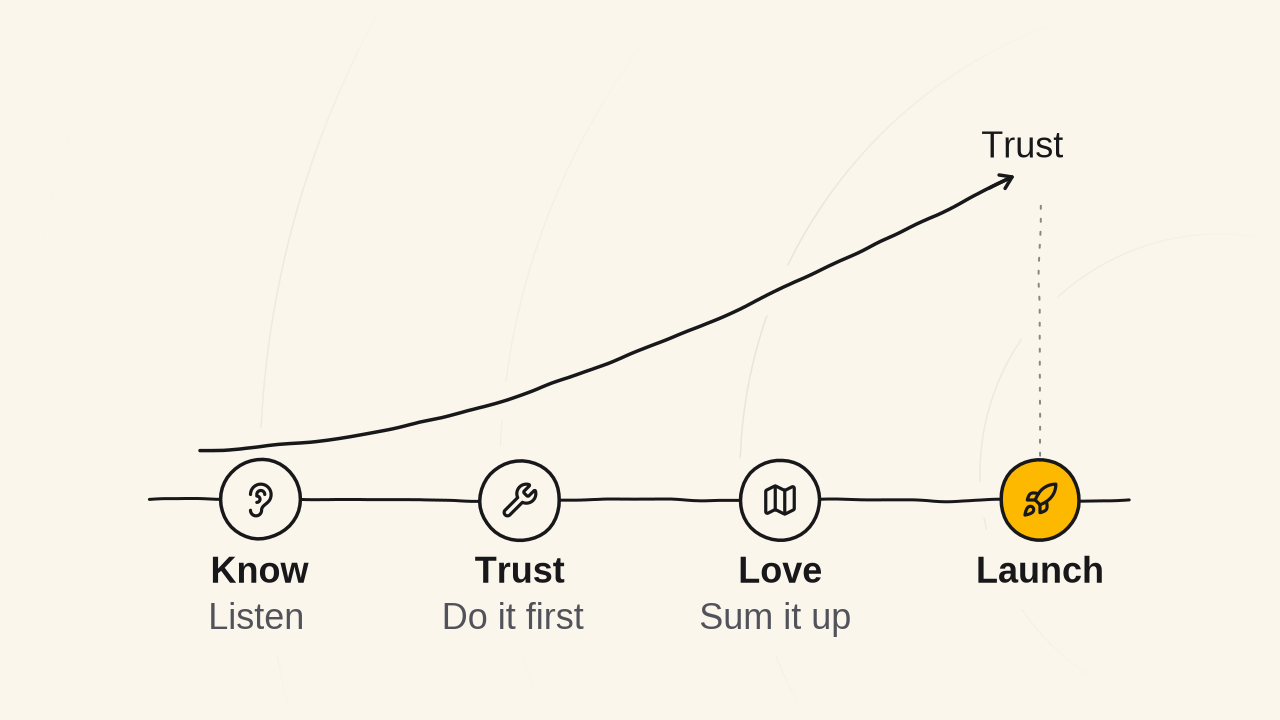
The Know - Trust - Love funnel works even before your product has taken shape.
The mistake of waiting for a finished product
If you can picture the product clearly, as if you were holding it in your hands, that is enough to start. A common mistake of product makers is waiting until everything is 100% done and only then fumbling for a way to write marketing posts. By then, you do not understand the market, and all you can do is use big words to praise the product.
Customers find it hard to believe praise with nothing behind it. For a product to sell, it must have a history and the marks of being tested in real life.
Building the funnel creates your product’s history
Building the funnel before you have the product is how you create that history:
- Listening becomes Know posts: you talk with people and gather each question and worry of the market. So the product you make fixes their real pain, not something made up.
- Testing becomes Trust posts: every time you get a real result on the way to finishing the solution, you write it up as a Trust post.
- Summing up becomes the Love post: after a long run of tests, you gather it all into one complete road.
Trust that is there before launch
By launch day, you do not need to work hard to persuade anyone. Customers have followed the road you walked, checked your expertise post by post, and clearly seen the effort you poured into the solution. You make sales because the product had trust before it even showed up.
Why does the Know - Trust - Love funnel help humans beat AI?
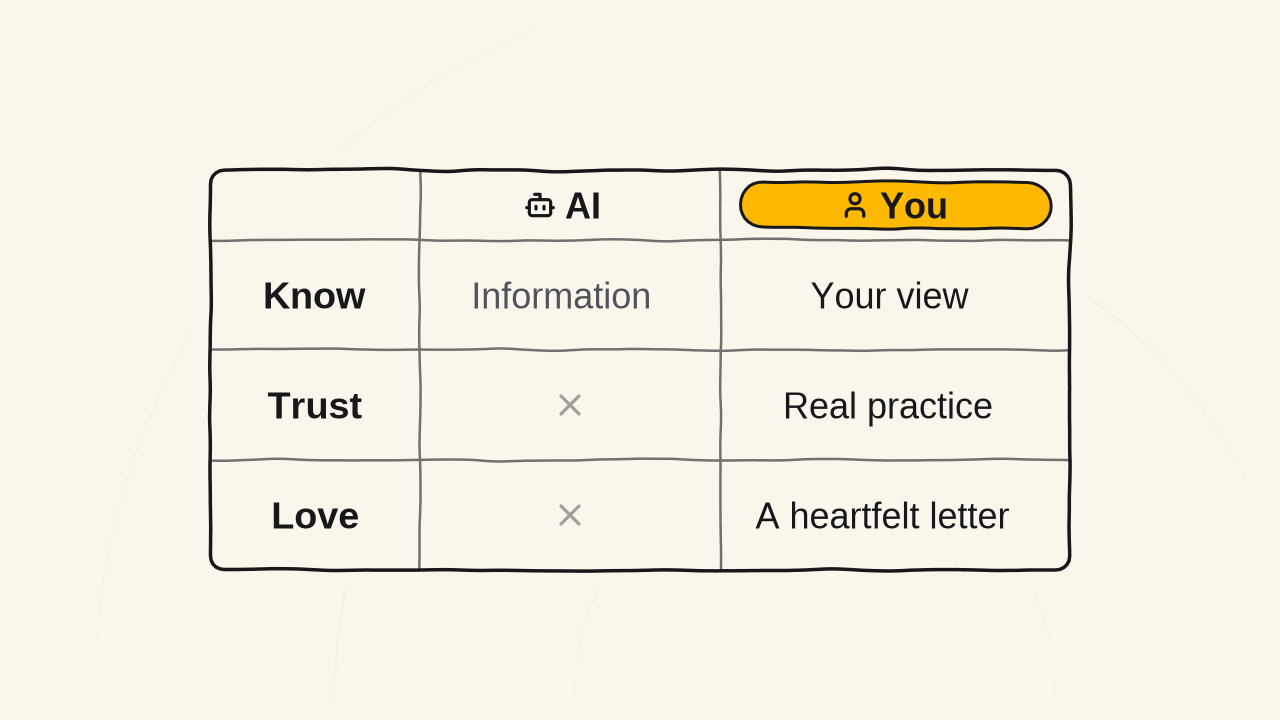
Because the funnel’s value lies in things only humans have, namely understanding customers, doing the real work, and your own story. The Know - Trust - Love funnel was made to help humans beat AI, not to push a button and churn out content in bulk. That is true to the content system’s philosophy that people come first.
The role of AI in the funnel
If you plan to let AI write your posts from start to finish, this funnel cannot help you. AI is a good assistant for sorting ideas, suggesting a structure or making pictures to illustrate. But the core of each layer is something AI cannot do for you:
- A Know post needs a human view: AI is faster and has more data, but its answers tend to be dry and cookie-cutter. You win with an understanding of your customers and a view only you have.
- A Trust post needs real work: AI cannot step out into real life to do it for you. Only someone one step ahead of the customer can write a Trust post with proven results.
- A Love post needs you: AI can help you put your work history in order or polish your process. But the big solution and the core belief must come from you.
What people are willing to pay for
People can ask AI for information for free. What they are willing to pay for is a human point of view and the empathy between one person and another.
When you put your human self and what is yours alone into the Know - Trust - Love funnel, you do more than protect your content from AI copying. You also build a brand that lasts.
Start building your own machine
The whole Know - Trust - Love funnel is the backbone I hand over in Write to Sell. Instead of wearing yourself out on hundreds of posts that bring no orders, you will work with me to turn your real experience into a machine that sells on its own, built from words.
If you are ready to own a machine of your own, I will see you in the program.