
Truth vault: Go slow to go fast, each post gets easier
Docs first, content second, every post built on a true story, so your content system runs on its own without you.


On this page
- Why does every post start from scratch?
- Without a true story, you write without confidence
- Drifting apart like a game of telephone
- Working alone or together, you drift either way
- What is the Truth vault?
- The Truth vault is not notes or a digital brain
- Write down only what you have done
- The 3 roles of the Truth vault
- A source of evidence every post links to
- The brand footprint of the one who spoke first
- Open docs that stay up to date
- Each post stands on the shoulders of the one before
- Idea - Write - Edit gets faster
- One fact, many ways to tell it
- The vault grows as your product grows
- Build the Truth vault from what is real
- Turn what is real into your first docs pages
- Grow the vault from customer questions
- Vault first, content after
- The system runs while you are away
- One person, every role
- Others write as correctly as you
- Slow at first because the vault is empty
- An empty vault means you have not done the work
- Where beginners trip
- Start your own Truth vault
You work alone and want posts fast, so you open your laptop and write from memory. Then your posts end up scattered, new posts clash with old ones, and the next post cannot reuse anything from the last.
The Truth vault does the opposite: go slow to go fast. Slow means putting in the work once to write down what your brand has really done. Fast means that once you have a place to look things up, post 20 is easier than post 2, every post says the same thing, and your content system keeps going the right way even when you are away.
Why does every post start from scratch?
Because there is no place that keeps the source of truth. Posts, sales pages, emails and videos all tell about the same brand, but none of them is the source. A new post cannot build on the old ones, so every time you open your laptop, you squeeze it out again from zero. And when the product changes, you do not know what the standard is to fix things against.
Without a true story, you write without confidence
Your philosophy, your concepts and your lookup tables live only in your head, so when you sit down to write, you remember one thing and forget another. Every time you write, you are afraid of clashing with what you said before, and your writing loses all its confidence.
A post that does not rest on things you have really done is only a general opinion piece, and no matter how hard you squeeze, you get a few posts before you run dry. On top of that, because everything sits in your head or in a private notebook, customers cannot look things up on their own, so every new customer means explaining it all again from the start.
Drifting apart like a game of telephone
Two posts that disagree are already a big deal. Leave them, and two become three, then four, just like a game of telephone. The features have changed, the benefits have changed, and the strategy has changed too. But the old posts still say the old thing, and the new posts say it the new way.
Customers go from one page to the next and find a different message on each, and nothing adds up. In the end, people do not understand your product, and they do not understand what your brand is doing either.
AI cannot save you here. AI can only fix things when you show it what the source is to check against. With no source, AI is stuck too, because it does not know which post to follow.
Working alone or together, you drift either way
Working alone, the old posts just sit there, especially the how-to posts, and nobody has the strength to go back and fix each one. Since 2017, I wrote about 300 blog posts. When I rebuilt the site, only 11 were kept, and more than 96% had to go. The full story is in the post Know - Trust - Love content funnel.
Once someone works with you, the drift doubles. The first time I saw this clearly was when I worked with Hoàng Hxn. The person who made the product knew the product well but did not hold the marketing strategy. The person who did the marketing had the strategy but did not fully understand the product. The strategy changed with no shared place to look things up, and the posts started to clash. What you think but do not write down as a source, the person beside you cannot work out on their own, and the number of meetings keeps doubling.
With no source, your content drifts away, and your brand is forgotten.
What is the Truth vault?
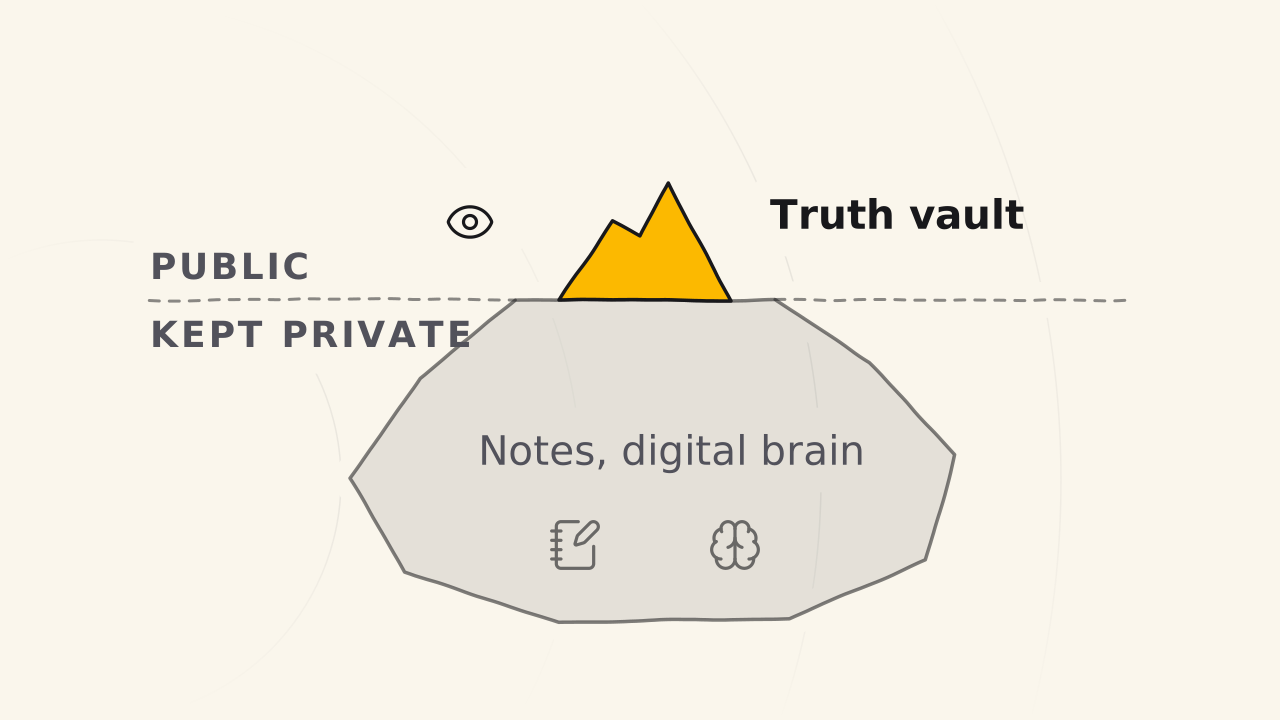
The Truth vault is where you make your brand’s footprint public: what you really did, true today, written down. In short, it is your product and brand docs: user guides, concepts, your philosophy, your brand keywords, and whatever makes you one of a kind. This is the place you look things up every time you sit down to write.
I often call it open docs, because it is public. The full definition and the structure of the vault are in the Truth vault overview in this site’s docs.
The Truth vault is not notes or a digital brain
Notes in Notion or Obsidian, or a whole digital brain, are where you keep your thinking. Most people keep a digital brain private. It is a business secret, a whole ecosystem of one person, and it can run for decades.
The Truth vault is much smaller. It focuses on one brand, sits on one domain, and is tied to your product. It is public, so customers can read it and answer back: a feature that is broken, a command that is missing, content that is not enough. Every piece of feedback fills the vault a bit more.
| Notes, digital brain | Truth vault | |
|---|---|---|
| Who reads it | Only you and your AI | Customers, people who write with you, outside AI |
| What goes in | Thoughts, plans, ideas | What you have done, true today |
| Scope | One person’s whole life | One brand, one product |
| Who gives feedback | Nobody but you | Anyone who reads it |
Your AI has read all your notes, so do you still need the vault? You do. Customers cannot read your notes, and neither can outside AI. What you are already willing to share, make public, so other people and their AI can read it too.
Write down only what you have done
The rule of the vault is if you really did it, write it down as it is:
- A customer gave real feedback, write it down.
- A real bug is fixed, write it down.
- A feature is dropped, write down that it is dropped.
- A collaborator has left, remove them from the list. Only then remove them from the pages of the site.
What about the things you only plan to do? They have no place in the vault yet. Plans, wishes and goals stay in your notebook. Put them in the vault and you are telling about something that never existed. From there the Truth vault turns into a lying vault.
It sounds extreme, but its name is Truth vault. If it is not in the vault, it does not exist.
Many people have a very big vault that is a dead vault: full of copied posts, collected documents and summaries written by AI. That vault never grows, because none of your own work is in it to update.
The 3 roles of the Truth vault
The Truth vault does three jobs at once, and each one answers a question head on: where your posts get their source, who spoke first, and who gets to read. Those three questions are also the three reasons to put in the effort of building a vault.
A source of evidence every post links to
The vault is a source of evidence when its content is atomic: broken down small enough that you can link to each single point. One atomic fact is complete. You understand it once you read it. It is not so short that it is thin, and not so long that you cannot link to exactly one place.
If a blog post has a term or a method that the vault already explains, link to the vault. When a customer asks one thing, you send a link. How to break a docs page down this way is in Source of evidence.
The brand footprint of the one who spoke first
Each time you write something of your own in the vault, you stamp it. You did it yourself, you checked it yourself, and you are the first to say it. From then on, anyone who mentions it is walking in your footprints.
Under Vietnam’s Intellectual Property Law, processes and methods are not covered by copyright, so you cannot register a way of working. But a public page with a publish date is already proof of authorship, and the algorithm prefers to cite whoever spoke first. The truth leans toward the one who dares to say it. Details are in Brand footprint.
Open docs that stay up to date
Open docs are your promise: public, and updated every time something changes. Its structure is easy for people to read, and for AI too.
Open docs help customers use your product, understand it, and then come to love it. They also serve your own content. What gets written down and what does not is in Open docs.
Each post stands on the shoulders of the one before
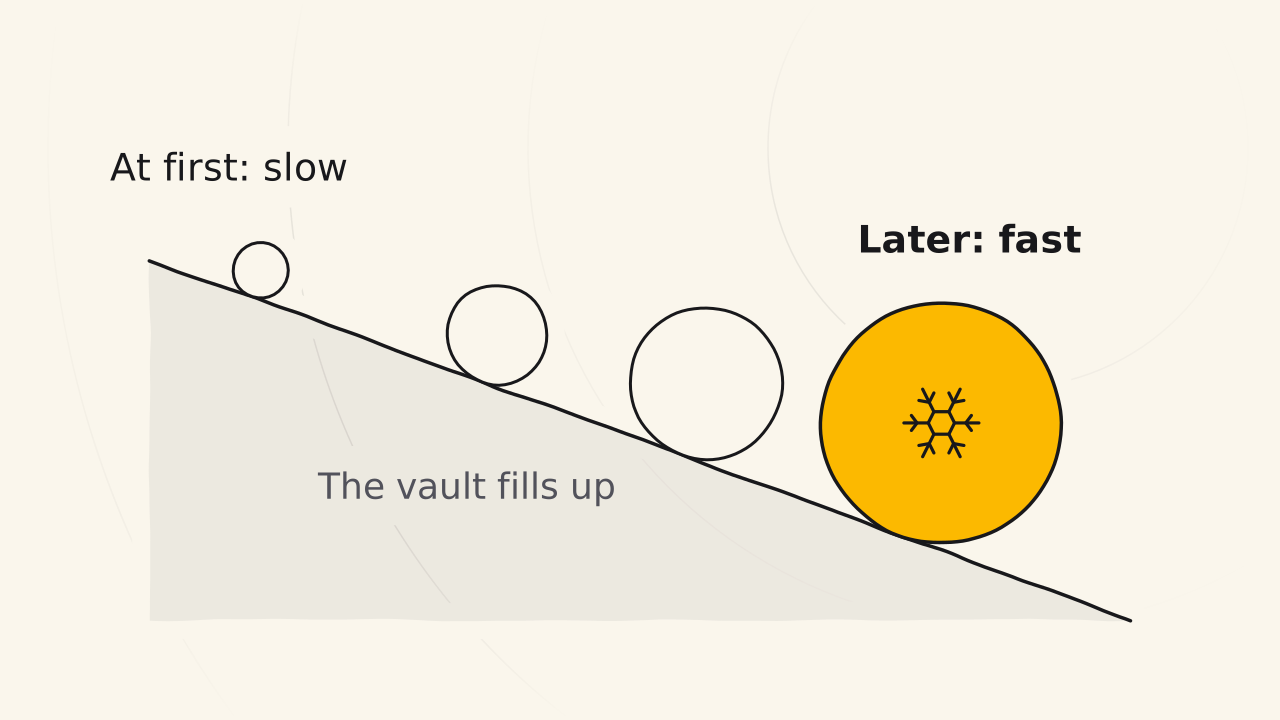
Every bit of work you add to your product makes the vault thicker, and each post stands on the shoulders of the one before. Post 20 is easier than post 2, because you do not think everything up from scratch. You build straight on a true story that grows every day.
Idea - Write - Edit gets faster
In the first step of the Idea - Write - Edit process, you do not start from memory. You open the vault to see what good things you already have, then ask: where does this apply, which angle has nobody covered, which story of mine goes with it? In the Write step, the facts are already there. In the Edit step, you only check against the vault.
Trust posts, the how-to posts, lean on the vault the most. When technology or a method changes, you update the new way of handling it in the vault, and then the Trust post changes to follow. That way your how-to posts stay fresh and accurate, and do not go stale fast in an age when AI moves this quickly. The Trust stage of the Know - Trust - Love content funnel needs consistency, and the vault keeps it.
One fact, many ways to tell it
When you put one fact in the vault, you earn the right to tell it in many ways. A post is really a way of telling a story. From the vault, you make:
- Blog posts, sales pages, landing pages.
- Emails, newsletters, social posts.
- YouTube videos, books, courses.
Think of a movie based on a true story. The director can cut scenes, add dialogue and rework the pace so the audience enjoys it. But because people know a real story stands behind it, they trust the movie far more than a made-up one. Your posts and your about page work the same way: the vault holds the template, and the story is the part only you can tell.
The vault grows as your product grows
Updating the vault is really making the product. When the product gets a feature, the vault gets a page. When you make your brand clearer each day, the vault builds up each day, and your posts have something to tell.
So do not use the vault to turn out lots of posts every day. A few posts a day, depending on how often the vault is updated, depending on how far your product and brand have come. Instead of chasing the writing, chase the making of the product, and the vault fills up by itself.
Build the Truth vault from what is real
Building a Truth vault is not drawing a theory on paper. It is putting what already exists in real life on the table. The strategy goes through three stops: take what you already have as the source, turn your customers’ questions into docs, and make your content follow the vault. The step-by-step details for each stage are in the guides in the docs.
Turn what is real into your first docs pages
The strategy starts with what you already hold in your hands: your brand keywords and your real product. Do not sit and imagine features for the future. Write down exactly what exists right now.
This is also when you separate the about page on your website from the vault. The website serves customers, so it puts the customer at the center. The vault is where you keep the whole truth about yourself, from your skills and your log to how you think about your work. Before you write, shape your topic groups and collections clearly, because the vault only takes docs pages written in full, and it does not feed empty skeletons.
Grow the vault from customer questions
The vault does not grow in a closed room. It grows where you really meet customers. Any question you get again and again is a fact waiting to be packed up. Instead of squeezing out ideas for a new post, take your most honest answer, with its context, in order, without frills, and build it into a docs page.
Once the vault has these atomic pages, the way you talk to customers changes completely: you answer with a link. You no longer type out the same instructions or long explanations for each new customer. You send one link and they look it up themselves.
Vault first, content after
This is the principle the system lives on: the vault is the root, content is the branches. Every change to a feature, a benefit or a strategy goes into the vault first, and then blog posts, sales pages and videos follow.
You do not need to rush to fix every old post at once. Small changes can wait for the regular update round, but the direction is always one way, out from the vault. When you work with AI, say clearly which page in the vault is the source, so AI sticks to it and drifts from your message less.
The system runs while you are away
A content system that runs on its own means every part still fits together when you are away. New posts do not contradict old ones, customers find what they need on their own, and the people you ask to write with you can work without asking you. You go out, you are away from home, you are not at your desk, and the vault is still there and everything still points the same way.
One person, every role
When you work solo, you play every role: the one who makes the product, the one who markets it, the one who sells it. Without a vault, each role keeps one piece in your head, and today you sell it one way, tomorrow you write about it another. With a vault, you always look at one place: when you market, you know where the product is strong, when you sell, you know why the price is what it is, and when you care for customers, you see right away what is new to go back and greet old ones.
The vault is written for people and for AI: customers read it, the people who write with you read it, you read it again, and AI reads it. When you make a video, you open the vault first too. One piece of writing serves that many people.
Others write as correctly as you
AI, Hoàng Hxn, students or anyone writing with you all lean on the same vault, so what they write stays right. Anyone who writes by the vault is accountable to the vault. When someone gives information that is wrong against the vault, you have the right to point it out.
Without a vault, you only tell things by mouth or hand over old posts, and people easily get the positioning, strategy and features wrong. The biggest damage lands on your brand. The Truth vault is like insurance for your content.
Slow at first because the vault is empty
At the start, the vault is completely empty. You will spend effort building it, and it is very hard to build because there is nothing yet. Later you go very fast, because you have a place to stand: a true story of your own.
An empty vault means you have not done the work
If you take lots of notes and still feel stuck, it is usually because you have not done the work. The vault only records what you have done, so to fill it you have to do more, not think more.
As for the posts you wrote before building the vault, reread them and sort out which parts are true to put in the vault. If a post has a method that was replaced by a new one, update that post right away, and update the vault too.
Where beginners trip
Beginners trip by not doing the work, or not understanding. Not understanding:
- Yourself.
- The product.
- The brand.
- The customer.
The vault has parts you must fill in, like philosophy, mission and your about page. If you do not know what you are chasing, you trip right there.
To build a vault, you have to pack up what you have done. Packing it up imperfectly is fine, the vault will update over time. But it has to be something you have done, not a plan you thought up and then packed away.
Start your own Truth vault
Next time you want a post fast, do not open your laptop and start writing. Open the vault first. If the vault is still empty, that is your moment to go slow once and write down each thing you have really done.
Then each post will stand on the shoulders of the one before, and you will no longer have to be there for every post.
If you want someone to walk that slow stretch with you, take a look at Write to Sell.