
Entity docs is what Cuong calls the Truth vault when you look at it from the reader’s side: public, and always up to date. Open means public. You open it up, promise to keep it current, and take feedback from readers. Its structure is easy to read for people and for AI.
This page is for you when you need to know what goes into the vault, what does not, and who keeps it alive. If you need to know how to write one page of the vault, read Source of evidence.
What goes into Entity docs?
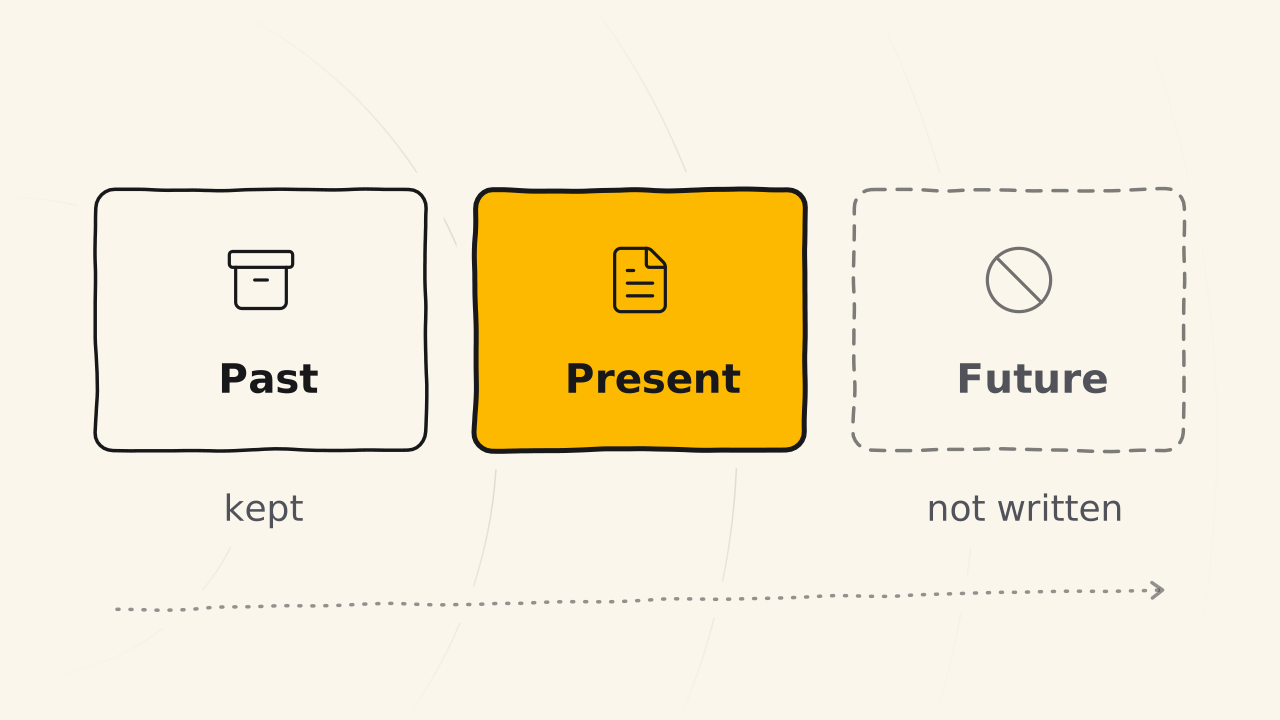
The rule is you do it for real, you record it for real. The vault holds the current state of your product and brand. What is not in the vault does not exist.
The vault holds the present and the past, not the future
The vault records what is true now, removes what is false now, records the mistakes of the past, and never records the future. The past is stored so you know the history, but the state of the vault is always the present.
| What happened | Goes into the vault? |
|---|---|
| The product gets a new feature | Yes, record the new feature |
| A feature is dropped | Yes, record that it is dropped |
| A real bug is fixed | Yes, record the bug and how it was fixed |
| A customer gives real feedback | Yes |
| You work differently than 6 months or 1 year ago | Yes, record how you work now |
| A philosophy is expanded to be more complete | Yes |
| An employee leaves | Yes, remove them from the team list |
| Plans, wishes, goals | No, record them somewhere else |
| A product that has not launched | No, keep it on the sales page or the pre-signup page |
The vault usually has a changelog, updated at the same time as the pages.
Why don’t plans go into the vault?
If you record what does not exist yet, you invent something that never was. Then the vault becomes a lying vault, and it is no longer a Truth vault.
For a plan, go and do it. While you work, you will see what is true and what is not. Record what is true. You can draft a structure somewhere else, but do not publish an empty frame in the vault. Whatever is published must be full content.
How is Entity docs different from notes and a digital brain?
Notes in Notion, Obsidian or a digital brain are where you store your thoughts. The Truth vault is where you record what you have done. They are two different places, and the Truth vault is not a place for notes.
| Entity docs | Notes, digital brain | |
|---|---|---|
| Who sees it | Everyone | Usually kept private, a business secret |
| Who gives feedback | Customers, team, readers | Only you |
| Scope | One brand, one domain, one product | A whole life, 10 to 40 years |
| What it holds | Work done, true now | Thoughts, ideas, plans |
| Which AI can read it | Your AI and outside AI | Only your AI |
AI already reads all my notes, so do I need a vault?
Yes. Your AI can read your notes, but customers and outside AI cannot. People read your public vault. What you are already willing to share is public for good, so others and their AI can read it too.
What is a dead vault?
A dead vault holds documents that are not yours: copied from somewhere, duplicated, or summed up by AI. You cannot update it, because it does not follow the work you do. The Truth vault follows your progress and your product, so it is alive.
Who reads and who updates Entity docs?
The vault has five groups of readers: customers, team, employees, you, and AI. You write once and serve all five, even when you turn the content into video.
How does the vault help a team work without you?
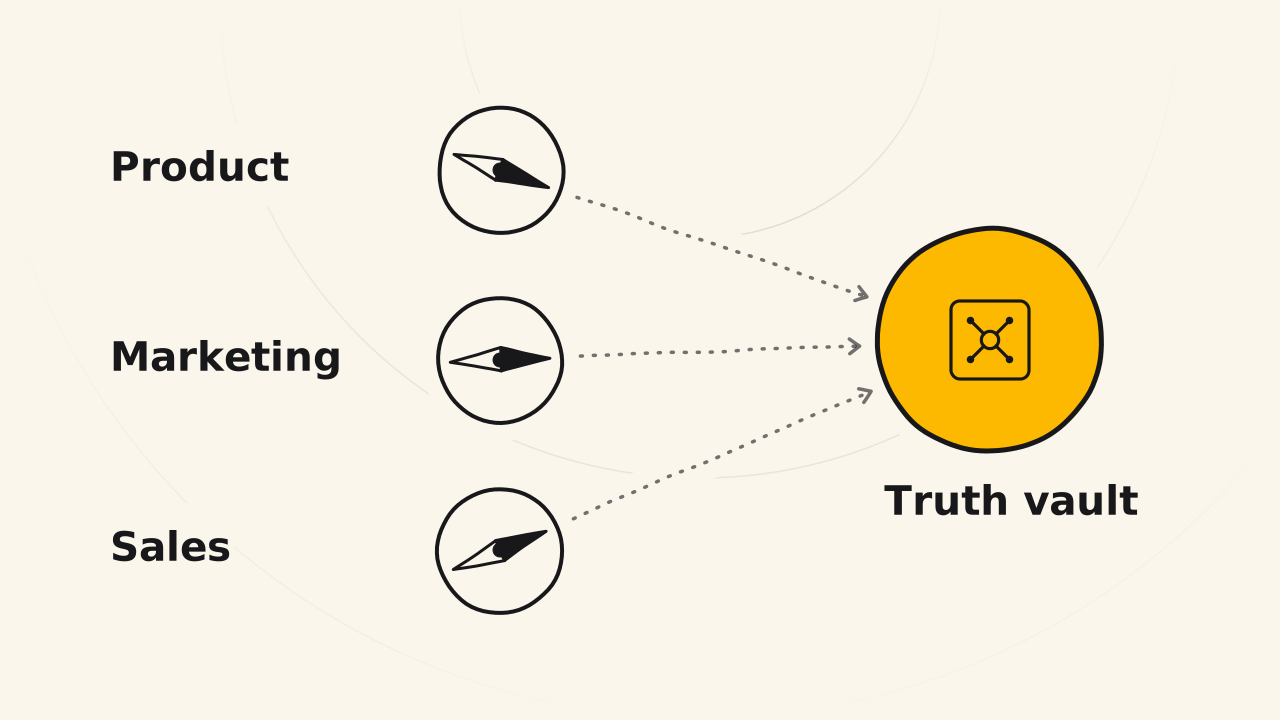
Product, marketing and sales are three different jobs. Without a vault, these three do not connect and drift apart. With a vault, everyone looks at one place:
- The marketer knows what features the product has, what is good about them and how to use them.
- The salesperson knows which feature goes with which price, and their history.
- The customer care person knows right away what is new, so they can go back to customers and sell more.
This lets you delegate. When you are away, the vault is still there for everyone to follow. Without a vault, what you think and do not say out loud is unknown to the people working with you, and the number of meetings doubles.
Who is responsible for updating the vault?
You are. When you work alone, you are the only person responsible for updating the vault, and the vault always comes before the post.
When someone else writes content from the vault, they are responsible to the vault. If anyone writes something that does not match the vault, you can point to the error and remind them. Without a vault, you only have stories and old posts to hand out work, and the person who gets it can easily get the positioning, strategy or features wrong.
An example of drift without Entity docs
Two cases Cuong has run into:
| How you work | What happened |
|---|---|
| Two people working together | The person who built the product knows the product but not the marketing strategy. The marketer does not understand the product. Posts start to drift apart |
| Working alone | Old content, especially how-to posts, cannot be updated |
Two posts that disagree become three, then four, like a story that changes every time it is retold. Even with AI, it cannot fix them without one place declared as the source to compare against.
What Entity docs does not do
- It does not store thoughts, plans or documents copied from other people.
- It does not replace the digital brain. It is only the part you choose to make public.
- It does not tell a story to customers. How to write each page is in Source of evidence.
- It does not update itself. How to update it is in Update the vault first, posts after.