
This page is the template to copy and the guide to filling in each entry. For what a brand profile is, which entries it has and what happens when one is missing, see Brand profile. A writer or AI agent also comes here to look up an entry before content work.
What does each brand profile entry hold?
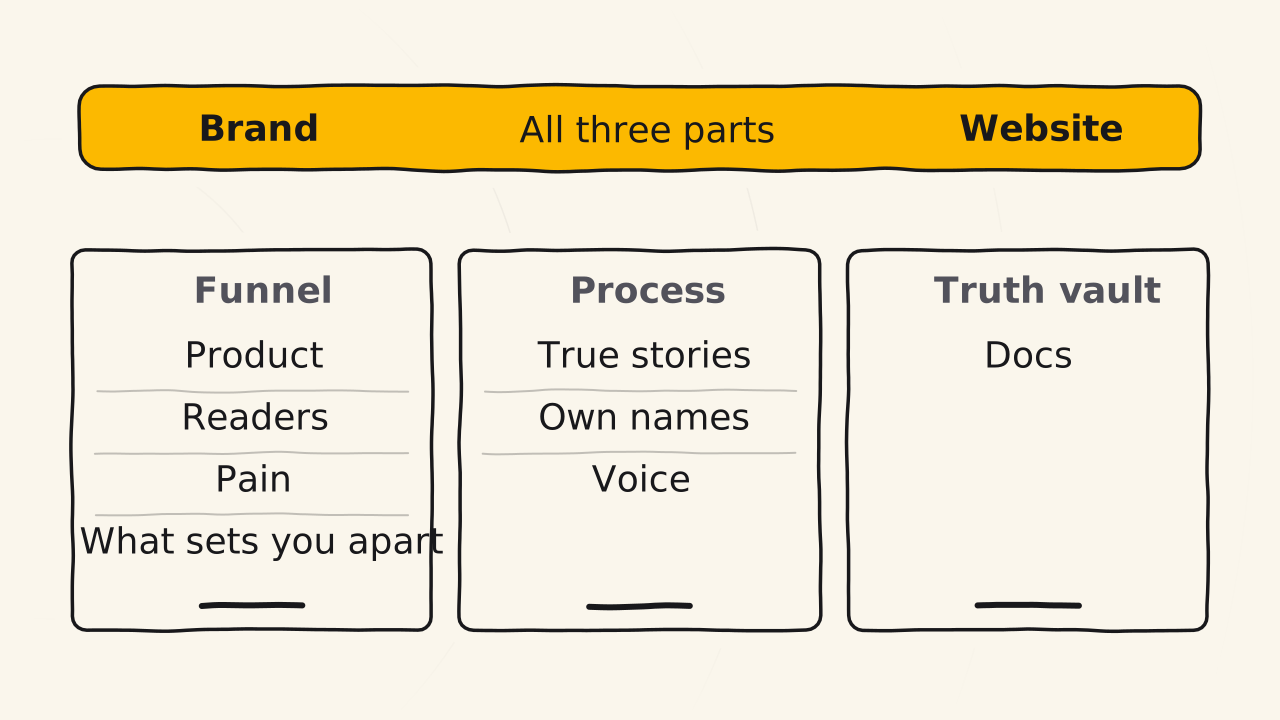
Each entry below says three things:
- Which part of the system uses it
- How to fill it in
- An example
The examples come from the profile of cuongthach.com, and hold only what that profile already says. It also lists a source under each entry, and when a source and the profile disagree, the source wins and the profile is corrected.
Brand
All three parts of the system read this entry to know whose name each post is written in. Write one brand name and the name of the person behind it.
Example from the cuongthach.com profile: the name is CuongThach (cuongthach.com, since 2017), and the person behind it is Cuong Thach. The Write to Sell course is led by Cuong Thach and Hoàng Hxn together.
Product
The Love post leads readers to the product, and the system is measured by waitlist sign-ups and orders. With no product, the funnel has no end point. The status (on sale or taking a waitlist) decides whether the Love post leads to a sales page or to the waitlist. Write its name, what buyers get, and its status.
Example from the cuongthach.com profile: the product is Write to Sell, cohort K3. It is a 12-week coaching course followed by 36 weeks of support, built on two pillars, “Core positioning” and “Dance of words”. The profile also lists the three benefits, the price of 9,999,000 VND a year, a 100% refund within 30 days, and the status: taking a waitlist (not on sale yet).
Readers
The funnel picks posts by this group’s questions, and the process writes for them. Write one specific group, not everyone.
Example from the cuongthach.com profile: people who run a business alone and sell digital products online, with no marketing team, with a focus on introverts, tech people and people who “fear writing”. Digital products include online services and training. The profile also lists who the product is not for, such as people who want to get rich fast or look for tricks to beat the algorithm.
This line about readers is used word for word as the “Reader” line of every recording question set, see Sample AI prompts.
Pain
The Know post names this pain. Buyers do not look for a product that does everything. They look for a fix for the one problem that hurts them. Write it in the readers’ own words, not in the words of the person who makes the product.
Example from the cuongthach.com profile, written in two layers:
- Content: writing a lot and nobody buys, not knowing what to write, burning out on the algorithm, packed into the line “Good product. Nobody buys.”
- Brand: not positioned well, sounding like everyone else, buyers who do not remember and do not trust.
What sets you apart
Rivals can copy features and buy the same AI tools, but they cannot copy the person who makes the product. This is the root of the Love post, because buyers love the person and the brand behind a product. Write the strengths, skills and experience of the person who makes the product, one idea to a line.
Example from the cuongthach.com profile, from the section “The edge of Write to Sell”: it does not fix your posts to make them better, it changes your mindset so that selling feels natural and light. From there the profile lists four ideas:
- Solving the problem at its root
- Not racing the algorithm
- Lasting and calm
- A tailored, realistic path
True stories
In the Write step, these stories are told out loud while recording, so they go straight into the post. When a post’s idea is the same as someone else’s, your own stories and experience are what make the post your own. Write what happened, when, and how it turned out, and only stories you may share.
Example from the cuongthach.com profile, which holds only stories already published on the site:
- In 2017, started CuongThach.com from a “blank page”, with no experience and no guide.
- Once came last in the class in literature.
- From 2017, wrote about 300 blog posts by keyword, then kept only 11 when the site was rebuilt: more than 96% had to be deleted.
Each story lists the page or post it comes from.
Own names
The Edit step uses this list to check each post. Write each name and its fixed translation. Own names never change to fit a keyword or SEO. Only the capital letter at the start of a sentence may change.
Example from the cuongthach.com profile: Know - Trust - Love, Idea - Write - Edit, Content system and Write to Sell each keep one fixed English name in every post, set against their Vietnamese originals. The profile also lists names that stay the same in every language, such as CuongThach, bePublish and Blueky.
Voice
The Edit step uses this entry to bring a post into the right voice. Write the language you write in first, how you address readers, how much spoken style to keep, and the words you never use. A personal brand keeps some spoken style so it feels close, like talking with a buyer, but keeps it in check. A business keeps spoken style to a minimum.
Example from the cuongthach.com profile: Vietnamese is written first, and English is translated after. Readers are addressed as “you”, Cuong is spoken of in the third person, and only the English version uses “I”. The three words of the voice: sincere, hands-on, easygoing. Never used: “ornate”, “template writing”, “instant noodle” business, “tricks”, “get rich fast”, ad words, long dashes and scare lines.
Website
The website is home: every post is published here first, and social media is only a copy that sends viewers back. The system is measured by how many people join the waitlist and how many orders come in, counted on these two pages. Write the website address and the links to the sales page and the waitlist page, and it helps to write where each is counted.
Example from the cuongthach.com profile: English lives at / and Vietnamese at /vi/. The product page is /vi/viet-de-ban/, the waitlist page is /vi/viet-de-ban/#giu-cho, and the waitlist is counted in FunnelKit Automations. Cuong counts orders by hand, because the course is not on sale yet.
Docs
This is the Truth vault: posts take their facts from the docs, not from memory, and only what has been checked goes into them. Write the address of the docs and their two sections: Method and Common questions. Write Not yet for a section that does not exist.
Example from the cuongthach.com profile: the docs live at /docs/vi/. The Method entry points to three overview pages: Content system, Know - Trust - Love and Idea - Write - Edit. Common questions exist only for Idea - Write - Edit, while the Know - Trust - Love funnel and the Write to Sell course are marked Not yet.
Brand profile template to copy
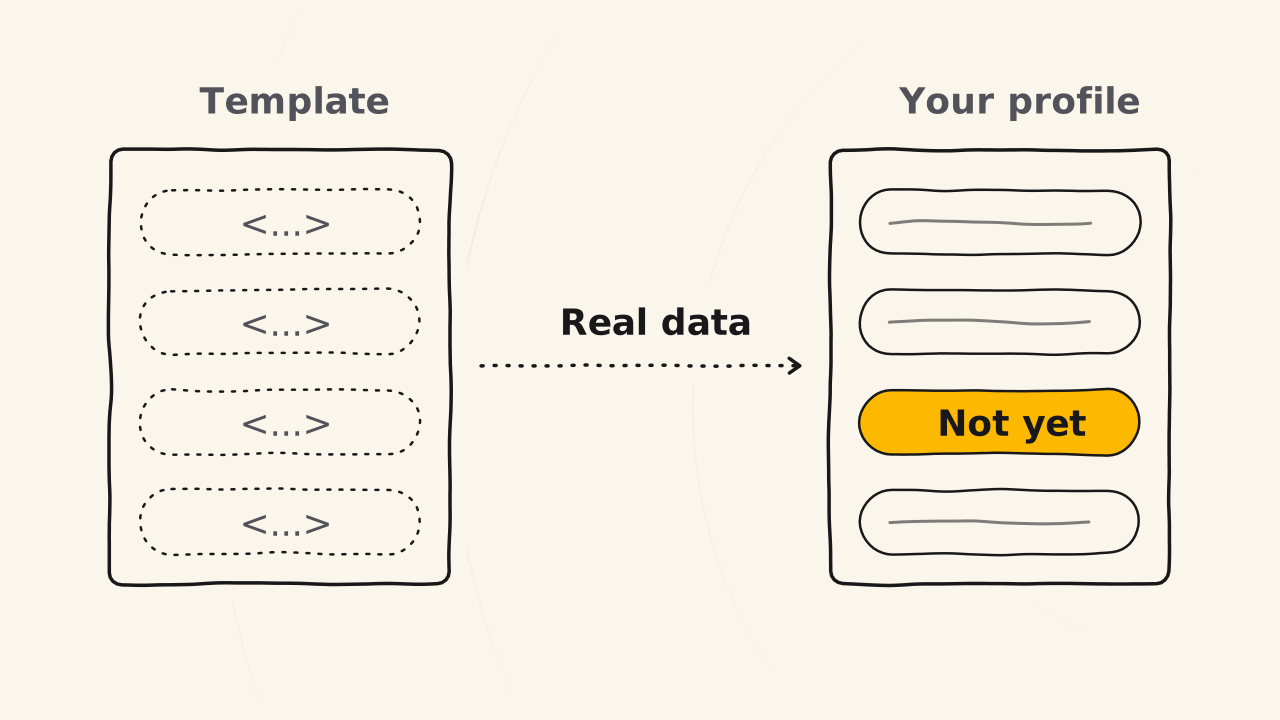
Copy the block below into a file for the brand, and replace each <...> with real data. If an entry has no data yet, write Not yet and keep the line. The template holds all ten entries, in the same order as the table on the Brand profile page.
# Brand profile: <brand name>

## Brand
- Name: <brand name>
- Person behind it: <person's name>

## Product
- Name: <product name>
- Includes: <what buyers get>
- Status: <on sale | taking a waitlist>

## Readers
- <specific group of people>

## Pain
- <long-running problem, in the readers' own words>

## What sets you apart
- <strength, skill or experience 1>
- <strength, skill or experience 2>

## True stories
- <story 1: what happened, when, how it turned out>
- <story 2>

## Own names
- <name> = <fixed translation>

## Voice
- Language: <language you write in first>
- Addressing readers: <how you address readers>
- Spoken style: <keep some | keep to a minimum>
- Never use: <words or kinds of sentences>

## Website
- Address: <domain>
- Sales page: <link>
- Waitlist page: <link or Not yet>

## Docs
- Docs address: <link>
- Method: <link>
- Common questions: <link>
Read next
Glossary of the content system
What every special term in the content system means, grouped by the Know - Trust - Love funnel and the Idea - Write - Edit process.
AI in Idea - Write - Edit
What AI does, what you do and what it does not do at each step of Idea, Write, Edit, with three sample prompts to copy and how to check results.
Common questions
Short answers to common questions about the content system, grouped by part, from what to write with and how many posts to whether it sells.