
A core message is the one sentence readers must remember after reading a post. Each post carries only one message.
You make it by answering three questions about context: who your customer is, what their problem is, and what your solution is. Then you squeeze the answers into one sentence with a short title.
The core message keeps the whole post consistent and on point. On a sales page, the core message is the second line, right below the product name: who it is for, what result, and by which solution of yours.
This page is for you when you have an idea for a post and are about to record or write. It is the first job of the Idea step in the Idea - Write - Edit process. If you only have a one-line topic and have not poured out your ideas yet, follow Outline a post from a one-line topic first.
What do you need to create a core message?
- Some material for the post. An idea, a note or a recording. A short seed or a few bullet points is enough.
- The person who will read it. You know who they are, because all three questions turn on them.
- Something you have lived through. You know the problem and understand it deeply, because you have run into it yourself. The solution in the message must be yours, so only you have it.
Create a core message for one post
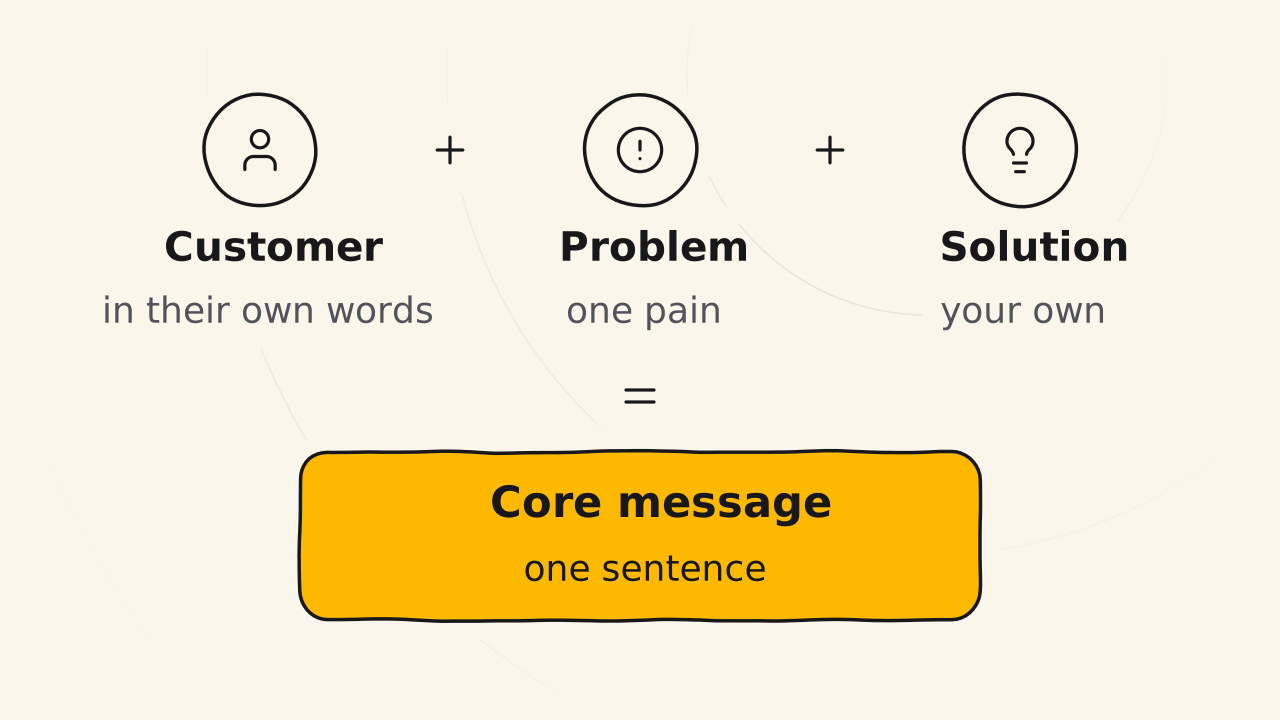
The three steps below take you from a pile of ideas to one sentence. Work in your head and on paper. Do not open AI or Google yet.
Pick one idea seed
Each post carries only one message. Stuffing four or five messages into one post confuses readers, and they remember nothing. Put every idea you have on the table, then pick exactly one for this post. Write the rest on a “save for other posts” list. Do not delete them. When this step is done, you have one idea for this post and a list of ideas for later posts.
Answer the three questions about context
The context is what the core message is made from. Write an answer to each question:
- Who is your customer, in their own words? For each expert word, ask: “Would my customer say this word?” If not, swap it for the word they really use.
- What is their problem? Pick one pain tied directly to this idea, at a level where readers see themselves. Write it at three levels. The outside is the problem people can see. The inside is the feeling, told through pictures without naming the emotion. The root is the wrong belief.
- What is your own solution? A view, a formula or a process taken from real experience, and where it takes your customer. If it is still rough, keep it as it is. Write it yourself before you ask AI or search Google.
Mark any question you cannot answer yet with ?. Do not fill the gap by guessing. When this step is done, you have three short answers.
Squeeze the context into one sentence and a title
One sentence is easier to remember and to check than three answers. Put them together: which problem your customer is stuck in, what your solution is, and where it takes them. That sentence is the core message. Add a short title that says exactly that sentence, with no fancy words and no metaphors.
From here on, the core message is the filter for the post: keep the ideas that serve it, and save the rest for other posts. How to filter is on the outline page. You will see the context, the message and the solution packed into one box. When it is time to write, you just open that box and write, instead of swimming through a pile of messy drafts.
An example of the core message of the Idea - Write - Edit post
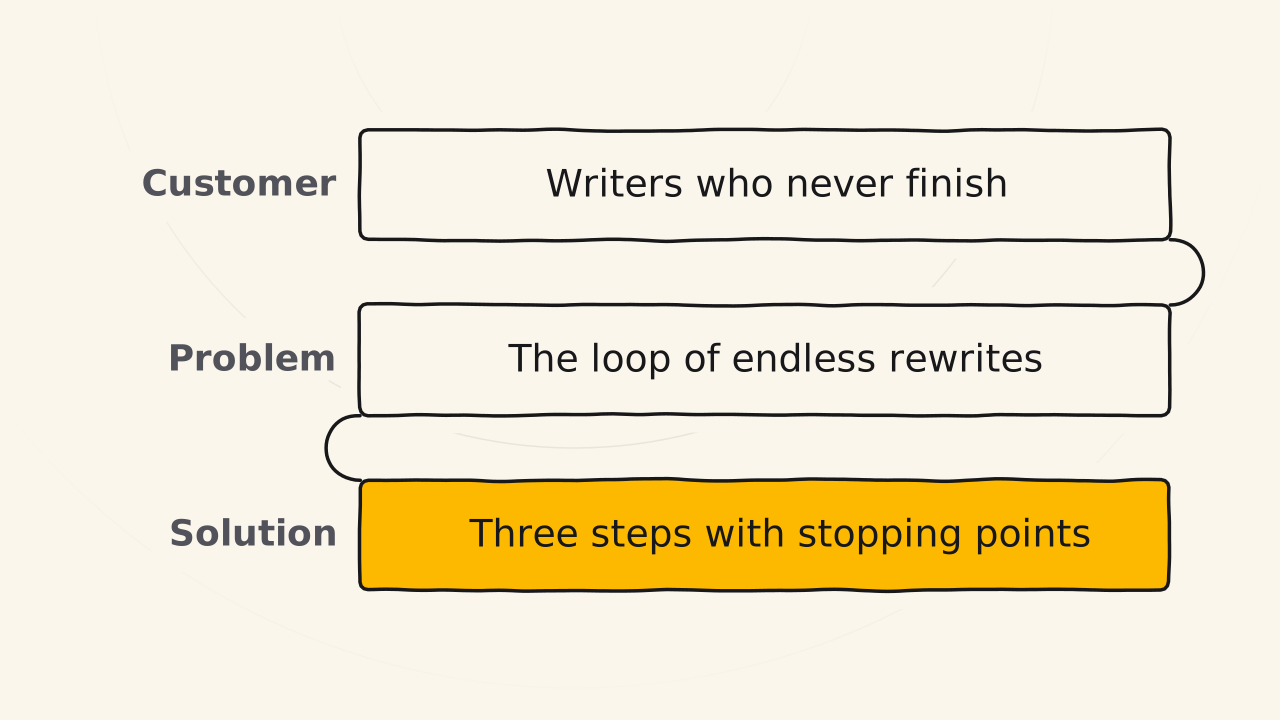
The blog post “The Idea - Write - Edit process: Escape the never-ending writing loop” was made from the context below. Every cell comes from that post.
| Question | Answer |
|---|---|
| The customer, in their own words | Someone who can never finish a post |
| Outside problem | One post is edited again and again, three to ten times, so it takes three to ten times longer than for others |
| Inside problem | Looking back, the post and the title no longer match: “Wait, where did my message go?” |
| Root problem | Working on the ideas, the writing and the editing all at once |
| Your own solution | Three steps with stopping points: write the script and commit to it, pour it all out without judging, edit only to cut extra words. With it, ideas that sat in storage too long get out onto the website |
| Title | Escape the never-ending writing loop |
| Core message | A three-stage writing process with stopping points gets you out of the loop of editing again and again and gets the ideas stuck in your storage onto your website. |
The message has all three parts of the context:
- The customer is someone who can never finish a post.
- The problem is the loop of editing again and again.
- The solution is three stages with stopping points that get ideas onto the website.
How do you know the core message is right?
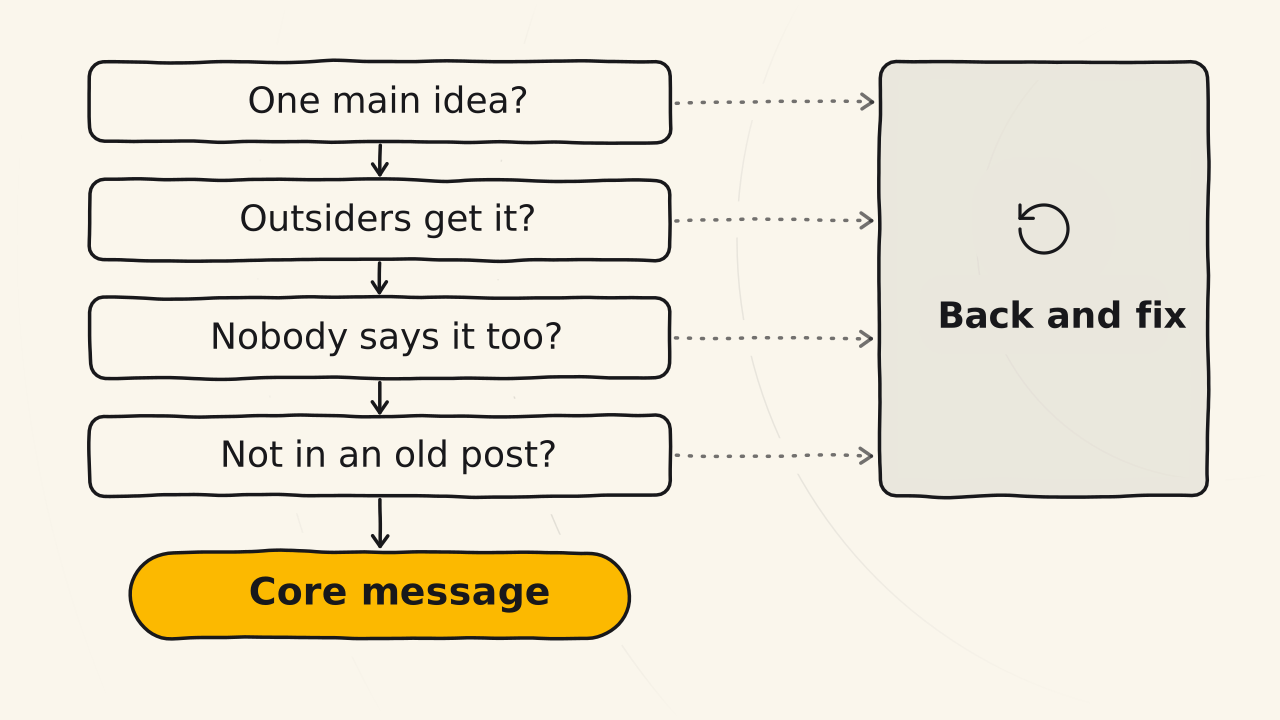
Read the sentence you wrote and ask four things. Each “no” has its own fix.
- Does it have only one main idea? If it has two, go back to picking the idea seed and split it into two posts.
- Can someone outside your field understand it without an explanation? If not, go back to the question about your customer and change the words. Drop slang, metaphors and fancy words: they puzzle both readers and AI.
- Could another post online say this exact sentence? If so, go back to the question about your solution and add your own experience.
- Have you already said this message in an older post? If so, choose one of three: link to the older post, make the new angle of this post clear, or update the older post instead of writing a new one.
When all four pass, that sentence is the core message of the post and the guide that keeps it on track.
If the core message does not work as expected
The post is long but readers remember nothing
The post carries four or five messages. It gets longer but leaves nothing behind, and customers do not know what to do next. Split it into several posts, one message each.
Readers do not understand your words
You are used to reading in-depth material, so it is easy to share in the language of experts. Translate it into the words customers really use.
The post wanders because of too many personal stories
You told every personal story, while customers only care about what bears directly on their problem. Keep only the stories that touch the pain you chose.
Readers feel understood but see no way out
The message names the problem but lacks the solution. Say clearly what your solution is and where it takes your customer.
Common questions about the core message
Long material holds a lot of valuable experience, but if you post it as it is, the post wanders and readers get sleepy because nothing hits home. On the other hand, forcing yourself to be brief from the start loses the feeling. The problem is not how long your material is but how you pack it before you share it.
A post with no core message only adds to the noise. Customers do not understand what you want to say, what to do, or whether their pain will be solved. Keeping one message through the whole post helps readers remember it better.
Yes. A solution is never right or wrong in every case. It is only more or less sensible for each situation. Even if it is rough or takes the long way round, it is your real lesson. Readers value a real journey and real experience more than a perfect but empty result.
A solution with your own stamp on it is what makes your post different from the flood of generic posts. If you leave it to AI or look for the answer on Google before you start writing, your solution will look like everyone else’s. Trust what you have learned over time and write it from your own experience.
Read next
Build a three-layer sales page
Build a short sales page with all three layers, the name and core message, proof even with no buyers yet, and a note from the person who made it.
The Idea - Write - Edit process
Idea - Write - Edit is three steps to publish a post, where you lock the outline, write in one go, then only cut, each step with its own stop.
The Idea step
The Idea step goes from a one-line topic to a locked outline, the script of the post, so ideas come first and decide most of its success.