
The Idea step is the first step of Idea - Write - Edit. You play the screenwriter, which means you pour out every idea, pick ideas by your core message, then lock the outline.
The stopping point is when you read the outline again and see the script is good enough and flows. The Write step starts only once you hold that outline.
From idea to outline
The Idea step starts from a one-line topic and ends with an outline, made of the post title and big ideas with short titles, usually six to eight of them, and more is fine. This step takes the most time, and it is worth it.
You pour out twenty or thirty ideas, sometimes fifty, then sort them by your core message and keep the ones that serve it. The core message is the filter of this step, not an item in the outline. The titles of the big ideas must be short and easy to understand, with no fancy words, no slang and no metaphors, because metaphors puzzle both readers and AI.
Every type of post in the funnel goes through the same Idea step, but the shape of the outline changes with the type, because each type has its own goal.
Before you write, there is a handover. You look over the outline to find where your knowledge is still thin, then study until you know enough.
Idea comes first
The idea is the only thing that makes your post different, so it has to be settled before you write.
The post’s script
The outline decides whether the post holds together. From a good outline, people skimming the post and AI scanning it see three things at once:
- The message of the post.
- Its overall point.
- Whether the ideas connect.
Readers today judge a post by four things, namely the title, the description, the opening and the main content, and the main content is your outline. One glance at those four tells them whether the post is good.
Each post is a piece of work, and the script is the only thing that makes your work different, not the wording. When a post has a good idea, people praise it right away, sometimes before they finish reading. Your post differs from other people’s posts on two layers:
- The idea layer. The idea of the post is one nobody has said yet. You are the first to say it, so the post is one of a kind.
- The telling layer. When an idea is the same as someone else’s, you make it different with your own stories, experience and way of saying things.
When the script is good, readers like the post even if the telling is a little clumsy. When the script falls apart or is stuffed with several messages, no wording can save it.
Where you beat AI
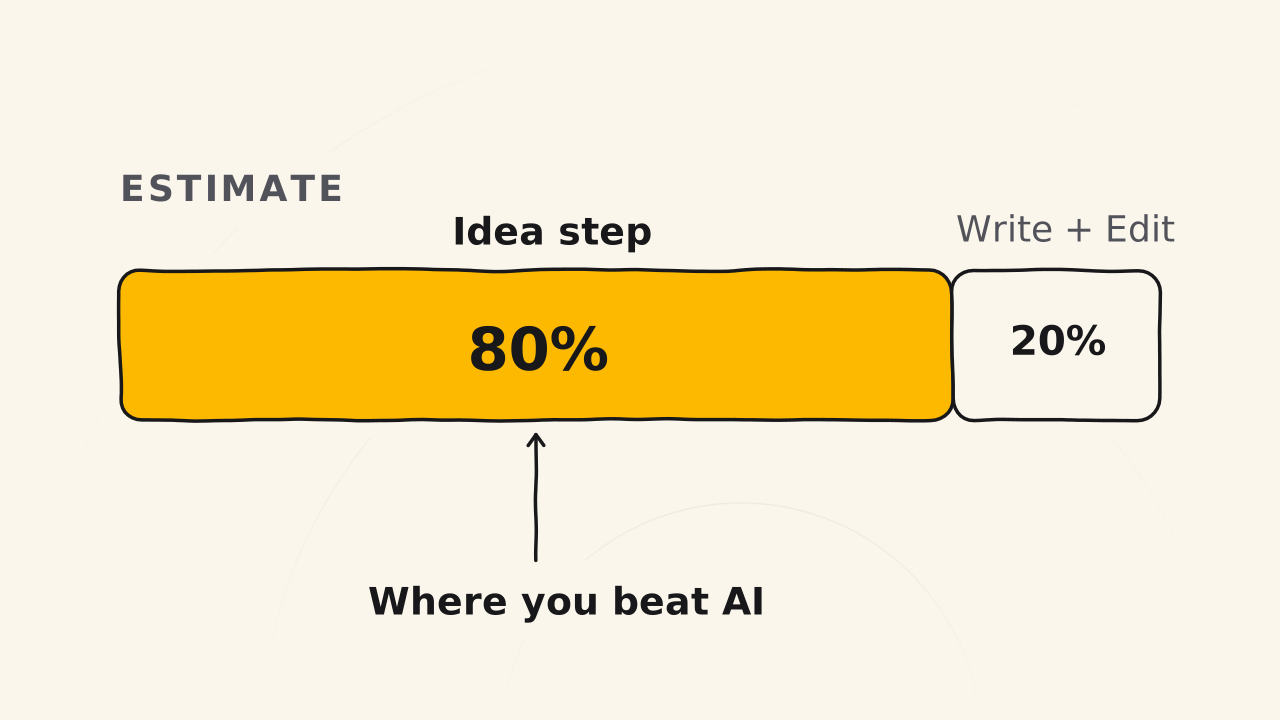
About 80% of a post’s success lies in the Idea step, and the Idea step depends on your sense, not on a gift for fine writing. People who read books or the news, or watch videos, every day already have that sense. They look at an outline and see whether it flows or falls apart.
The Idea step is also the step where AI is weakest and has the hardest time competing with a person, so you beat AI here.
Going out of order
Words always carry a fixed meaning. When you change the title of an idea, its meaning changes too, while the part below was still written for the old title, so the post goes off key. Locking the outline first and not touching it again keeps the whole post on one message.
Out of order, you write first, edit, and only then ask whether the post serves the message. You redo the outline, write in the missing ideas, change the titles to match, then have to fix the ideas above again.
Each loop like this costs almost as much time as finishing a whole post. One post on the cuongthach.com blog was once edited over and over, three, four, five, sometimes ten times. A post that goes in order usually needs to be done only once.
Related pages
- It does not write the words. The words belong to the Write step, and the Write step starts only once the outline is locked.
- It does not let AI pick the ideas for you. A good script is not a mix of ready-made content patterns, so AI only helps you pour out ideas and sort them, while picking the ideas is your job.