
After this page, you can build a Know - Trust - Love funnel that grows out of your product’s core: one Love post, Trust posts for each hard leg, and Know posts split out of the Trust posts. You build from the end of the funnel to the start, while customers travel the other way.
This page is for you when you have a product, or can picture it clearly, and want every post to lead to it. To get your first three posts running right away, follow Get started. If you already have posts and do not know which stage each belongs to, read Sort a post into the right stage.
What you need
- A product you can describe. Test it with one sentence: what a user gets after using it. A product that is not finished still works for a funnel, so you do not need to wait for the final version.
- A group of readers you have chosen. Test it with one sentence: who they are and which pain keeps coming back for them. The Love post answers exactly that pain.
- A list of your own strengths: what you have done yourself and the results you got. Put them in the What sets you apart entry of your brand profile.
The original blog post builds the funnel in four steps. This page folds them into the three steps below: picking your edge and writing the Love post are one step.
Build the Know - Trust - Love funnel out from the Love post
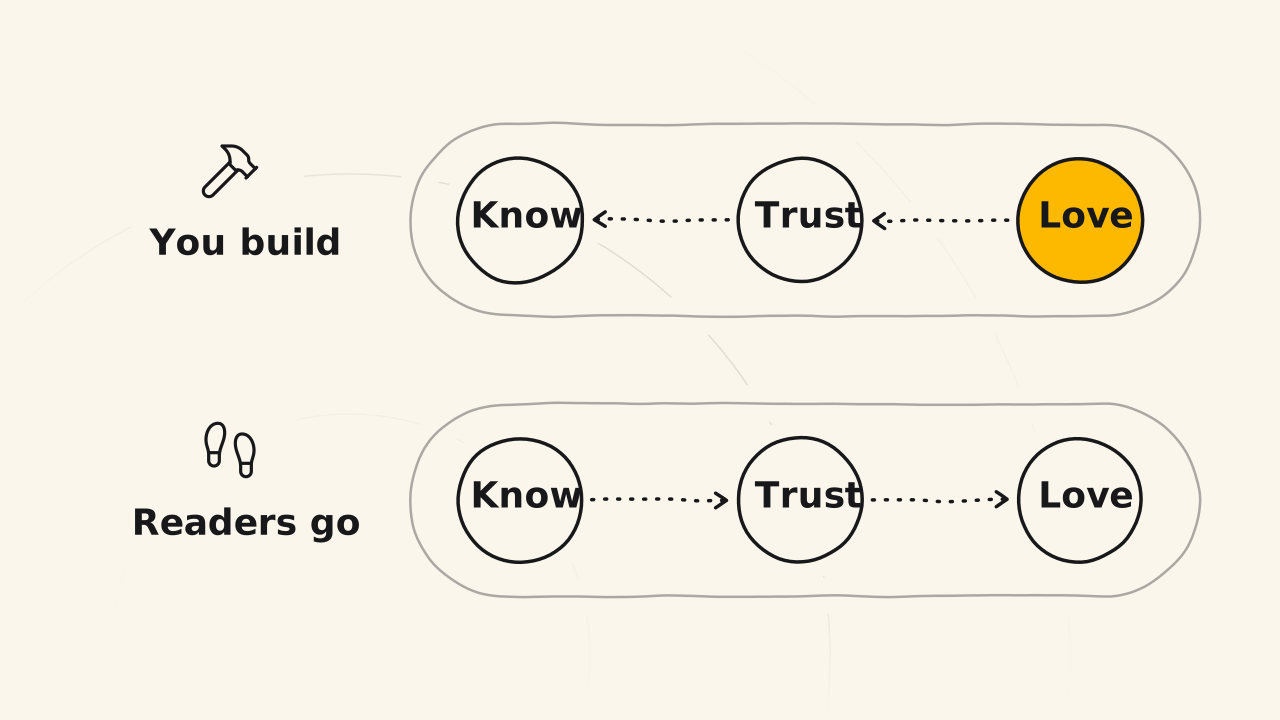
The writing order is the Love post, the Trust posts, then the Know posts. Each step uses the result of the one before as its input.
Pick your edge and write the Love post
Keep two or three points that other people would find hard to match, taken from your list of things you have done yourself. Leave product features off the list. The Love post builds on those points: it runs from the customer pain to the result, then ends with a link to the sales page. Test it by reading it again: every leg readers must take to reach the result is named in the post. That list of legs is the map for step 2.
Write a Trust post for each hard leg
Go through the map and mark each leg that has one of two signs: it needs technical skill, or readers often give up there. Every marked leg gets one Trust post, written from work you have really done and with a result readers see right away. If you have not done it yourself, do not write it yet. The end of each Trust post links back to the Love post, and the invitation changes in style from post to post. Test: the number of Trust posts equals the number of marked legs.
Split the Know posts out of the Trust posts
While you write a Trust post, note every place where you have to stop and explain, such as a term or the reason for an order. If an explanation runs longer than a few sentences, turn it into a Know post, and leave the Trust post with one sentence and one link. The end of each Know post leads to the exact Trust post it was split from. Test: every Trust post reads in one go, and every Know post has exactly one Trust post as its target.
How do you know the Know - Trust - Love funnel is fully linked?
Walk the funnel forward like a new reader:
- Open a Know post. Click the link at the end. You should land on a Trust post.
- Follow the Trust post. Click the link at the end. You should land on the Love post.
- Read the Love post. Click the link at the end. You should land on the sales page.
If you get through all three without stopping at any post, the funnel is fully linked.
Besides the end-of-post link, each post also links to related posts inside its body, so search engines and AI can understand the structure of your website and your expertise.
If the Know - Trust - Love funnel does not lead readers on
Readers stop at one post
That post is missing its end-of-post link, or the link points to the wrong stage. Add the link in order: Know to Trust, Trust to Love, Love to the sales page.
A post has no place in the chain
A post that sits behind no other post and leads to none stays a draft. The condition to publish: the post answers a question of one stage and has a next link. This way of choosing topics replaces writing on a whim or by keyword. The full reason is in the Content funnel post.
You want to write another Love post
The funnel has one Love post. A new post that looks like a whole solution is usually a long Trust post, or one leg of the existing Love post: turn it into a Trust post. How the funnel grows is in Funnel phases and links.
Read next
Sort a post into its stage
Sort a post into the Know, Trust or Love stage by what readers need from it, check the stage's signs, then split mixed posts and add links.
Create a core message
Squeeze one idea into a one-sentence core message from three questions on your customer, their problem and your solution.
Build a three-layer sales page
Build a short sales page with all three layers, the name and core message, proof even with no buyers yet, and a note from the person who made it.