
Know - Trust - Love is the base philosophy of the content system. Each piece of content takes the reader to exactly one of 3 states, in the order know, trust, love.
The Know - Trust - Love content funnel is the method that applies it to posts, with 3 kinds of post, which are the Know post, the Trust post and the Love post.
Why a Content funnel?
The Content funnel gives every post a place on the path to the product, so a post that gets readers also has somewhere to send them next. Without a funnel, posts get views but orders do not grow with them.
Buyers pass through the 3 states of know, trust and love, and cannot skip any of them. They buy because of content and small proofs that arrive again and again, not because of a sales page that is as long as possible.
The old cuongthach.com site wrote to keywords, about 300 posts, and only 11 posts were kept in the rebuild. The funnel gives each post a direction, a formula and a place, so a post with no place is not published.
That place sits on a funnel with 3 tiers.
The three-tier funnel
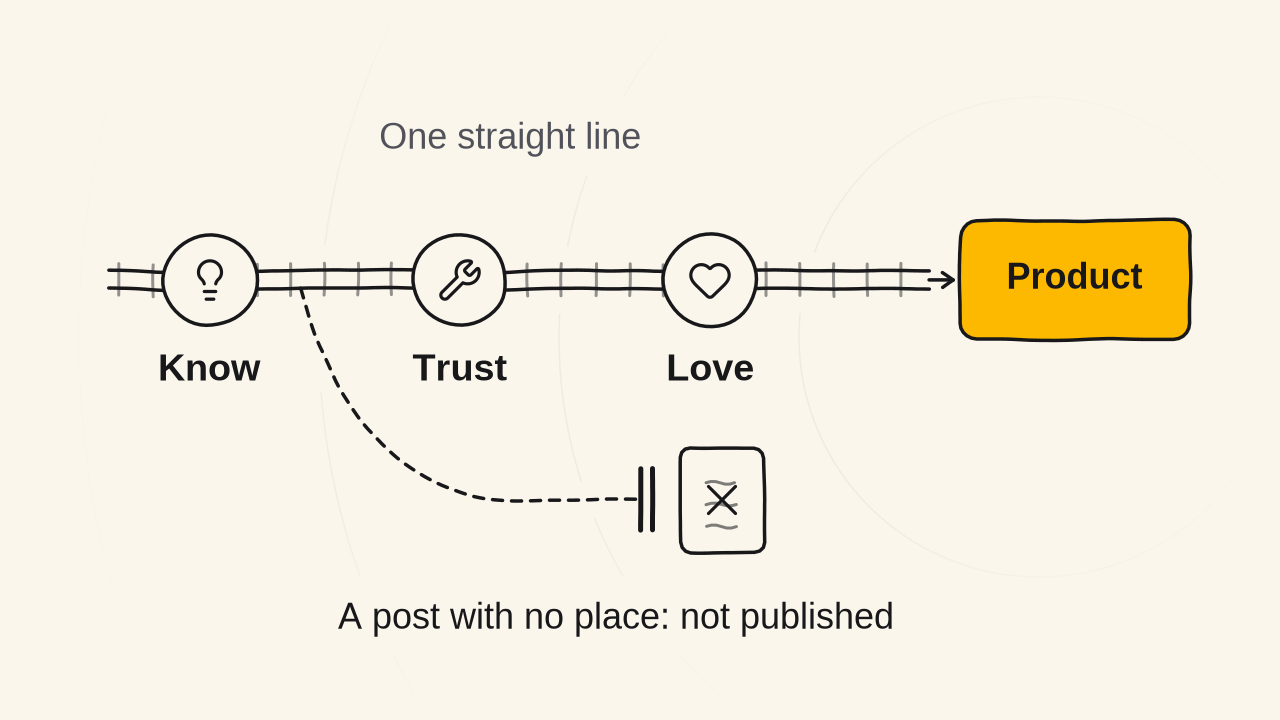
The funnel is a straight path with 3 stages in the order of the reader’s feelings, each stage points to the next, and each post takes exactly one row of the table.
| Stage | Type of post | Points to | Number of posts |
|---|---|---|---|
| Know | Know post | Trust post | The most, each one adds a touchpoint |
| Trust | Trust post | Love post | Fewer than Know posts |
| Love | Love post | The product | A single post, taking up to 80% of the effort |
3 signs that a website is missing a funnel:
- Posts get readers, but orders do not rise with them.
- Nobody can answer the question “where does this post lead the reader?”
- New topics are picked by keyword or by what is trending, not by position in the journey.
Strategy and execution
The funnel is the strategy of making content. With the wrong strategy, few readers buy, even when each post is written and published the right way. So your posting plan is measured by the funnel.
Writing and publishing each post is the job of the Idea - Write - Edit process. The funnel decides which posts are worth writing and where they lead, so it is a filter too. A post with no place is not published.
The 3 tiers are built and linked in 2 phases.
The funnel runs in 2 phases
When you build a funnel you go backward, while buyers go forward. The funnel rolls out in 2 phases so you do not get overwhelmed:
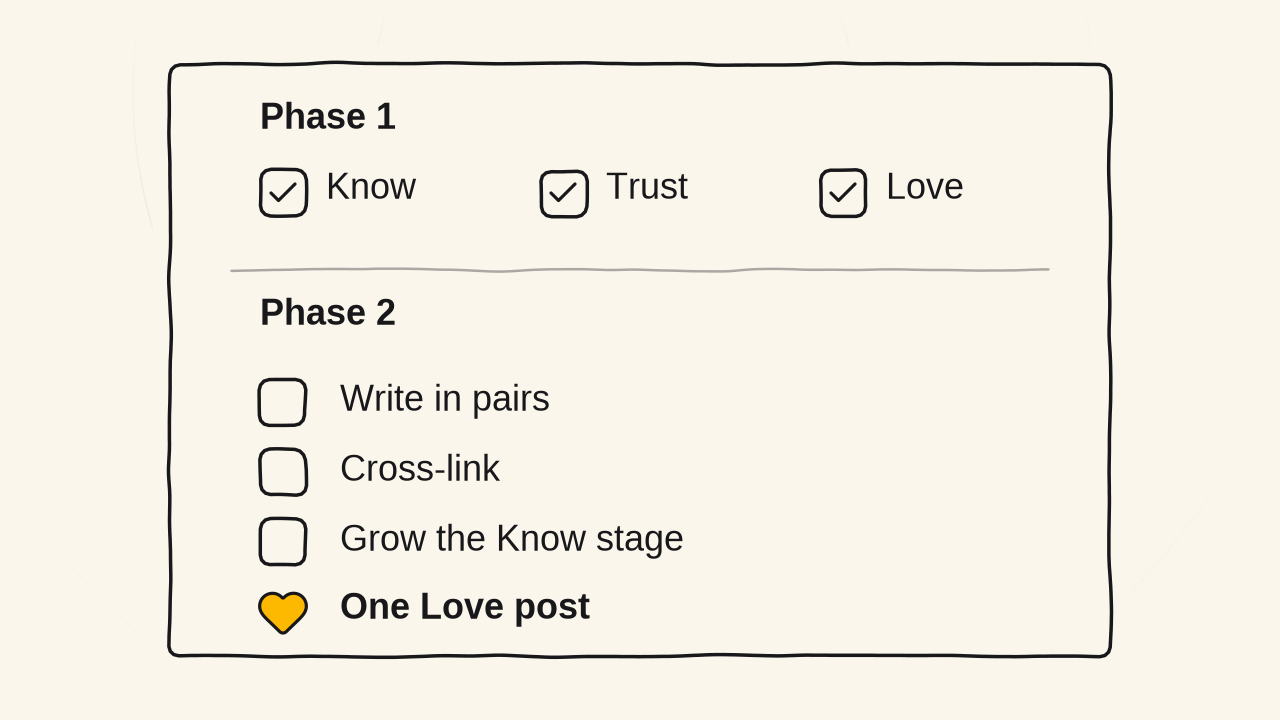
- Phase 1: exactly 3 linked posts, one Know, one Trust, one Love, with the Love post pointing to the sales page.
- Phase 2: add posts that bring readers to the Love post.
Build from the Love post
The build order has 3 steps, and each step gives birth to the stage before it:
- Write the Love post from the core of the product.
- For each stretch in the Love post with a technical difficulty or a barrier to action, write a Trust post.
- The “what is” and “why” questions that come up while writing a Trust post are split off into Know posts, so the Trust post does not get diluted.
The funnel starts running once all 3 posts are published and the links run from start to end. Readers get their problem named, make a result themselves, and see the full solution to buy. No other post is needed before you open sales.
Phase 2 starts once the three-post funnel frame runs. The rule does not change. The Love post is the only one, never write a new one. Every post you add only brings more readers to the Love post, in 3 steps:
- Write in pairs. Each new Know post comes with a new Trust post, so readers who just understood something get a guide to follow right away.
- Cross-link. Once there are enough Trust posts, a new Know post points to the existing Trust post that fits best.
- Grow the Know stage. Write more Know posts to add touchpoints, even on topics that are trending, because the Trust stage below is strong enough to hold new readers.
Links within posts
The link at the end of a post points to the next step. A Know post leads to a Trust post, a Trust post to the Love post, and the Love post to the sales page, or to a waitlist before sales open. As the writer, you know what readers need next after they understand something in a Know post or finish a task in a Trust post.
In the body, in all 3 kinds of post, you place links to related posts where they fit. The posts share one Know - Trust - Love frame and link to each other. That way, search engines and AI understand your website’s structure and your expertise, and Google knows which post relates to which.
The cuongthach.com blog shows those phases and links in practice.
Example of 2 funnels
The cuongthach.com blog runs 2 funnels of 3 posts each, and both Love posts lead to the Write to Sell sales page.
| Funnel | Know post | Trust post | Love post |
|---|---|---|---|
| Sales page | “Is a long or short sales page better in the age of AI?” | “How to make a simple sales page in 3 layers: Know - Trust - Love” | “The Know - Trust - Love content funnel: Write less, sell more” |
| Writing from recordings | “Write hands-free, stop procrastinating with Talk to write” | “How to turn a recording into a fully published post” | “The Idea - Write - Edit process: Escape the never-ending writing loop” |
In the first funnel, the Know post shows readers that the right length of a sales page depends on where the buyer stands, and it was split off from the Trust post of the same funnel. The Know post of the second funnel names the habit of putting off writing, then invites readers to make their first post with their own hands.
Both funnels follow the same buyer’s journey.
The buyer’s journey
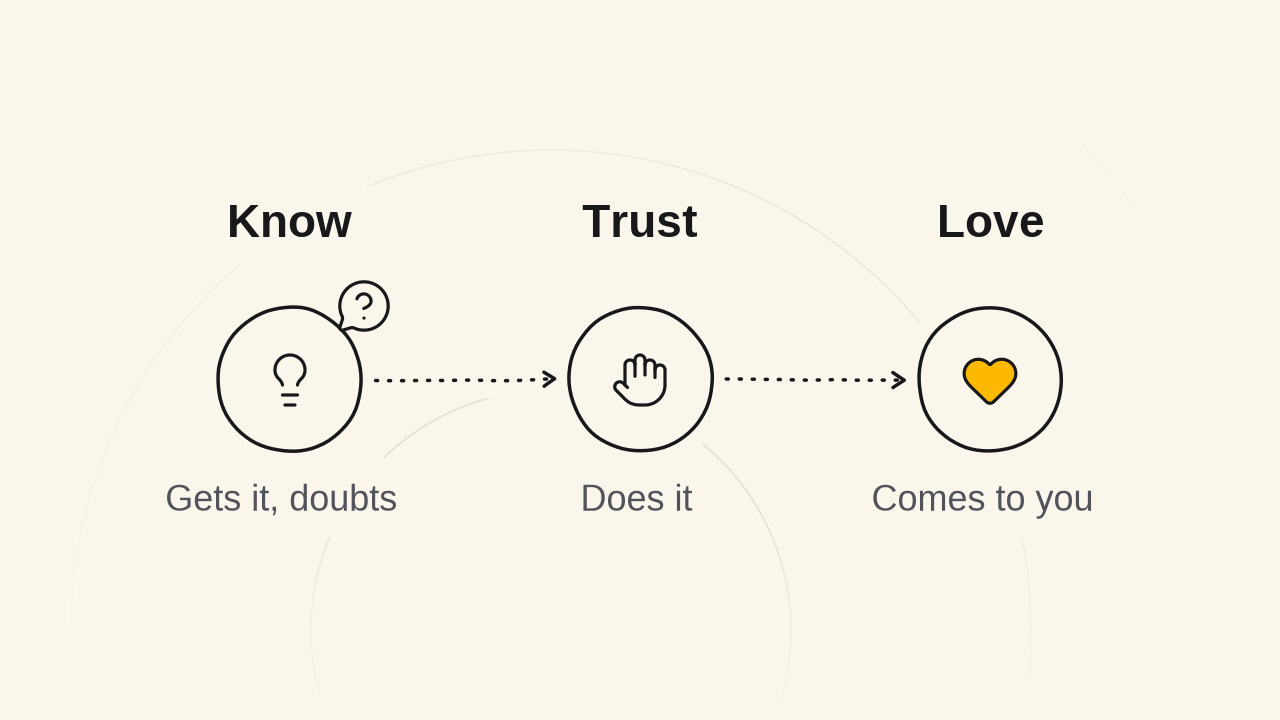
Know is discovery, Trust is action, Love is direction. At Love, the product appears as a lever that helps readers go faster and not give up halfway.
The 3 states join into one straight line, matching the 3 layers of the content funnel. The table is the definition you use to check a piece of content.
| State | What the content must do | Sign it worked | Matching stage |
|---|---|---|---|
| Know | Name the reader’s problem correctly | They recognize themselves in the post and read on | Know post |
| Trust | Give them one small job to make a result themselves | They follow along and hold a result | Trust post |
| Love | Lay out the whole road to solving the lasting pain | They look for your product | Love post |
No step can be skipped
Buyers pass through the 3 states over time, and no state can be skipped.
Two common approaches fail, namely handing a price list to someone who just met you, or cramming everything into one very long sales page because you don’t know which state the buyer is in. Both try to get the buyer to buy in just 1 or 2 steps, and the buyer does not buy.
Every time a reader meets you is a touchpoint. The table below follows the slow way, like rain that soaks in.
| Touchpoint | They move to | How long the sales page must be |
|---|---|---|
| First meeting, price list right away | Does not know you | No page is long enough |
| Repeated meetings, each time seeing that you have a product | Know | Not buying yet, needs more proof |
| Seeing a proof, seeing others use the product with good results, or trying it themselves | Trust | A short page to check again and buy |
| Learning more deeply about the product | Love | The Love post first, then a short page to buy |
Content makes these touchpoints without you meeting each person. Buyers buy because of content and proof that arrive drop by drop and repeat, not because of a sales page that is as long as possible. The sales page is the last touchpoint, where the Love post leads.
Control the path
Search engines and AI drop readers into any post. A technical question lands them on a Trust post, and an opinion lands them straight on the Love post. What you can control is the path, in which each piece of content points out the next step.
| Readers enter at | The content must point to |
|---|---|
| A Know post | The way into the Trust post |
| A Trust post | The way into the Love post |
| A Love post | The sales page to buy at once. Those who don’t buy go to the home page or read another post |
Someone who needs a solution fast may buy at once. Someone who does not buy yet stays on the website, and the links at the end and in the body of each post lead them to the same Love post.
The philosophy also has 6 rules for every method.
6 Shared rules
The 6 rules of this philosophy hold for every method:
- Every piece of content has a place. Each piece of content serves one state and points to one next step. Content that cannot name both need not be made: you work from a plan, not from inspiration, keywords or trends.
- People come before AI and real work comes before guides. AI helps order ideas, make images and store working history. The point of view and the work done in the real world are not handed to AI, because readers notice the marks of AI content and judge the brand along with it. In Know, you rely on understanding customers and your own angle. In Trust, you rely on the result you made yourself ahead of the reader.
- The edge is you. A product stands out through a few points that come from the strengths of the person who made it. Competitors can copy the product and the tools, but not you.
- Trust comes before the product. A product needs a history, meaning real contact with customers, before launch day, so readers already trust it. That is why you can start even while the product is still on paper. If you wait until the product is done before writing, you get no early feedback and are left with big praise that is hard to believe. Making content early shows you what you thought was right and customers did not need.
- You control the path, not the way in. Readers may come in through any post, as long as each piece of content points out the next step.
The philosophy answers “which state does the reader need to reach?” for all content, posts and sales pages alike. A method answers “which posts, in what order?” for one kind of content. The content funnel is the first method in these docs, but not the only one. A sales page is also built in that order, with a Know layer, a Trust layer and then the place to pay, with no Love layer.
Use the philosophy to check any piece of content, and a method to do the work, such as picking posts, building a page and setting the order you publish in. Every method must answer the philosophy’s 3 questions:
- What new thing did the reader just learn
- What did they do themselves, and did they get a result
- What way forward do they see