
The Write step is the second step of Idea - Write - Edit. You play the actor: say or write everything you understand about each idea in the locked outline.
What this step makes is a rough draft, the longest version of the post. The stopping point is when you go through every idea in one go. An idea where you get stuck is one you do not understand well enough yet.
The hard part of this step is procrastination: you have a topic and you have the knowledge, and you still do not sit down to write. If you are stuck at one specific spot in one post, go straight to Stuck at the Write step. To do it move by move, read Write a draft in one go from the outline.
The Write step makes the rough draft
You turn off the internet, look nothing up, and focus only on pouring out what you understand, remember and have lived through about each idea.
You do not:
- Polish words.
- Try to persuade.
- Stuff in keywords.
In the Write step you try to say it right the first time, because every time you say an idea again, that is more words to cut in the Edit step. Repeating and stumbling are fine only when you pour out ideas in the Idea step.
What is writing procrastination?
Writing procrastination is when you want to write and lose your drive right at that moment. Once you start, the post rolls and you tend to keep going until it is done. Before you start, nothing moves, and that is procrastination.
It is not laziness. Cuong had thirty topics in a notebook and wrote no post in three months, and that was not laziness. By Cuong’s account, this is not only about writing. It happens in any work you do not start.
Fixing procrastination means fixing the one act of sitting down at the computer and starting, not fixing a lazy streak. In Cuong’s words, once you have started, you have already won.
The hardest part of writing is sitting in the chair, not the writing. You sit down in front of a blank page and get up and walk away before a single word is written. A person who puts things off looks for another place to sit, lies far from the desk, and sometimes fears and obsesses over the chair.
The chair is hard to sit in because sitting down means you start to think about where to begin, instead of thinking about what to say. Cuong calls that moment of sitting down to think the moment of procrastination, because you have not started at all.
Two kinds of writing procrastination
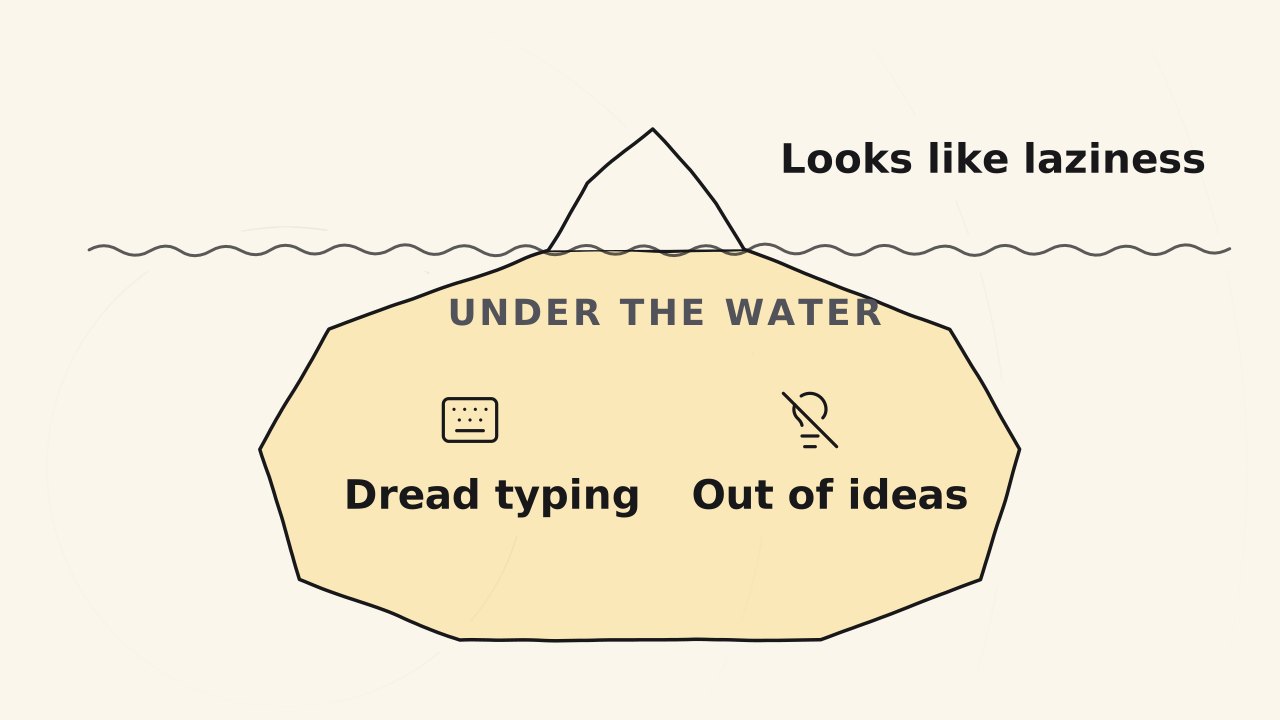
Cuong tells two kinds apart:
- Putting off because you dread typing. You look at a long post, it seems like too much, and you do not feel like typing it. To publish a post of 5,000 words, you have to type about 7,000 to 10,000 words and then edit, and that picture alone makes you want to quit.
- Putting off because you have no ideas. You do not know what the ideas are, so you start putting it off right away.
Both pile up with low confidence, little love for the work and fear. When you repeat a mistake and cannot get past it, you lose heart. Then today you find an excuse not to do it, tomorrow you find another, and in the end you forget how to start.
Fear is the main root of procrastination, and it grows from times you spent hours and got nothing.
In Cuong’s example, he opened a document with everything gathered, wrote a title, deleted it and wrote again, and two hours later it was still not done. The next time he sat down, he panicked. The title is the idea you are going to say, so when you do not lock the idea, the time drags on.
Why does typing feed procrastination?
Typing feeds procrastination because it makes you think deeply and wears out your hands at the same time, so your energy drains. The upside of writing is that you think slowly and deeply, and your sentences come out sharper, but that very thing drains your energy. Looking at that picture ahead of time, you find it hard before you type a single word, and that is where the reluctance to start begins. By Cuong’s account, this is the most common cause of procrastination.
Energy runs out by the fourth sentence
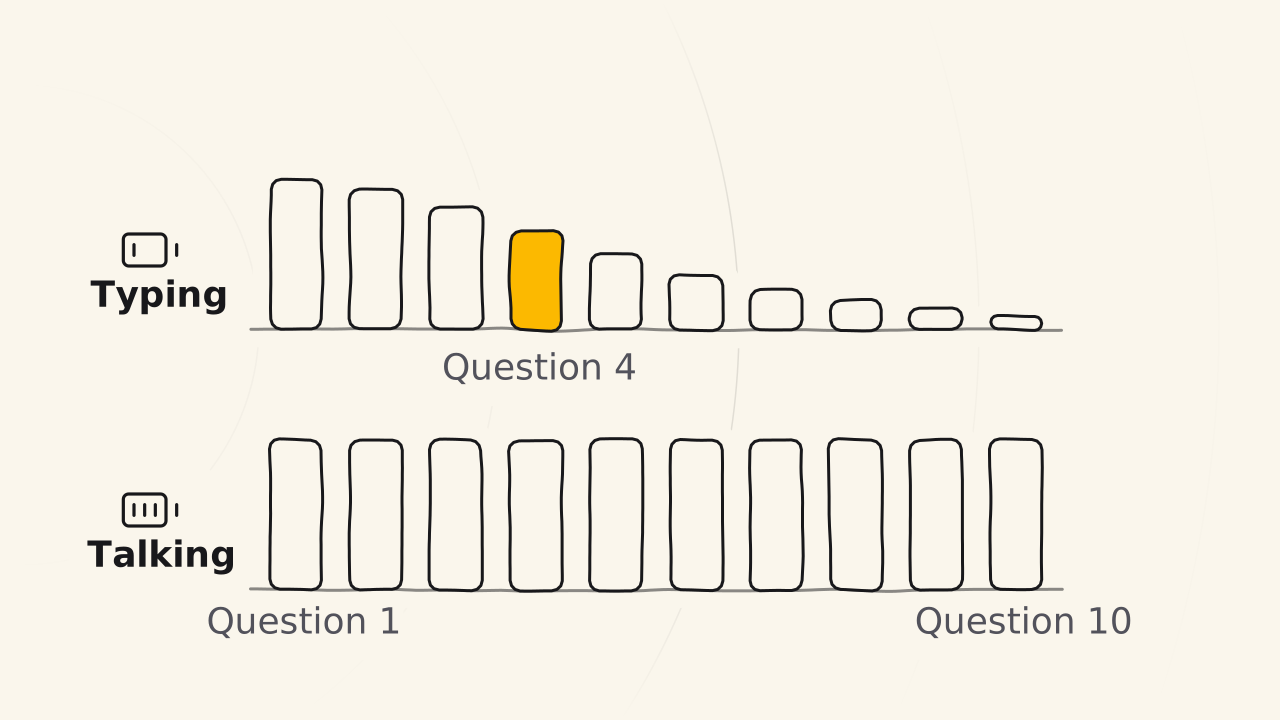
Typing drains your energy bit by bit. With ten guiding questions, by the fourth or fifth question you start to tire. By the tenth, your answers are short.
That is why Pomodoro exists: write for 30 minutes, rest for 15, to recharge from 60% back to 100%, and then it drops again. Cuong compares that energy to a battery: after a stretch of typing, the battery runs low, you cannot keep the fire going, and what you make is not good.
You can see the result in the post: the opening and the first ideas are very good, and it gets worse the further down you go, because you cannot keep your form from start to finish. Every writer who has started wants to finish, so many people type in one go to get it done, and the downside of that is running out of steam: you decide to finish, but your pace is uneven.
Editing disease
Typing also catches you in editing disease: you edit while you write, delete a line ten times, and sink into polishing, so you are very slow. Cuong’s own rough guess: typing is already three times slower than other people, and deleting one sentence ten times makes it thirty times slower.
You do not need to polish while you write. In Idea - Write - Edit, editing is the last step: recording belongs to Idea and Write, and you edit in the Edit step. The place to type yourself is the opening and the ending, in the Edit step.
How does talk to write fix procrastination?
Talk to write swaps the keyboard for your mouth: you talk, and a recording app and AI turn it into text. It is not recording a podcast or a video.
The closest picture Cuong gives: you are still typing, only you type with your mouth so the text appears faster.
You do not listen back to your voice, because this is talk to write, not talk to be heard. AI turns your words into text and trims roughly, and you read the text to see whether you said it right. The ideas, stories and experience are yours.
One shot keeps your energy
For the person who dreads typing: talk through in one go and one post is done, which Cuong calls one shot. Talking keeps your energy up, so the work feels easy, and from that ease, procrastination drops.
Your energy holds because talking is many times faster than typing and you do not try to talk slowly. Cuong’s rough guess: a slow typist gets 10, 20, 30 times faster, a good typist about 3 times.
Talking needs no Pomodoro, and your energy is almost fully kept. Cuong talks in one stretch for about an hour per post, and once he starts talking, he does not stop until it is done. Talking also cures editing disease, because you have little chance to polish each sentence.
The idea-starter structure replaces having no ideas
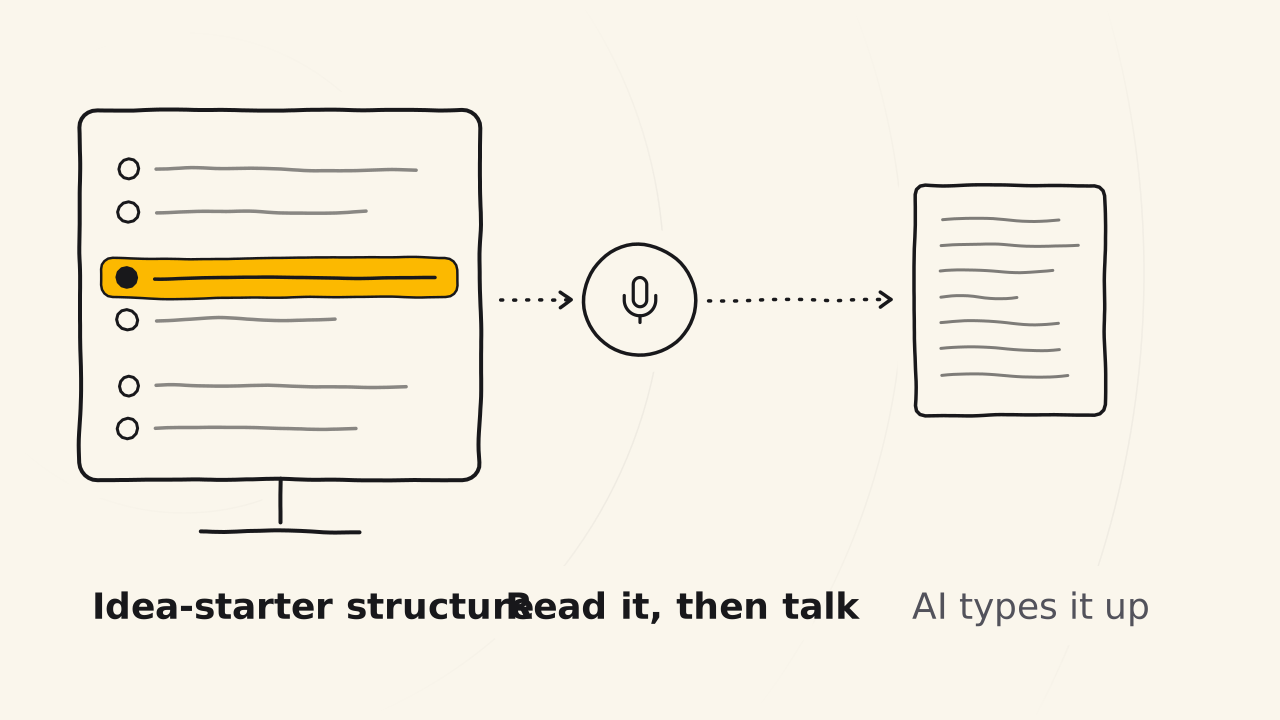
For the person with no ideas: you build in structure from the very start with a set of guiding questions, which Cuong calls the idea-starter structure. With a question in front of you, you only need to answer it, and you do not have to think about what to say.
The idea-starter structure is a guiding structure, not a locked outline: a sharp outline exists only after you finish recording and lock it. The set of questions follows the post type in the Know - Trust - Love funnel, and it is grouped, with some questions to say before others, so the recording has structure from the start and wanders less.
Cuong pastes the question script into his phone or puts it in front of his computer screen, reads a question and then talks, and does not talk with his eyes closed.
Going blank is normal: when you do not understand an idea deeply, you talk about it shallowly, then write it in a notebook to study more, and so patch your own blind spots.
A small step, and two ways to make a long post
Start with one small step: open the recorder and answer the first question. The hardest part is starting, so a small step cures procrastination.
For a long post, you have two choices: make it in parts and join them, or make it in one go. Making it in one go with a keyboard is a struggle, because you cannot type fast enough and your energy fades, so one shot relies on talking.
Recording also suits moving around: talking while you walk is normal, blood flows to your brain and your mood lifts. Cuong records when he is at his sharpest, like early morning after exercise, and not when he is sleepy, tired or angry.
If you have never recorded, spend the first week practicing talking: write down one topic, then talk about it. The first time, repeating yourself, stumbling and saying “um” are normal, because you have not practiced enough yet. How to practice is in Practice until it sticks.
How do you know the procrastination is fixed?
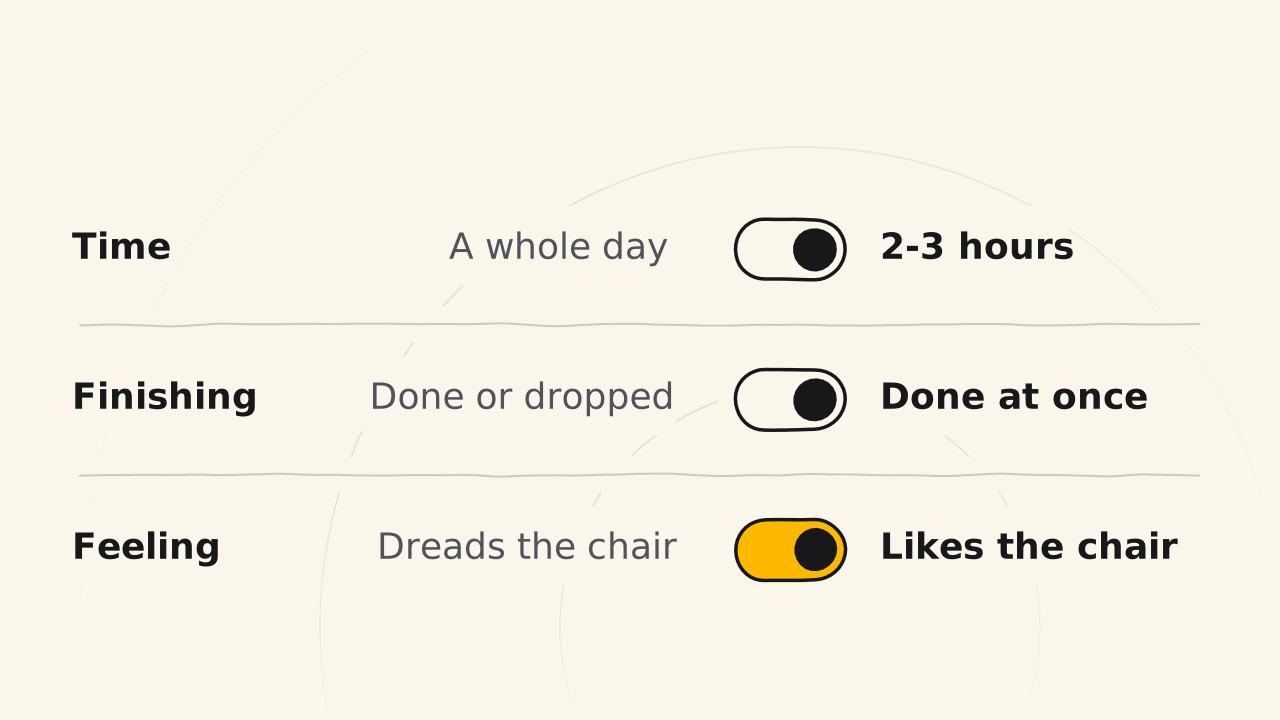
Compare talk to write with your old way of writing, and you see three signs.
The first sign is time, and you can measure your time budget. By Cuong’s formula:
- Half an hour to plan.
- One hour to record.
- Half an hour to edit.
In an 8-hour day that makes 3 posts, and a fourth post is overtime. The old way cannot be measured: some days you think for an hour, write for two and edit for two more, other days you think for half an hour and still write for two, so your time budget is off.
The second sign is finishing: you do one shot. The quality may not be the best, and sometimes you need to say it again, but it is always steady and you always finish. Talking also misses no ideas, while typing misses some even when you polish every word.
The third sign is how you feel about the chair: when you no longer fear the chair and start to like sitting in it, the procrastination is fixed.
The first time Cuong used talk to write, he talked all over the place, because he had no direction and no structure yet. He went on and on, repeated ideas, forgot what he had said, stumbled and said “um”.
After each recording, Cuong reviewed it and drew a lesson for the next one. From there he wrote the set of questions before recording and put it in front of his screen.
| Sign | Before | Talk to write with a set of questions |
|---|---|---|
| Topics in the notebook | Thirty topics, no post in three months | Each recording becomes a post |
| Time for one post | A whole day | 2 to 3 hours |
| Finishing | Uneven, sometimes done and sometimes dropped | Done in one go, quality always at a steady level |
| Length of a post | About 1,500 words | About 2,500 words, no ideas missed |
| While recording | Talking all over the place | Answering one guiding question at a time |
| Feeling | Afraid of the chair | More excited, starting to like sitting down |
Read next
The Edit step
The Edit step tightens the opening, cuts the rough draft and puts it in your customer's words, until you and your customer both understand it.
Outline from one line
Turn a one-line topic into a locked outline with three starter questions, pouring out every idea, then filtering it by the core message.
Record and check the transcript
Record on your phone with the internet off, let the app turn your voice into text, then check the names before you filter ideas or edit.