
The Truth vault is a Source of evidence when each fact has its own page to point to. A blog post mentions a term, and it links to that page. A customer asks about one thing, and you send the link to that page. A page that is not small enough to link to cannot do this job yet.
This page is for you when you are building the vault and need to know how big a page should be and how to write it. If you need to know what may go into the vault, read Entity docs.
What is an atomic fact?
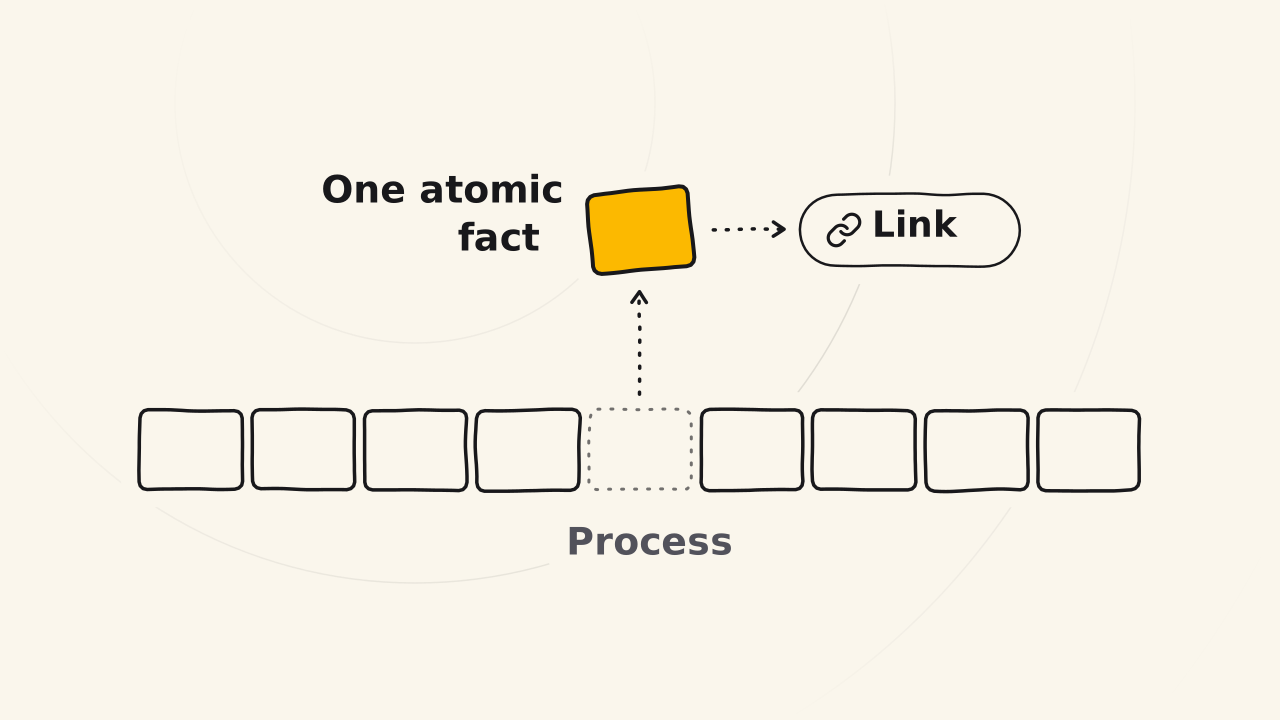
An atomic fact is one complete page about one thing, clear on its own. Take a process and split it as far as it will go into small solutions. Each small piece that can still stand alone is an atomic fact.
An atomic page is not a short post. It is just enough for readers to get the point as fast as they can, with no missing step and no missing context.
If a page is too short, it is thin, hard to understand and weak for SEO. If it is too long, it holds many things, and you can no longer link to exactly one. The test is a question: can a reader who reads only this page understand it and act on it?
A post is one complete picture. A page in the vault is one piece of that picture.
| Page in the Truth vault | Blog post | |
|---|---|---|
| Scope | One thing, split as far as it goes | One complete picture |
| How it is written | States the fact, tells no story | Tells a story from the facts |
| Focus | The brand and the product | The customer and their feelings |
| Sending a link | You can send one page for each question | Rarely sent, unless the whole post answers the question |
So you rarely send a customer the link to a post. You send the link to a page in the vault.
How do you write a page in the vault?
A page in the vault is written like a normal post, except for the emotional touch with the customer. The top has a summary, the way you open a post. The body states the fact so readers understand it as fast as possible.
Why does a vault page not tell stories?
The vault states facts so readers get them fast. A story makes the page longer and adds no fact.
Stories belong to posts. A post takes the facts from the vault, weaves in your own story, adds pictures and video, and looks at the fact from another angle. The process still has the same three steps as in the vault, but the story around it carries your mark.
What four kinds of page does the vault have?
Vault pages come in four kinds, across two stages of the Know - Trust - Love content funnel:
| Kind of page | What the reader needs | Stage |
|---|---|---|
| Step-by-step guide for newcomers | To finish one job from start to end for the first time | Trust |
| Do-it-yourself guide | To complete one specific job | Trust |
| Explanation | To understand what something is and why | Know |
| Reference | To find exactly one value or one rule | Know |
The vault has no Love posts. A Love post touches the reader’s feelings, while the vault stays on facts, so Love posts live on the blog.
How do posts and customers use the Source of evidence?
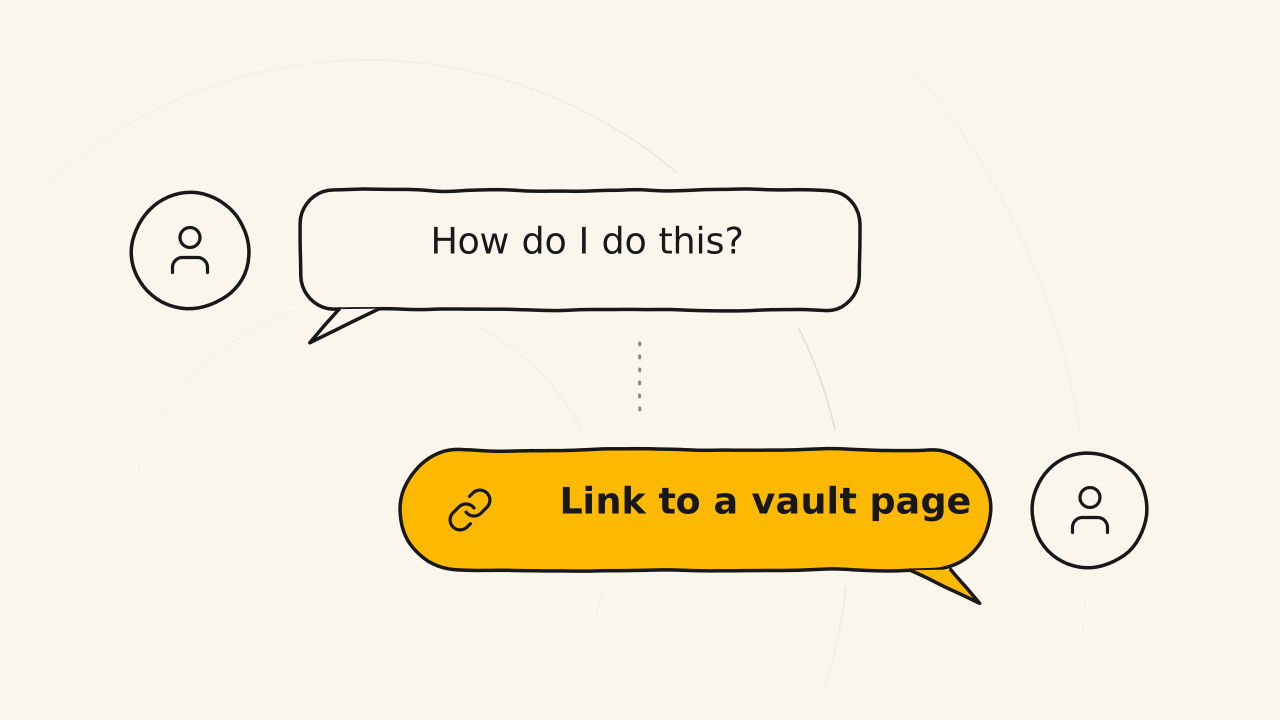
The Source of evidence has two users: your posts, and the customers who ask you questions. Both go to the same place by link.
Every post links to the vault
When a blog post has a term or a method that the vault already explains, the post links to that page instead of explaining it again. The post gets lighter, and readers who want to dig deeper have a place to look.
Links to the vault help both SEO and reading. A post always has something to refer to. Without a vault, a post has nothing to link to.
Answer customers with links
The vault’s rule is to answer with a link. A customer asks about one thing, you send the link to the page that answers it, and the customer reads it and looks up more on their own.
Without a vault, you introduce yourself once for each new customer, explain once, and send the reference table once. With an atomic vault, you send exactly one link for one question, or a few links for a few questions.
Plan a new post from the vault
At the Idea step of the Idea - Write - Edit process, you compare the idea of the post with the vault. The post does not repeat what the vault already states. It is about the use of that fact. It extends the fact, looks at it from another angle, and points out what is still missing.
The vault usually keeps the template and the common ground. A post usually tells a story around that template. Having a vault does not mean you run out of things to write.
Example of a Source of evidence on cuongthach.com
The blog post The Idea - Write - Edit process: Escape the never-ending writing loop tells the whole writing process. Where the reader needs to work step by step, the post does not rewrite the steps. It links to three pages in the vault:
| Place in the post | Link to the page in the vault |
|---|---|
| Create a core message | Create a core message |
| Make an outline | Outline from one line |
| Edit a post | Edit a draft into a post |
Each target page is one complete job. A reader of the blog post follows the story. A reader who needs to do the work opens the page for that step.
What the Source of evidence does not do
- It does not tell stories or touch feelings. That belongs to blog posts and sales pages.
- It does not replace posts. The vault keeps the template, and posts tell the story around it.
- It does not hold what you have not done. What may go into the vault is set out in Entity docs.
- It does not prove that you spoke first. That is the job of Brand footprint.