
By the rule of the Know - Trust - Love content funnel, a Trust post only works when the result is made by the reader, not announced by you.
If you already have a post and don’t know which stage it belongs to, sort it into the right funnel stage first.
Why do readers only trust what they do themselves?
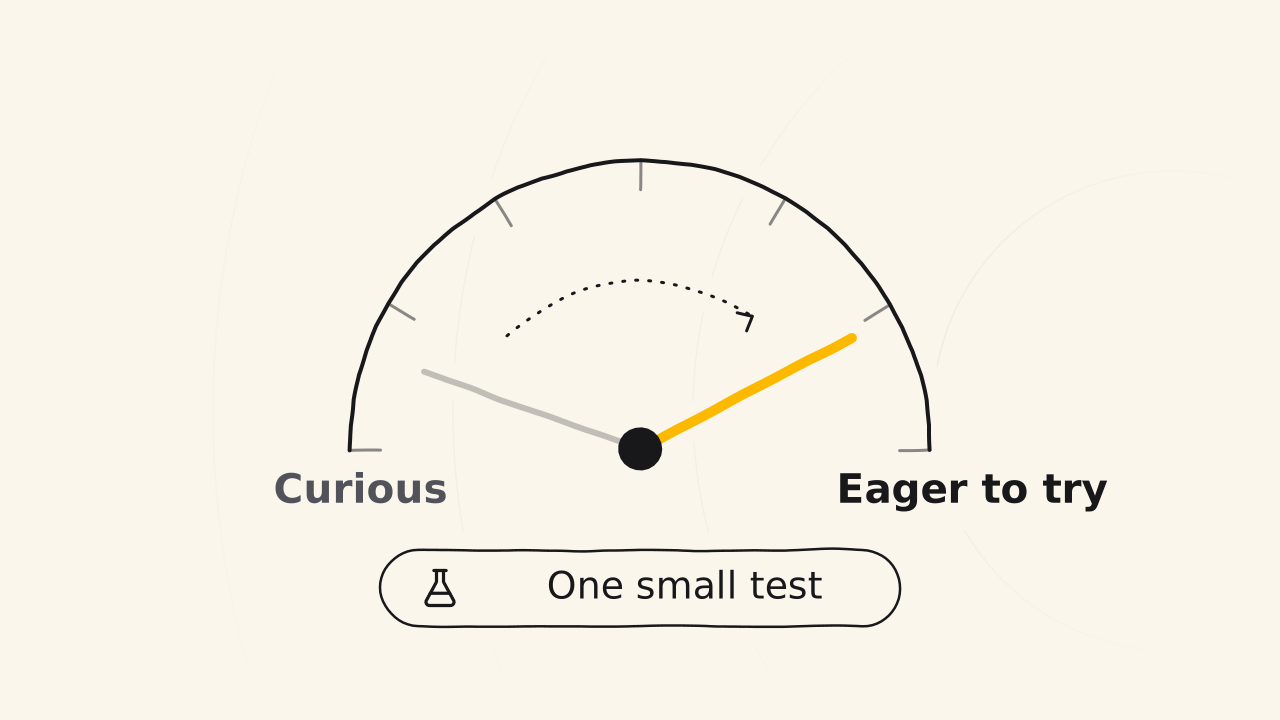
After a Know post, readers may understand and still doubt. Only a result they make themselves clears that doubt, and the writer’s words do not.
So a Trust post is built as a small test: a short action the reader does alone, with a result they can see. The post works when readers hold a result in their hands before they reach the invitation to the Love post.
| When | The reader’s state |
|---|---|
| While reading | Curious, wanting to try |
| After finishing | Sure they can do it |
A Trust post is for newcomers. Each one is split off from one idea of the Love post and removes exactly one obstacle on the road the Love post draws.
What does a Trust post need?
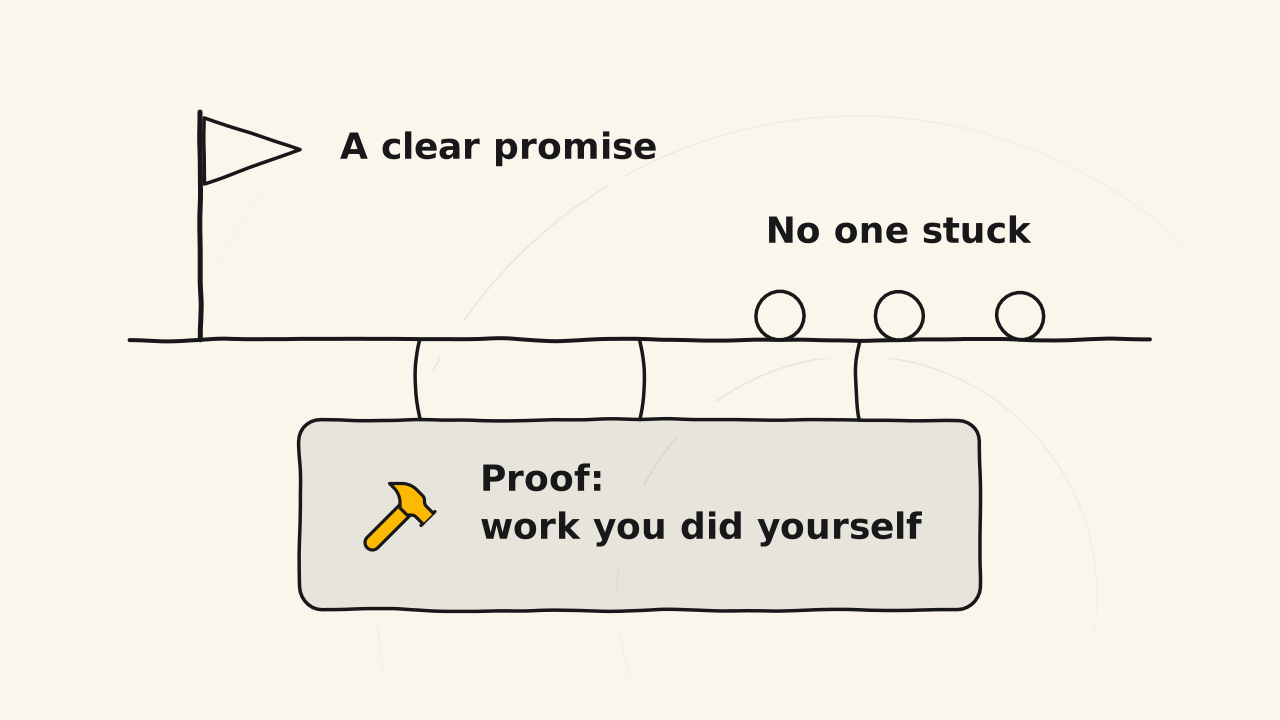
A good Trust post must have two things: a clear promise of a result, and steps that never leave the reader stuck. Behind those two things is proof: the work you really did yourself.
Where the promise goes and how to write it
The promise is one sentence you can say aloud: follow these steps, get this result. By the site’s writing standard it goes in the description and in the first 50 words of the post, not in the title.
The title of a Trust post follows this pattern:
| Item | Rule |
|---|---|
| Opening | “Guide” or “How to” |
| Content | The job the reader will do |
| Length | 45 to 60 characters |
| Colon | No second half after it |
Example: “How to turn a recording into a fully published post”.
Steps that leave no one stuck
Check with one question: does anyone following along have to look for information outside the post to get past a step? If so, that step lacks detail.
The place where readers get stuck, especially on technical points, is called friction. The job of the Trust post is to cut friction as far as it can.
Proof is the work you really did yourself
The condition: before you write, you tried it yourself and got a real result, and only then packaged it as a guide. You are one step ahead of the reader. That real-world trial cannot be handed to AI, so AI cannot write the Trust post for you.
A customer’s proof belongs to the Trust layer of a sales page. When you have no customers yet, you can still build a lean sales page. Writing a Trust post also helps you learn deeper and faster, because you learn from the work you do.
The splitting rule: while you write the how-to, each foundation question, such as “what is this”, “why is there this step”, “why does this step come first”, is moved out into a Know post of its own. That way the Trust post keeps one line of action, and each Know post already has a Trust post to lead to.
Should you write a Trust post or a Know post?
Look at what the reader needs from the post:
Write a Know post when
The reader asks “what is this” or “why does it work this way”.
Write a Trust post when
The reader needs to be shown how to do one job and make a result themselves.
An example of a Trust post in a funnel
The post How to turn a recording into a fully published post is a Trust post of the Idea - Write - Edit process. The table lists its parts.
| Part | In the post |
|---|---|
| Title | “How to” plus the job the reader will do |
| Promise | About an hour of recording and 30 minutes of editing for a finished post |
| Less friction | A section on three things to prepare before recording: a microphone, a recording app, a set of guiding questions |
| Steps | Three steps: Idea, Write, Edit |
| Stopping point | The post is on the website |
| End of the post | A link to the Idea - Write - Edit Love post |
| Relationship | Paired with the Know post on Talk to write, and the two lead to each other |
This example meets all three conditions of a Trust post:
- A promise you can measure.
- A preparation step that removes friction before readers begin.
- A last step that ends at a stopping point you can see.
The table below puts it next to the old site’s how-to posts, written for keywords with no funnel (about 300 posts since 2017, such as guides to Mailgun, Amazon SES and Stripe).
| Keyword how-to | Trust post in a funnel | |
|---|---|---|
| Why it was written | A keyword people were searching | A place in the funnel |
| Promise | Not set | Recording time and editing time stated in the opening |
| Less friction | Not set | Tools prepared before the first step |
| End of the post | The guide ends, the post ends | Points to the Love post |
| Result | Readers, but no sales. Only 11 posts kept when the site was rebuilt | Readers are led on to the solution |
What does a Trust post not do?
- A Trust post doesn’t carry the “what is” and “why” explanations. That part belongs to the Know stage.
- A Trust post doesn’t solve the lasting pain. That belongs to the Love post, and the Trust post only clears one snag on the road.