
Each Love post sits at the bottom of a funnel, and its closing leads to the product.
What does the Love layer show the customer?
The Love layer shows the customer the big picture: a method to follow and a tool to follow it with. Your product is what helps them walk the whole road.
The big picture and a shorter road
After the Trust layer, the customer has done one small thing. The Love layer shows them the whole process, and your product makes that process shorter:
- A shorter road.
- A way to save money.
- A way to cut the friction of learning, and to cut time. Time is money.
- A real push to finish what they start.
If you sell a tool, that tool is the product that fits the Love post.
One Love post, one reason to buy
Each Love post covers one standout point of the product and gives the customer one reason to buy. You weave that standout point into the post and say it plainly. One reason is enough for one post.
A customer may love you, and still that reason may not fit them. Then a second funnel on your site, with another Love post and another reason, may fit them well. They keep reading and decide to buy for that reason.
How many Love posts does one product have?
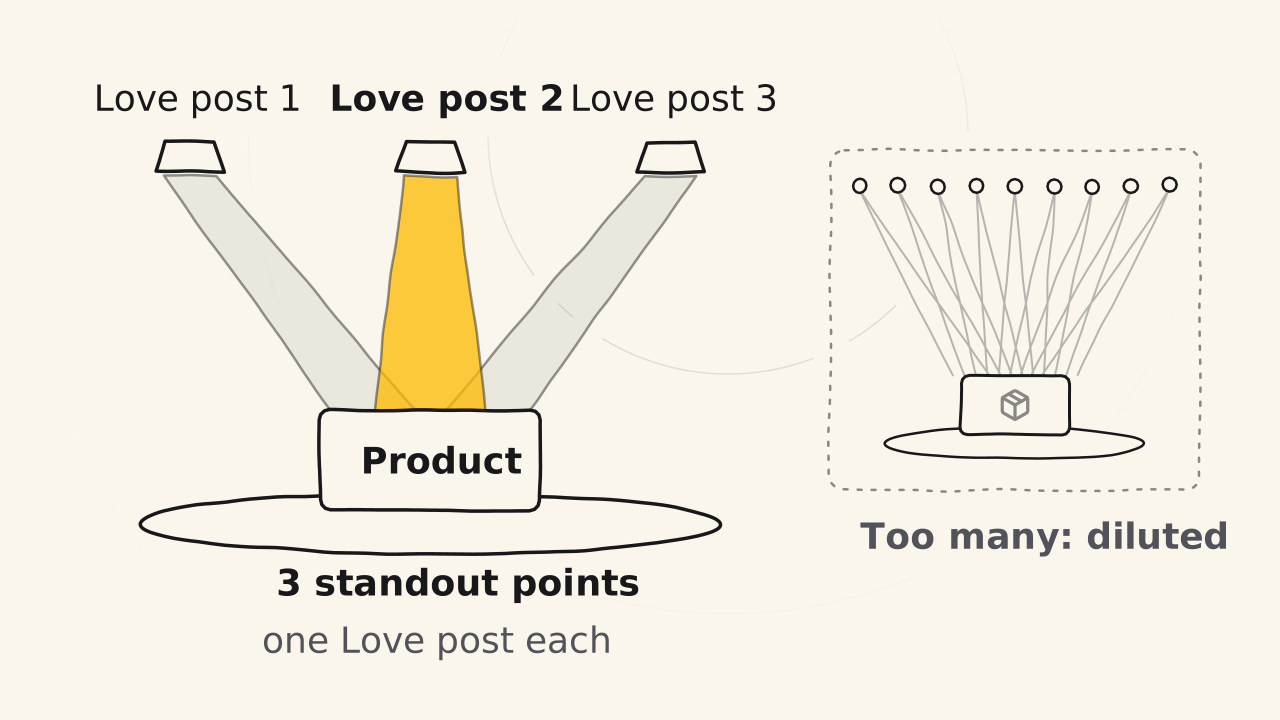
The number of Love posts depends on the product, but it is always limited. A solo business usually sells a niche product, so the standout points are limited too. Choose three at most, the ones the customer will really pay for.
Too many Love posts water things down. If you offer too many standout points, none of them stands out. Each Love post sits at the bottom of its own funnel, with its own Trust layer and Know layer. Most of the effort, up to 80%, goes into the Love post, because it creates the sale directly. But the number of posts goes into the touchpoints in the Know layer and the Trust layer, not into Love posts.
| What you want to do | With the Love layer |
|---|---|
| Just starting to sell | Three posts are enough: one Know, one Trust, one Love |
| Add another Know post or Trust post | Keep the Love post as it is, and only add a link leading to it |
| Say one more standout point of the same product | Write a new Love post and build a funnel for it, three in total at most |
| Sell a different product | Build a new funnel with its own Love post |
A reader can enter the funnel at any post, the Love post included, so each Love post must stand on its own. Do not make the reader go back to another post to understand it.
How does a customer move through the Love layer?
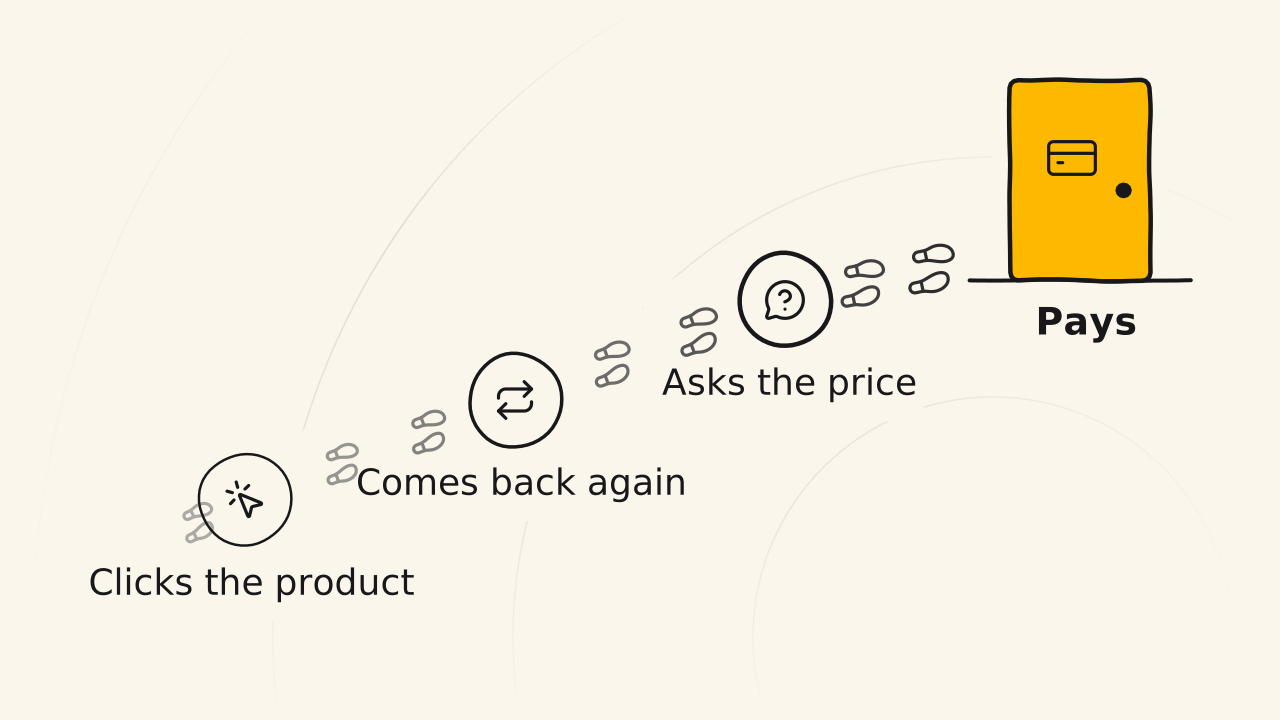
Customers reach the Love layer by many roads, and they leave clear signs when they want to buy.
Where do customers reach the Love layer from?
You cannot choose which layer a customer enters the funnel at. If they enter at the Know layer, they move to the Trust layer, then down to the Love layer. If they enter the Trust layer directly, in the middle of the funnel, the Trust post pushes them down to the Love layer.
When they cannot decide, they go back and read the Know posts on your site, and they may enter a different funnel. Some customers buy straight from a Love post without passing through a Know post. They see the benefit by instinct, because the Love post already solved their problem. That is good, and it is not strange.
Signs that a customer wants to buy
- They click the product, leave, then click it again. They still worry about the cost, and may be short of money, but they still want it.
- They message to ask about buying, ask for a price list, or ask how to pay, through Facebook or the chat box on the website.
- They look for a way to contact you and fill in a message on the contact page.
- They click to pay, when the site has automatic payment. This is the surest sign.
How do the Love layer and a sales page differ?
The Love layer is a set of Love posts. The closing of each Love post leads to the product. A sales page is not a Love post: on the sales page, you do not explain the standout point again.
The sales page is only for the customer to confirm this is what they want to buy, and then pay:
- The benefits and features of the product, written short and easy to understand.
- Feedback and proof.
- The bright spots, with links back to the Love post.
- The price and how to pay.
The shorter the page, the better, as long as it is enough. How to build the page is in build a short sales page.
Example: a course sales page with no posts yet
This is the case where Cuong answered someone who already had a course sales page but had written no posts before it:
| Step | What to do |
|---|---|
| 1 | Find the standout points of the course, the ones customers will pay for |
| 2 | Keep three at most, and turn each one into a Love post |
| 3 | Build one funnel for each Love post: the three-post funnel frame first, then add the Trust layer and the Know layer |
The sales page keeps its own role. The Love posts lead customers to the page.
What does the Love layer not do?
- It does not replace the sales page. The sales page is where the customer pays, and the Love layer is where the customer wants to buy.
- It does not give the customer many reasons at once. One reason for each Love post, and three posts at most for each product.
- It does not replace touchpoints. Bringing in new people is the job of the KNOW layer and the Trust layer.