
The Love post is the last post of a Know - Trust - Love funnel. It is the longest and most demanding post, written from your real experience and ending with a pointer to the product.
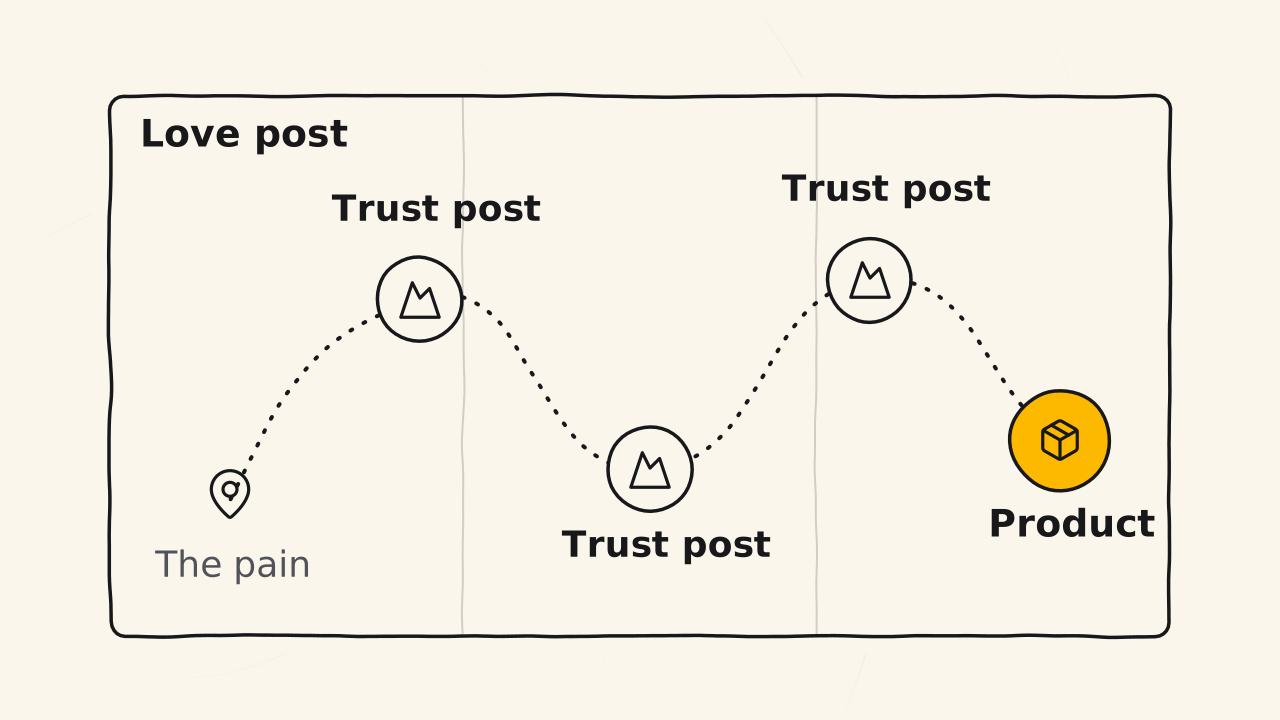
Love is the state where readers already have a reason to trust and need a solution to a lasting pain. A solution of this kind needs a plan, practice and repetition, so it brings no result at once: readers only see the whole road.
Spot a Love post with four questions
A post is a Love post when you can answer “yes” to all four questions:
- Does it cover the whole journey from the problem to the result, instead of stopping at one stretch?
- Does the solution in it need a plan and many days of practice, rather than one sitting?
- Does every Know post and Trust post in the funnel link back to it?
- Would someone who lands on it straight from search or AI, without reading any other post, still understand it fully?
The third and fourth questions test position. The first and second test size: a Trust post clears one obstacle, while a Love post lays out the whole route.
What is in a Love post?
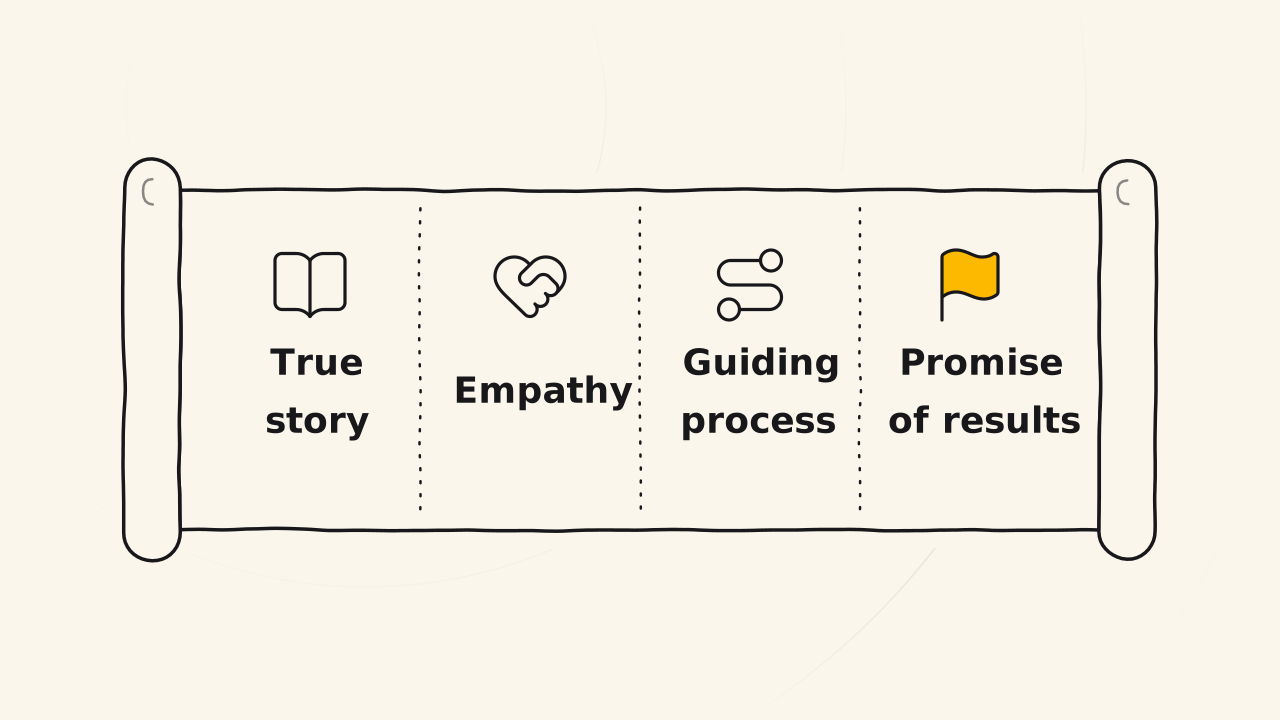
A Love post has four parts, written like a long letter from the founder to someone facing exactly that problem. Each part has a question for checking yourself.
| Part | Content | Self-check question |
|---|---|---|
| A true story | Your own experience and expertise | Is there a detail only someone who lived it would know? |
| Empathy | Naming the pain with what you went through yourself | Do readers nod within the first few lines? |
| A guiding process | The stretches from problem to result, in order | Does each hard stretch have a Trust post to catch it? |
| A promise of results | What readers get when they finish the process | Can you say it in one sentence, and can readers check it? |
The true story and empathy open the post, before it points the way. The story is your own, not borrowed from another customer.
You don’t need many: a few real edges of your own are enough to start the funnel. Empathy comes from having stood exactly where the reader stands now.
The guiding process sets the Love post apart from a Trust post, which crosses only one obstacle. A stretch where readers get stuck on technique, or hesitate to start, is split off into a Trust post of its own.
After the Love post, readers see the whole road but do not yet hold the result. That gap is where the product comes in, as a lever to finish the road faster and not give up halfway.
Which parts of the Love post must you write?
Customers buy the person more than the product, so the parts that carry your mark must be written by you. The table splits the work between you and AI.
| Job in the Love post | You | AI assists |
|---|---|---|
| Story and expertise | Write it fully | No |
| Main solution and underlying philosophy | Decide and write | No |
| Re-arranging your work history | Supply the material | Arrange it |
| Guiding process | Fix the stretches | Tighten it |
| Ordering ideas, illustrations | Review | Make the first version |
Four things only you can supply: the story, the expertise, the main solution and the underlying philosophy. Quick test: if a paragraph could go into someone else’s post without changing a word, it is not yet yours. Everything AI gives you needs you to read it again and confirm it matches what you actually went through.
The sales page after the Love post
Long or short is not the right question for a sales page. Whether buyers buy depends on where they stand on the Know - Trust - Love road when they reach the page, not on word count. The right question is how far the buyer has got to know your brand, and the page only has to fill in what is missing.
Why the page after a funnel is always short
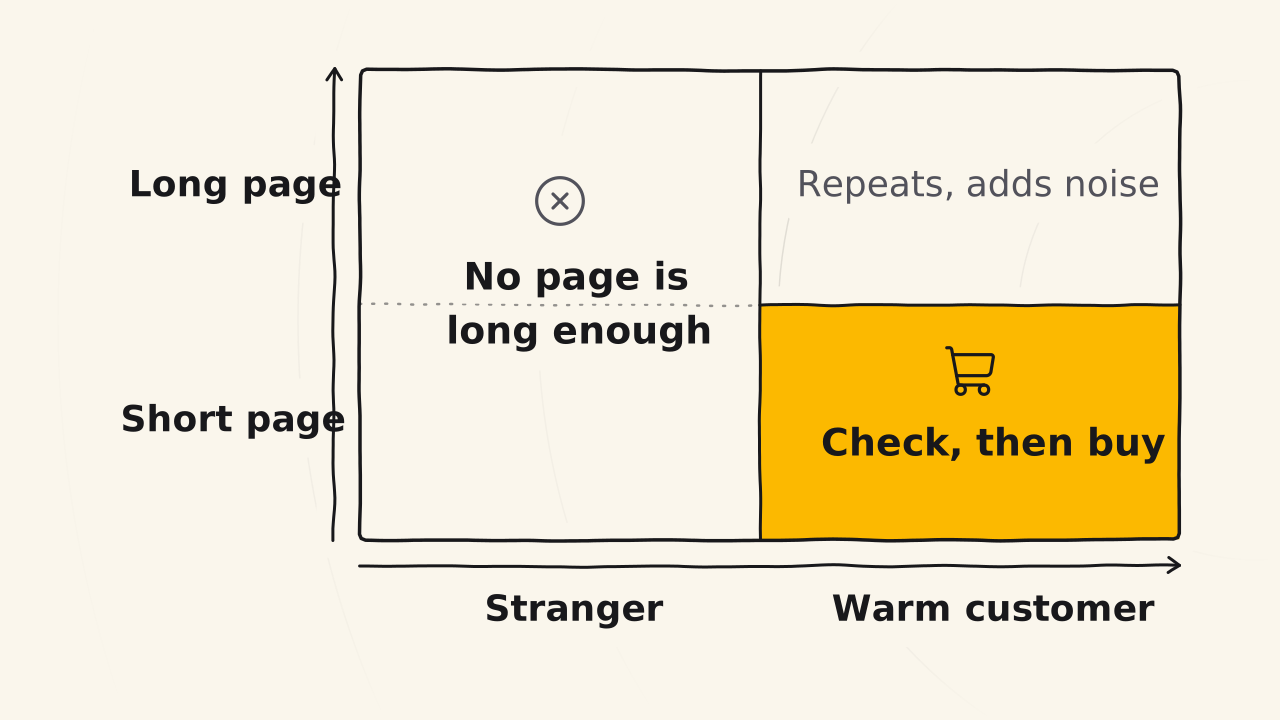
The page after a funnel is short because the hardest part of persuading is done before the reader clicks on the product: they have tested your skills in the Trust post and read the whole journey in the Love post. On the page, they lean toward buying and take one last look to check what they are buying. For them, arguing about features or telling stories of other customers is only repeating yourself, and it adds noise.
The page has only two jobs to do well:
- Say clearly what the product includes and how readers get it.
- Give them a payment button with no friction and no technical hurdle.
The sales page has no Love layer. The part that makes buyers want the product is already in the Love post, so the page keeps only what helps buyers check and pay, each part short:
- The Know layer names the product right and gives its benefits and features in short.
- The Trust layer is feedback and proof from buyers, or from you when you have no buyers yet.
- The price, how to pay and a link back to the Love post.
How does the Love post differ from the sales page?
A sales page is not a Love post. The two are easy to mix up because the Love post ends on that very page.
| Love post | Sales page | |
|---|---|---|
| Where it is | A post of its own, at the bottom of a funnel | The product page the Love post leads to |
| Length | Very long, a full solution | As short as it can be while still complete |
| What it covers | The reader’s pain, the whole road to solve it, and one standout point of the product | Benefits, short features, feedback, proof, the price and how to pay |
| Where the reader is | Looking for a way forward | Wants to buy, needs to check and then pay |
The product sits at the end of the Love post, exactly where readers have seen the whole process but lack the time or tools to finish it. The product:
- Shortens the road.
- Packages the method.
- Provides tools and templates.
- Comes with a person and a route to walk with them, so they do not give up.
If the product is not finished, the Love post leads to the waitlist instead of the sales page. The only condition for starting to write is that you can describe the product concretely, as if you held it in your hands. Your posts and the readers’ feedback become the product’s history before launch day, so when sales open, people already know the product.
Why does a sales page grow long?
A long page is born when you try to win buyers in one or two steps, before you know which stage they are at. You want them to know everything in one place, from the product, the brand and the ecosystem to every feature and every customer who has used it, because readers walk in on guard.
A long page can also be a mistake: you have not compressed the information for the buyer yet. The sign is that each feature makes buyers think one more time, while the product has only one shared benefit to tell. Cuong’s fix: write a short page that sums up those points, and only cut, never add.
Many people think a high-priced product needs a long page to persuade. In Cuong’s words, the opposite is true: people who sell high-priced products well sold low-priced products first, and they always have lines of content that help buyers understand the high-priced product and its benefits. By the time buyers reach the high-priced page, they already understand, so the page is even shorter. A low-priced product has even less reason to be long.
What can a short page do that a long page cannot?
- Sum up for the buyer yourself. When buyers must read everything and then sum it up, they go through two steps, and they are more likely to turn back. The one who has to sum up is you, the seller.
- Faster A/B tests. An A/B test means making two versions of a page to see which one works better. With a long page, each version is another long piece of writing, so testing is hard and slow. With a short page, you can make more versions, faster. This is a practical reason to go short even when buyers have not come through the funnel.
- AI cannot strip out the feeling. When buyers see a long page, they tend to ask AI for a quick summary. AI keeps the facts but drops the story and the lines that touch the pain, while a sales page lives on feeling. With a short page, buyers understand at a glance and do not need AI. In Cuong’s words, for now a short page therefore converts better than a long one.
An example of a Love post that leads to a product
The post “The Know - Trust - Love content funnel: Write less, sell more” on the cuongthach.com blog is the Love post of a funnel of the same name. The last section of the post leads to the Write to Sell product.
| Part | In the post |
|---|---|
| A true story | About 300 posts written for keywords since 2017, with only 11 kept when the website was rebuilt |
| Empathy | Writing one decent post takes a lot of work, and then it has to be deleted: for someone who does not love words, that is torture |
| A guiding process | Build the funnel in four steps from the product’s core, then roll it out in two phases |
| A promise of results | Write less, sell more, and the product is already trusted before launch day |
What do the Love post and the sales page not do?
- The Love post and the sales page do not replace each other. The Love post makes buyers want the product, and the sales page lets them check and pay.
- The Love post does not guide one small obstacle. That is the Trust post’s job.
- A short page does not win strangers or drop the proof. Short means each part is short, not that you skip the Trust layer.