
The core message is the nucleus of a post. It is one line that says which pain your customer is stuck on, what your solution is, and what result it brings them. You make that line out of the ideas you have already poured out, following the definition of a core message.
Do this in the Idea step, after you have poured out all your ideas, usually right after a recording, and before you build the outline. If the ideas aren’t out yet, this page comes later.
What to prepare
- The ideas you poured out. A recording transcript or notes on one topic, the more the better. What you don’t use is saved for a later post.
- Your brand profile, the customer entry. The customer of a post is the person who buys your product, already written in your brand profile. You only pick one group for this post.
- Something you have done yourself. The solution in the message must be yours, so only you have it.
4 Steps to one line
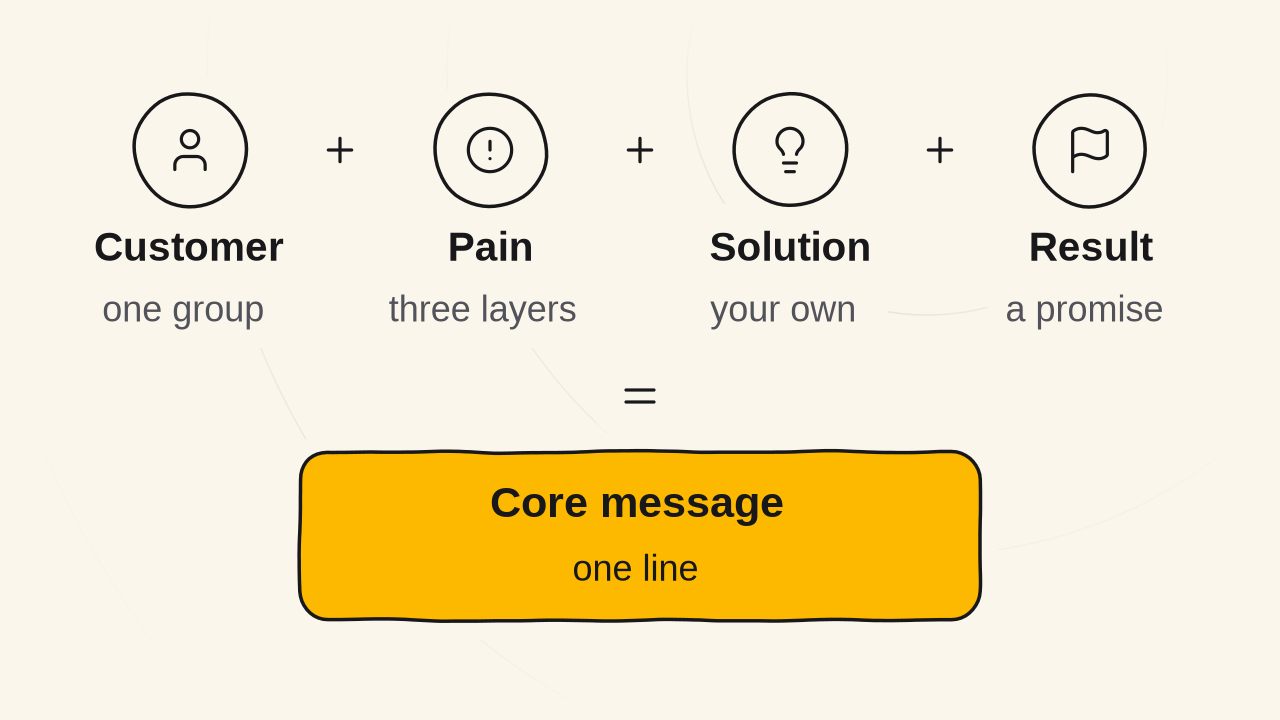
The 4 steps below go from a pile of ideas to one line. The first 3 happen on paper. The last one can lean on AI.
Settle on one customer group
Take the customer from your brand profile and pick one group for this post. A product usually has a main customer and a secondary one. The post serves the main one, and the secondary one gets its own post. Name the group with a clear label, like “retired people who still want to learn” or “eager young people short of money”.
Two groups in one post have different inner pains and no shared root, so that is two posts. After this step, you have one customer label.
Take the pain apart into 3 layers
This is the most important part and the one that takes the most work. Write 3 lines:
- Outer: the symptom you can see, in the words the customer says, like “I can’t write”, sitting down and not one line comes out.
- Inner: how they feel carrying that symptom. You have to get into their head and feel it with them: not good enough, behind colleagues, behind people online.
- Root: the real cause the customer never sees on their own. You see it as the one who went before: no direction, no formula, no template, no way to practice.
A layer you can’t see yet gets a
?, never a guess. After this step, you have the 3 layers of pain of one customer group.Write down the solution and the result
The solution is your own way of solving it at the root, taken from real experience. If it is still rough, keep it rough. For a Know post that only explains a concept, the solution is the way you help readers understand fastest, such as examples, pictures, video, a short post, no lofty terms.
The result is what the customer gets after using the solution, and it is what you promise them. For a Know post, the result you can measure is readers clicking through to your Trust post. After this step, you have all 4 parts of the context.
Squeeze it into one line
Join the last 3 parts of the context into one line that says what the customer is stuck on, which solution you use, what result it brings. No full stop in the middle, no “and” joining two halves, readable in one breath.
AI does this well. Give it all 4 parts as context, ask for one line by the rules above, take a few versions, and pick one. Put the line you picked on top of the outline frame. From here, every idea gets pulled in around it.
The 4 steps show best through a real post.
Example from the Idea - Write - Edit post
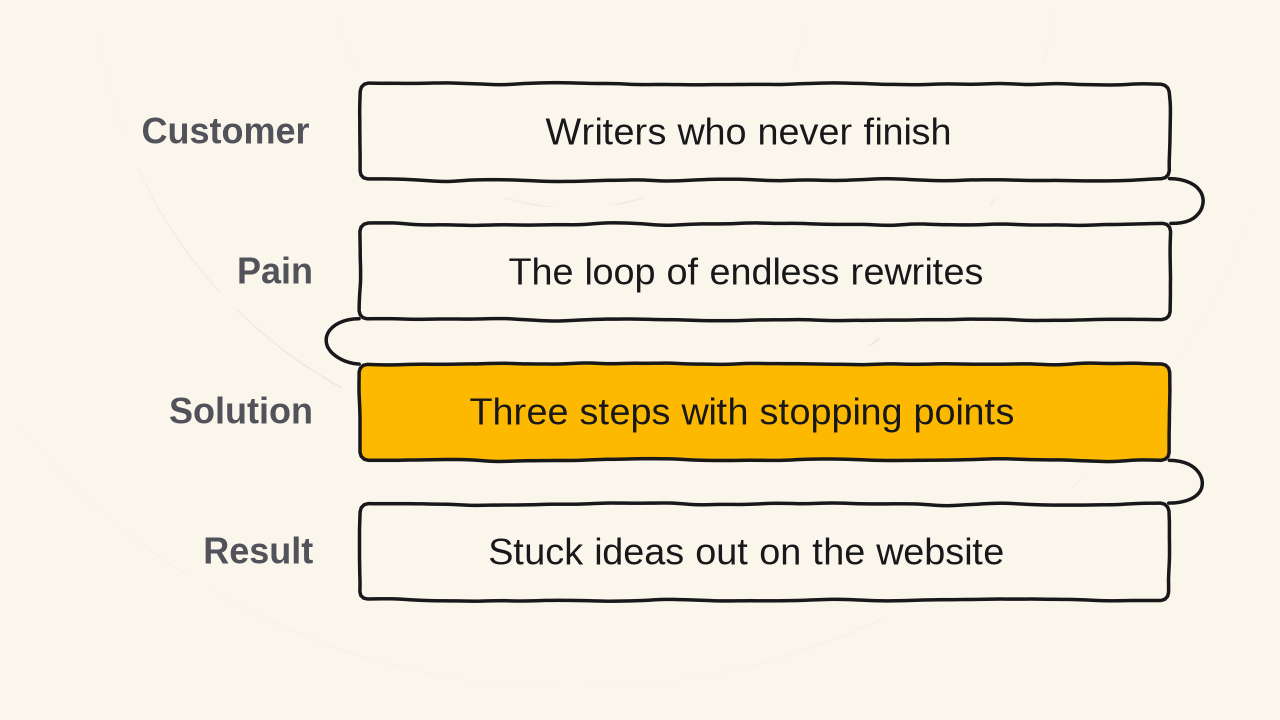
The blog post “The Idea - Write - Edit process: escape the never-ending writing loop” was built from the context below. Every cell comes from that post.
| Part | Answer |
|---|---|
| Customer | The person who “keeps writing and never finishes” a post |
| Outer pain | One post edited three to ten times, three to ten times slower than others |
| Inner pain | Looking back, the post and the title no longer match: “Oh, where did my message go?” |
| Root pain | Doing the idea, the writing and the editing all at once |
| Solution | Three steps with stopping points: a firm script, a free-flowing draft with no judging, an edit that only trims spare words |
| Result | Ideas that sat in storage too long get out onto the website |
| Title | Escape the never-ending writing loop: the outer pain, in the customer’s words |
| Core message | Three stages with stopping points get the stuck ideas of a writer who never finishes out onto the website |
The post’s description still keeps the long sentence with an “and” joining two results. The message line in the table keeps only the last result, because “escape the loop” already sits in the title. With the line in hand, you check it with 4 questions.
4 Questions to check
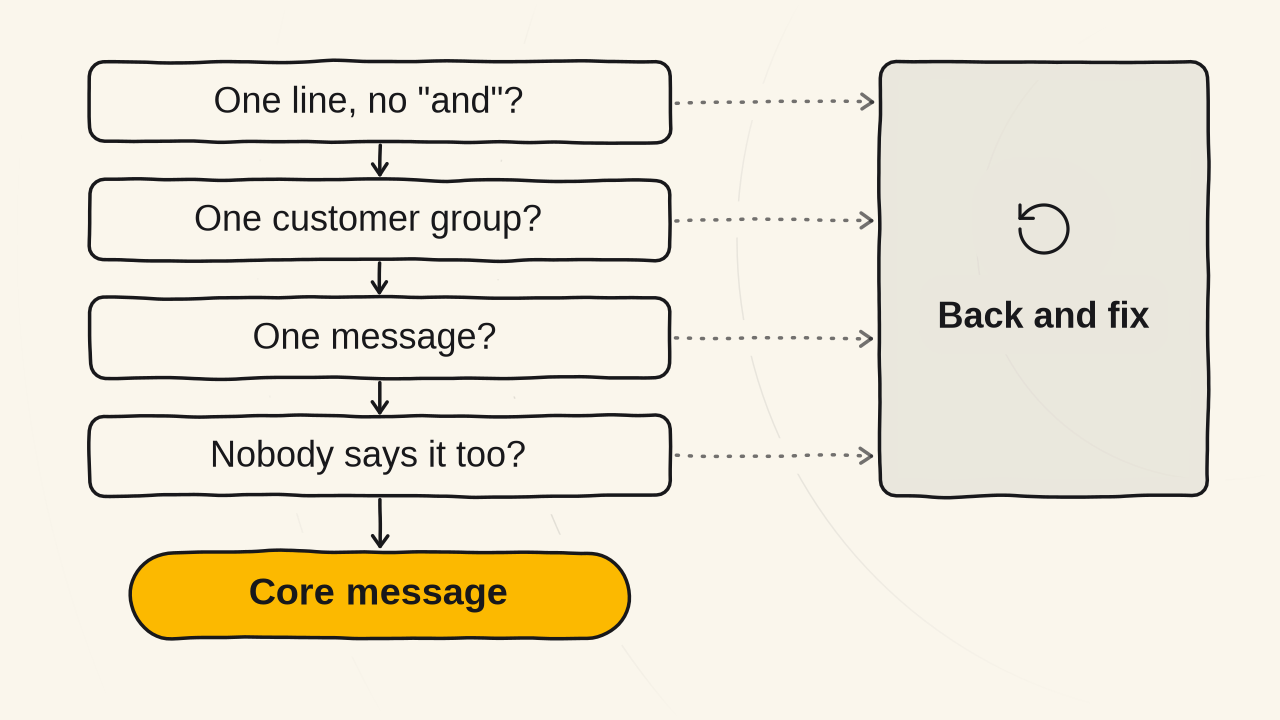
Read the line you just wrote and ask 4 things. Each “no” has its own fix.
- One line, with no “and”? If you have to join two halves with “and” or break them with a full stop, the post carries two topics. Cut back to one half, or admit it is two posts.
- One customer group? If the line talks to two groups, keep the main customer. The other group gets another post.
- One message? If there are two, pick one and split the other off. Where you write it is up to you.
- Has nobody said this exact line? If you sound like someone else, you lack your own mark or you read theirs first. Change the wording to your own. One matching sentence does no harm, unless that sentence decides the whole idea.
When all 4 pass, the line is the core message of the post, and the title and the opening come out of it.
Once you have the line
- The title names the outer pain in the customer’s words. Often the title is the core message itself.
- The opening promises the result from the root cause, says a little about the solution, and names the customer and their pain.
- The storytelling after the opening sits at the inner pain, through your own story, and promises nothing more.
- The outline pulls the ideas you poured out in around the line. An idea that serves the line only halfway is one you think through until it is whole: take 10 of 30 ideas and find 11 and 12 missing, then add exactly those two.
Beyond the title, never paste the message line into the post word for word. The body says the pain, the solution and the result in full. When the line won’t come, the cause is usually one of 4 common snags.
When it doesn’t work
Each snag has its own fix.
A long line that needs “and”
The post carries two topics, or the result isn’t clear so you keep stuffing more in. Keep one half and save the other.
No solution of your own
Common in Know posts. The solution of an explaining post is the way you help readers understand fastest, so it lives in your examples, your pictures and the way you rebuild the problem, not in a new formula.
Readers don’t nod
You picked the wrong customer group, or the inner pain belongs to another group. Older people with money don’t think like students. Go back to the customer step.
The message loses its value
The solution is outdated, or the problem is too big to solve. Put the post away. A different message is a different problem and a different solution, so a completely different post.
Frequently asked questions
After. The recording is when you put every idea on the table, and the recording confirms the message. Before you record, you only need a rough sense of what problem this topic solves for the customer and what the result is. With the topic already in your head, talking is easy, and there is no fear of drifting.
Give it all 4 parts as context, namely customer, pain, solution, result. AI uses that context to squeeze a sharp line, no “and”, no full stop, gives you a few versions, and you pick. Paste the whole recording with no context and you get back lines that sound like ads.
Yes. There is no absolute right or wrong solution, only one that fits and works in a given situation. Rough or roundabout, it is your real lesson. Readers value a real journey and real experience over a perfect but hollow result.
No. A Truth vault page needs truth. The core message is the soul of a blog post and of every sales page. It decides whether people want to read, and it leads customers to see what problem the product solves and with what result.
Related pages
- It does not explain what a core message is: see Core message.
- It does not show how to filter ideas into an outline: see Outline.
- It does not show how to record so the ideas come out: see Record by questions.