
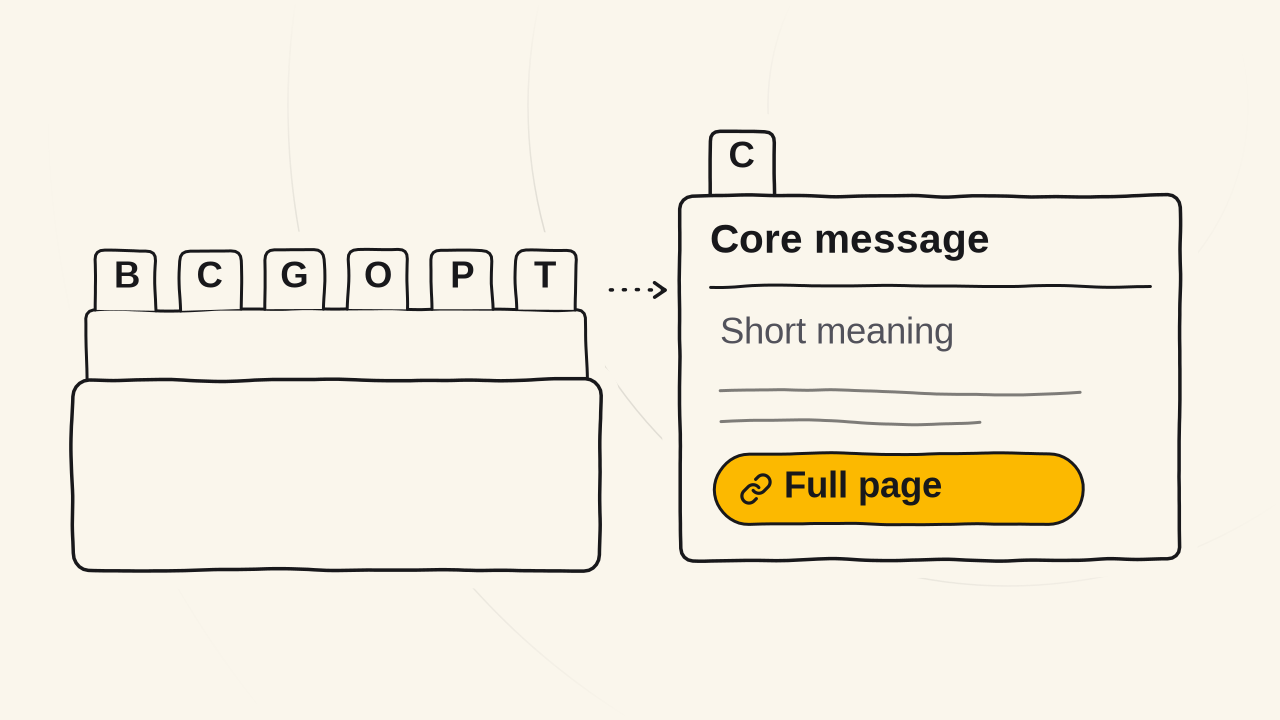
The key terms these docs use again and again, in alphabetical order. Each has a short meaning and the page that explains it more. How to write these names is set out in Trademark.
Brand profile
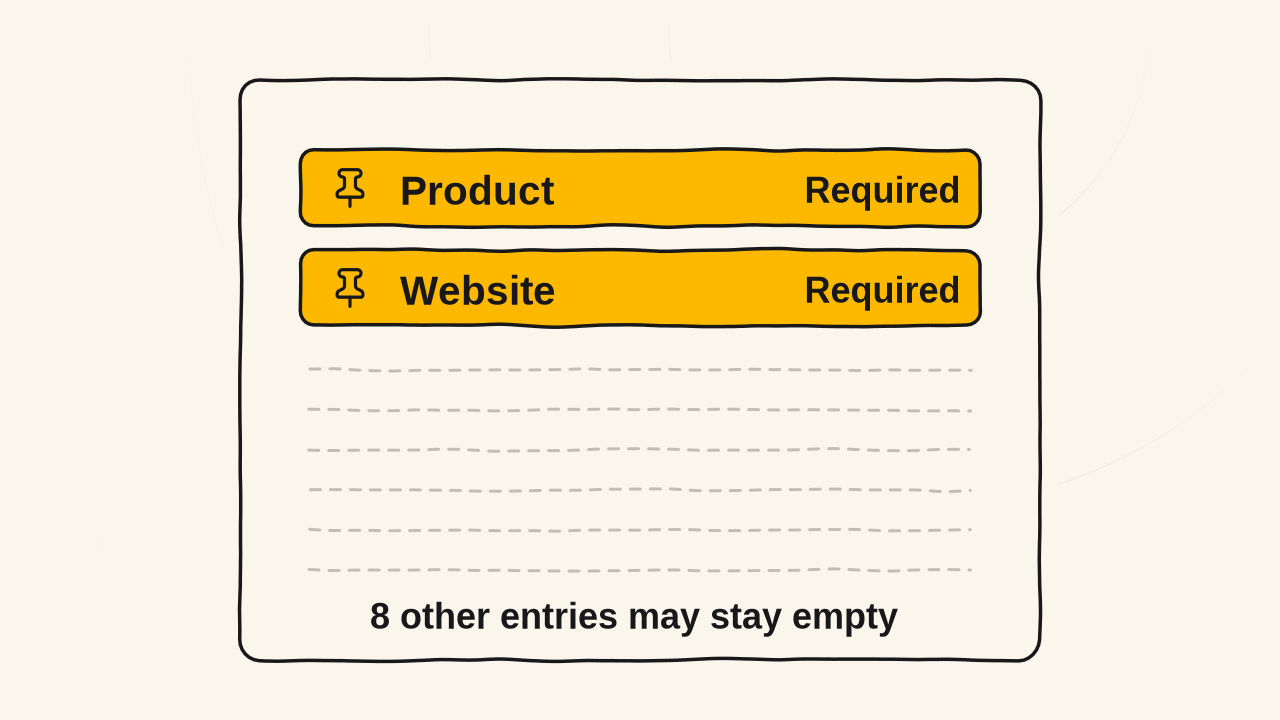
One file of data about one brand, with 10 entries, 2 of them required. The content system needs it to run for you. See Brand profile.
The method of the Content system is the same for every brand, and the profile supplies the brand’s own data that method runs on. The profile has 2 required entries, Product and Website. Without a product, the funnel has no destination. Without a website, a post has nowhere to be published.
Writers and AI agents read the profile before any content work. When an entry is empty, they ask the person behind the brand instead of filling it in. The profile’s Docs entry leads to the Truth vault.
Content funnel
A way to join every post into one line, from Know to Trust, Trust to Love, then Love to the product. A post that is not on this line stays a draft. See The Know - Trust - Love content funnel.
The Content funnel is the method that applies the Know - Trust - Love philosophy to posts, with 3 post types:
- Know post: the most numerous.
- Trust post: fewer than Know posts.
- Love post: a single post that takes up to 80% of the effort.
The funnel is the strategy of content work, which means the funnel decides which post is worth writing and where each post leads. Without a funnel, posts get read but orders do not grow with them. Writing and publishing each post belongs to the Publishing process.
Core message
The nucleus of a post, one line with no “and” in it that says which pain your customer is stuck in, what your solution is and what result it brings them. Each post carries only one core message, set after all the ideas are out. See Core message.
A core message is drawn from the context of the post and has 4 parts:
- Customer.
- Pain.
- Solution.
- Result.
The part that takes the most work is analysing the pain clearly. Each core message is for one customer group. When a post has 2 messages, you pick one and split the other into another post. From the moment the core message is set until publishing, the title, the opening and the outline all follow this line.
Guiding questions
A set of questions written for your topic and post type, read aloud and answered while you record in the Idea step. They keep you on point and stop you from repeating yourself. See Record to questions.
Each post type has its own set of questions. The set used for the cuongthach.com blog has about 16 questions for a Know post, 26 for a Trust post and 36 for a Love post. These numbers are not a standard.
Recording for a post means answering each question in turn, not keeping a diary. When you cannot answer a question yet, move to the next one. The answers are the raw material for the outline.
Outline
The script of the post and what the Idea step makes, namely the post title and the big ideas with titles, usually 6 to 8, picked by your core message. Once locked, it is not changed. See Outline.
An outline is built through 3 tasks:
- List every idea.
- Filter the ideas by the core message.
- Order and lock them.
Each big idea has a short, direct title with no metaphor, because both readers and AI scan these titles. An outline has no opening. Locking means the titles of the big ideas no longer change, because changing a few words in a title changes the idea of the part below it.
Publishing process
3 steps to publish a post, namely lock the outline, write in one go, then only cut. Each step has its own stopping point. See The Idea - Write - Edit process.
Each step makes one product:
- Idea: a locked outline.
- Write: a rough draft, the longest version of the post.
- Edit: a finished post, ready to publish.
The next step starts only once the product of the step before exists. Thanks to the stopping points, a call in the middle leaves only one step unfinished and does not lose the direction of the whole post. In the Idea step, every idea is chosen by the core message.
Truth vault
Public docs that hold what a brand has really done, in 3 parts, namely Source of evidence, Brand footprint and Entity docs. See Truth vault.
The Truth vault is one of the 3 parts of the Content system, with the Content funnel and the Idea - Write - Edit process. The vault holds only what was really done and has been verified. Every post and every sales page takes its facts from the vault. AI also has one right source to rely on when it answers about the brand.
Without the vault, each post has to be written again from memory. At first the vault is empty, so building it is slow. Later, each post is faster because the facts are already there.
Related pages
- Not how to create a core message: see Create a core message.
- Not a template to fill in a brand profile: see Brand profile template.
- Not the prompt for AI to write guiding questions: see AI and sample prompts.