
This split suits people who run a business alone and have a few free hours a week, but not in one block, for example 30 minutes here, 1 hour there, 2 hours another time. If you do not know yet what the three steps do, read The Idea - Write - Edit publishing process first.
What to prepare
- The three steps of the process. You know the Idea step makes an outline, the Write step makes a draft, and the Edit step makes a finished post. The free-slot plan splits the work along these three steps.
- A topic for your next post, taken from your funnel plan. You do not pick a topic while you are counting minutes.
- One place to keep what each step makes, named after the post: a folder or a notes page. Next time you open it, you see right away which step the post is on.
- A phone to record on, for times when the slot for the Write step is too short to type.
Split a post across free slots
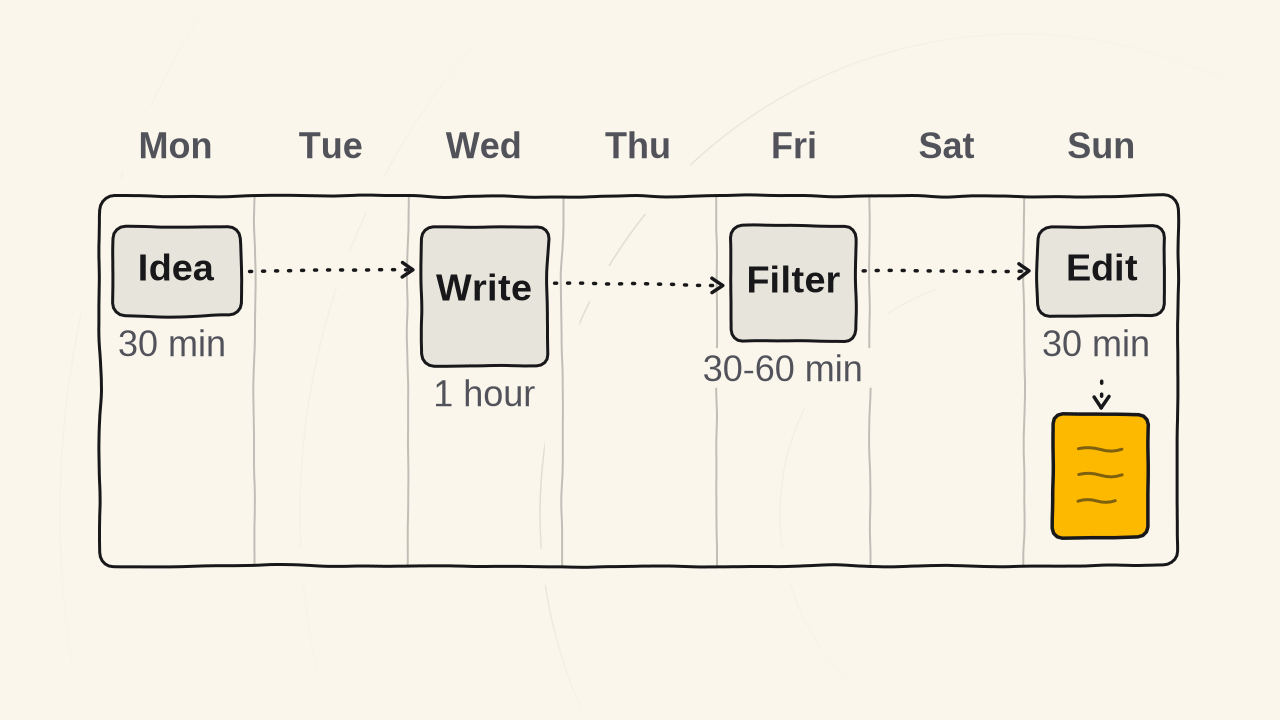
Without a process, a post needs one long, unbroken block of time to do from start to finish. With a process, each step has its own stopping point, so scattered bits of time still produce a post.
Measure your time budget
The old way of writing cannot be measured, because some days you think for over an hour, write for two more, then edit here and there for another two. Three separate steps can be measured.
Write down each slot in the week when you can sit still, then add them up. With talk to write, one post takes half an hour to plan, one hour to record and about 30 minutes to edit. Once you know your hours, you can work out the number of posts. For 30 posts a month, write one post a day. For 90 posts, write three posts a day, and a fourth post in one day is overtime.
When this step is done, you know how many posts you can publish this week.
Give each step its own slot
Match each step to a slot that fits how long that step takes, so no step gets cut off halfway. The table below is one way to measure it.
Slot Step What you hold when it is done About 30 minutes Idea: plan and prepare the guiding questions The set of guiding questions About 1 hour Idea and Write: record from the guiding questions A transcript to filter ideas from, which is also the draft 30 minutes to 1 hour Idea: filter the ideas and polish the outline A locked outline About 30 minutes Edit A finished post If you only have 2 hours a day, spend half an hour to plan, one hour to record, and the last half hour goes as far as it goes. Finish the rest the next day, because you know which step the post is on.
When this step is done, every slot in your calendar has the name of one step and the name of what it makes.
Finish one step, then pack it up
The stopping point at the end of each step is where you can rest without losing the thread. In each slot, finish exactly one step, put what it made in the place you prepared. The next slot starts with that very thing. The Write step starts from the locked outline, and the Edit step starts from the rough draft.
When your hours are tight, you have to make time for recording and practice recording, even if you write better than you talk, because your voice puts out words many times faster than typing.
When this step is done, you can open the old work and carry on at once, without recalling the whole process.
Signs the plan works
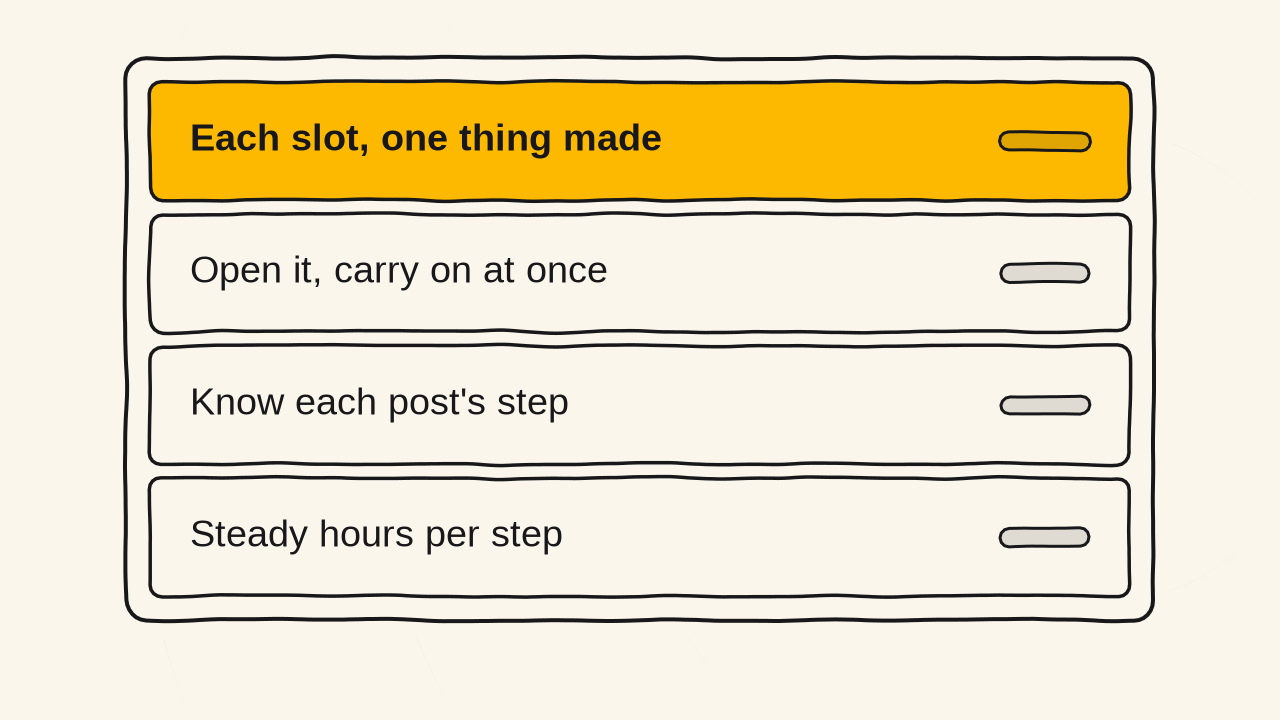
The plan works when all four things below are true:
- Each slot ends with something made. If one step runs across several slots, split it smaller or give it the longest slot in the week.
- When you open the old work, you can carry on at once. If you have to reread from the start to remember, name what you save more clearly, after both the post and the step, before you pack up.
- You know which step each post is on. If you do not, open the place where you keep your work: the latest thing a post made tells you which step it is on.
- The hours for each step stay steady from post to post. If a step is fast one time and slow the next, that is the step to practice on its own.
If the plan yields no posts
When the plan yields no posts, find where the hours are getting stuck before you look for more of them.
One step drags on
It is usually the Idea step. The outline takes four or five days while writing and editing are still fast. That is a sign you stumble on the Idea step, not that you lack time. Practice that step on its own with Practice Idea - Write - Edit to get faster with every post.
Chasing deadlines
When there is no free time left to prepare the next post, every post runs on a deadline. You do not have time to research, you put out a post you are not happy with yourself, and then you lose heart and burn out. Once you measure your hours, you can see your spare time. Use that spare time to prepare the next post, with half an hour to plan and prepare the guiding questions before you record.
Missing pictures or video
Publish the post first, and add screenshots or a video later. Once a post is published, you are responsible for finishing it. A post kept on your computer until every picture is ready easily becomes a reason to put things off.
Related pages
- It does not show how to find where you are stuck: see Find where you’re stuck.
- It does not show how to write a draft in one go: see Write a draft.
- It does not show how to edit a draft and keep the outline: see Edit the draft.