
The Know post rests on one information question, “What is this? Why?”, names the reader’s problem, and gives your own point of view.
A post that explains something belongs to the Know stage. A post that shows how to do a job belongs to the TRUST stage. If you are not sure which stage a post belongs to, sort it into the right funnel stage before you write.
Role in the funnel
The Know post is the door into the funnel. It names the problem for people who do not know you yet, then sends them away with one small discovery.
Three jobs it does
A Know post does three jobs. Check them with three yes/no questions once it is written:
- Does a reader who has never heard of you see their own problem named in the first paragraph?
- Is there a point of view of your own in the post, beyond the information?
- Does the end of the post offer a way into the Trust post on the same topic?
Any “no” means the post has not finished that job, which is naming the problem, giving a point of view, or leading the reader on.
A Know post travels easily through online communities and is usually the kind that gets shared outside the most, so it takes on the job of inviting newcomers into the funnel.
One small discovery
The goal of a Know post is a small discovery, not a decision. Readers leave with one thing they just understood and see their problem called by its right name, with no sales pitch in their heads.
Even after they understand, readers still have doubts, and that doubt is not the Know post’s job. The Trust post settles it, when readers make a result themselves. So at this goal, a Know post only has to name the problem and spark curiosity.
What holds it up
Know posts are the most numerous in the funnel, because each one adds one more touchpoint. They are also the hardest kind to get right, because a Know post competes on information.
On plain information, AI is faster and more complete than the writer. What AI lacks is a human point of view, which covers the path you have walked and the work you really did. A Know post holds up when it has that part, and it is also the part readers are willing to pay for, not the information.
Three things it needs
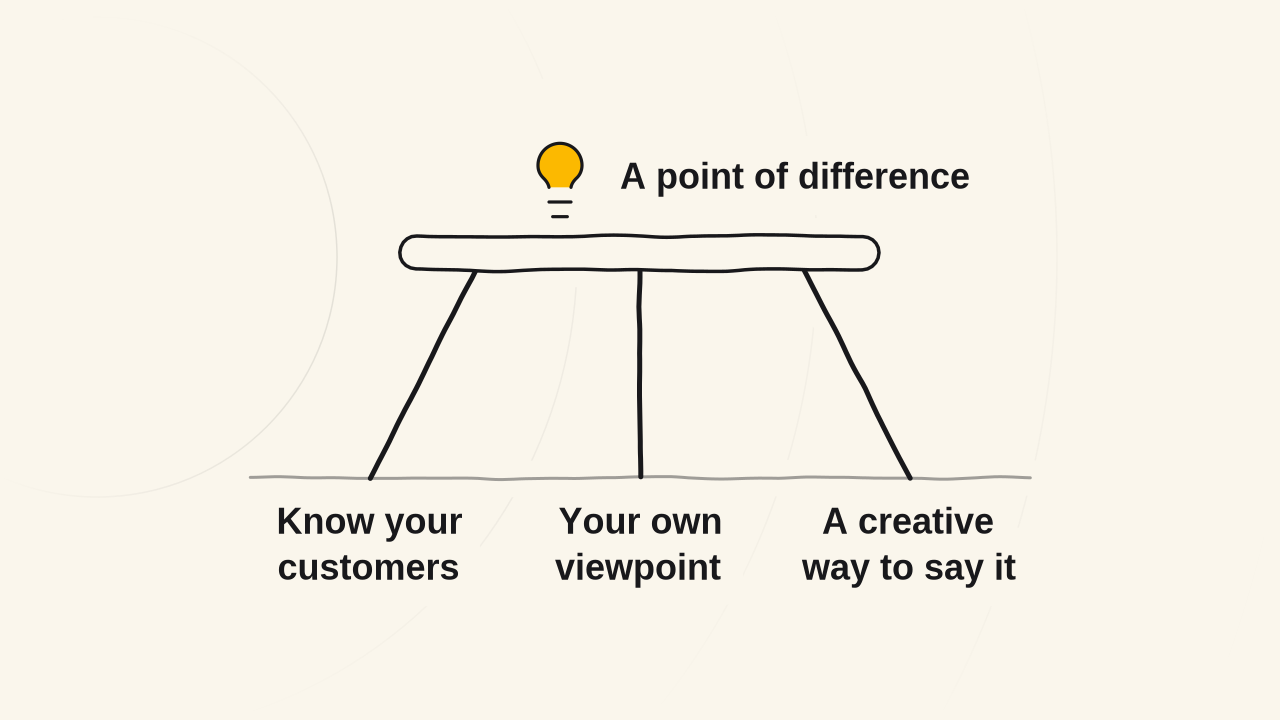
| What it needs | Check with a question | If missing, fix by |
|---|---|---|
| Knowing your customer | Does the post answer what readers actually ask, in their words? | Collect each common question, reread the product through a newcomer’s eyes |
| An original angle | Is there one line of opinion that comes from work you did? | Rewrite the point of view |
| A creative way of saying it | Is there a place where the post says a familiar thing in a way only you would? | Change the way in, the example or the image |
With all three, readers see one thing that sets you apart and are curious enough to read on.
When a post turns ordinary
Without these three, the Know post looks like every other post on the topic. Signs:
- Readers ask AI instead of reading on.
- No one clicks through to the Trust post.
- The posts behind it have no readers.
Readers also spot the marks of AI content and judge the brand behind it. The fix is to go back to the three things in the table.
Topics and titles
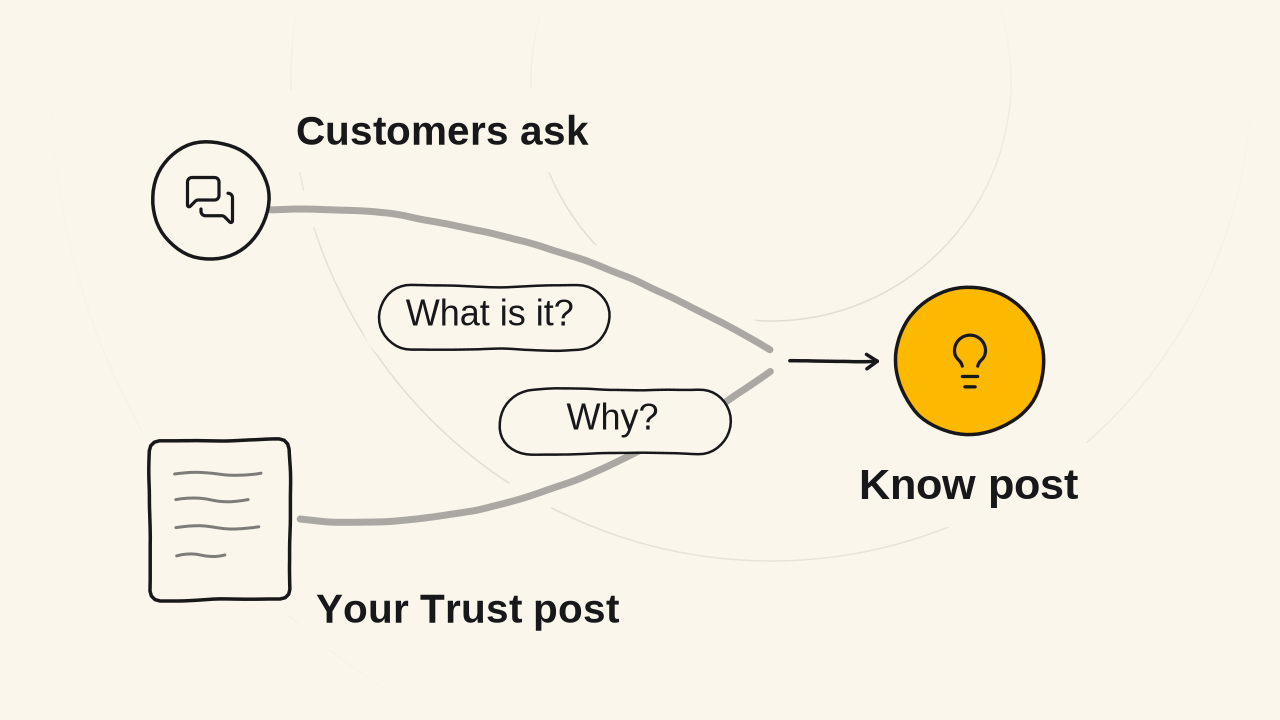
A Know post topic has two sources:
- Common questions that come up when you talk to customers.
- Your own Trust post.
To take them from a Trust post, while you write the how-to, each time you meet a question like “what is this”, “why this step”, “why does this step come before that one”, note it and split it off as its own post. The Trust post keeps only the action, and the posts split off are Know posts.
The second source goes with building the funnel backwards (Love, then Trust, then Know split off from Trust), so each Know post already has a Trust post to lead to.
A natural question
A Know post title is a natural, short question. The site’s writing standard, MocSEO, sets the length at about 50 characters. A real example is “Is a long or short sales page better in the age of AI?”.
That question is what the reader asks themselves, in their own words. The “why” does not have to sit in the title. It lives in the answer inside the post.
Vary sentence shape
The Know posts of one funnel don’t repeat one sentence shape. Don’t start every title with “Why”. Mix the shapes:
- “Should you …?”
- “Does … help …?”
- “How much …?”
- “What is …?”
- “When …?”
The two Know posts running on cuongthach.com are “Is a long or short sales page better in the age of AI?” and “Write hands-free, stop procrastinating with Talk to write”, which have two different shapes.
Example of a Know post
The post Write hands-free, stop procrastinating with “Talk to write” is a Know post of the Idea - Write - Edit process. The table lists its parts.
| Part | In the post |
|---|---|
| Title | A 48-character question that does not open with “Why” |
| The problem it names | Putting off writing |
| Point of view | People balk right at the starting point, not for lack of effort |
| Description | Record with a set of guiding questions, then edit with AI into a post in 2 hours |
| Body | Five H2s, each one a reader’s question, from “is it laziness” to “how much time does it save” |
| Relationship | Paired with the Trust post “How to turn a recording into a fully published post”, and the two lead to each other |
| End of the post | Invites readers to the Trust post to make their first post |
Read this example with the three check questions of a Know post:
- The problem is named right in the title.
- The point of view sits in the body, where the post changes what readers think causes the delay.
- The way into the Trust post comes at the end.
Because the two posts are a pair, readers who enter by either one have a path to the other. The Know post keeps the “what is it, why” part of Talk to write, and the Trust post keeps the doing part.
Related pages
- A Know post doesn’t guide step by step. That is the job of the Trust stage.
- A Know post doesn’t sell the product. That is the job of the Love post.
- A Know post doesn’t gather general information, because that kind of post loses to AI at once.