
Run ads or write your own posts?
Ads bring you to customers. Content lets customers find their way to you. Both can lead to orders. The difference is who takes the first step.
Running ads wins on speed. You switch on a campaign today, and your post or video shows up the same day in front of people the platform thinks are likely buyers. A post you write yourself needs time to be found and to spread on its own.
Writing your own posts with Write to Sell is slower at first, and you have to put in the work. In return, every post lives on your website and is still there when you stop paying.
What do you buy each time you pay?
Both ways cost you something. The question is what you get for it.
Running ads sells you visibility. You pay for a banner, a post or a video to appear in front of the people you chose, charged by impressions or by interactions. Platforms like Google, Facebook, X and YouTube filter the audience for you, and how well each one filters differs.
What ads do not promise is orders. You pay for views and clicks, and whether those viewers buy is another matter. When many people run ads in the same niche, each click usually costs more, because the result of every auction depends on the competition at that moment, according to Google Ads’ explanation of its auction (opens in a new tab).
Write to Sell pays with time and effort, not per view. Publishing a post on your website costs almost nothing more. The price is that a post needs time to be found, and nobody promises it will be read.
Do customers see you or find you?
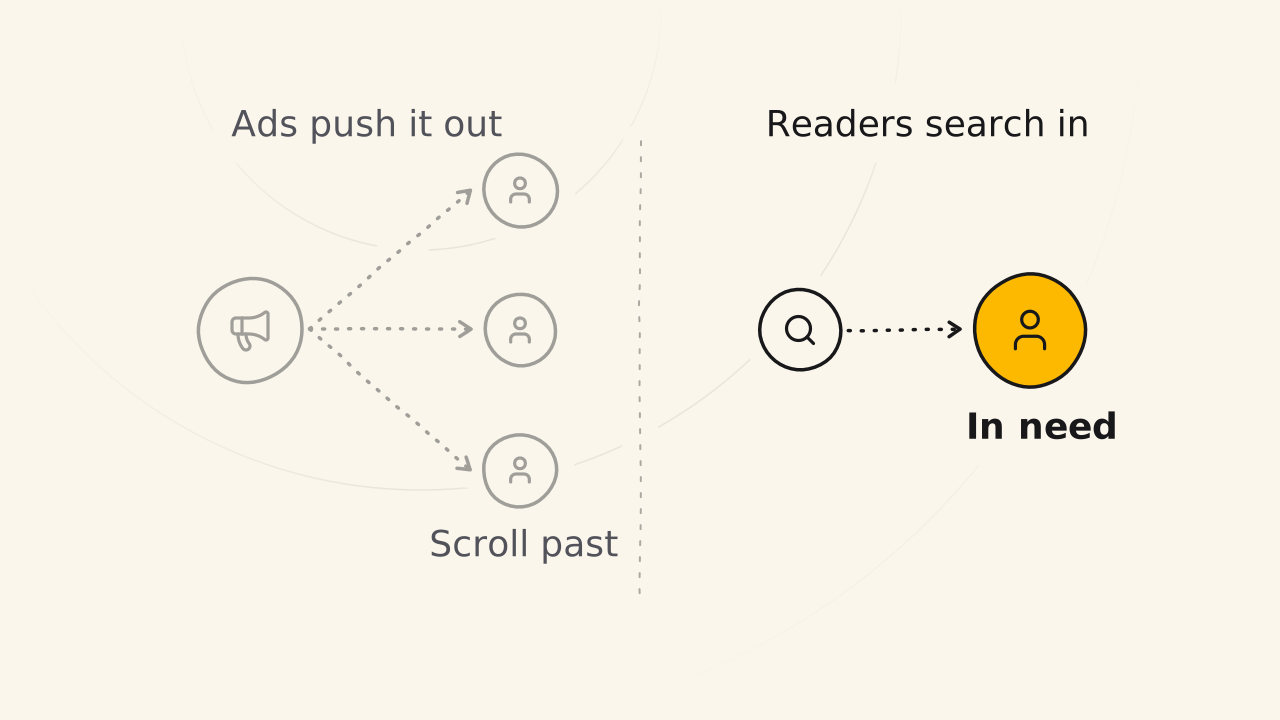
Someone who sees an ad and someone who searches for a post are in two different states.
Running ads puts your content in front of the right group. Some people truly need it and click to buy. But many see the ad when they have no need yet, have already bought, or were targeted by mistake. They scroll past, and someone who already bought but keeps seeing the ad easily turns annoyed.
People also avoid ads more than you might think. According to a GWI survey (opens in a new tab), nearly 1 in 3 consumers worldwide use an ad blocker.
Write to Sell meets people who have a real problem. When they hit a problem, they ask AI, search Google, and move from one post to the next guide until it is solved. The price is that only people who are searching meet you, so you reach fewer people than ads do.
The two groups of customers also ask different things:
- Customers from ads often ask the price first, or message you to claim the gift in the ad. When they ask the price, many already mean to buy.
- Customers who read your posts usually message to get something clear: more about the product, about a tool you mentioned, or simply to connect with you.
Ads off, where do customers go?
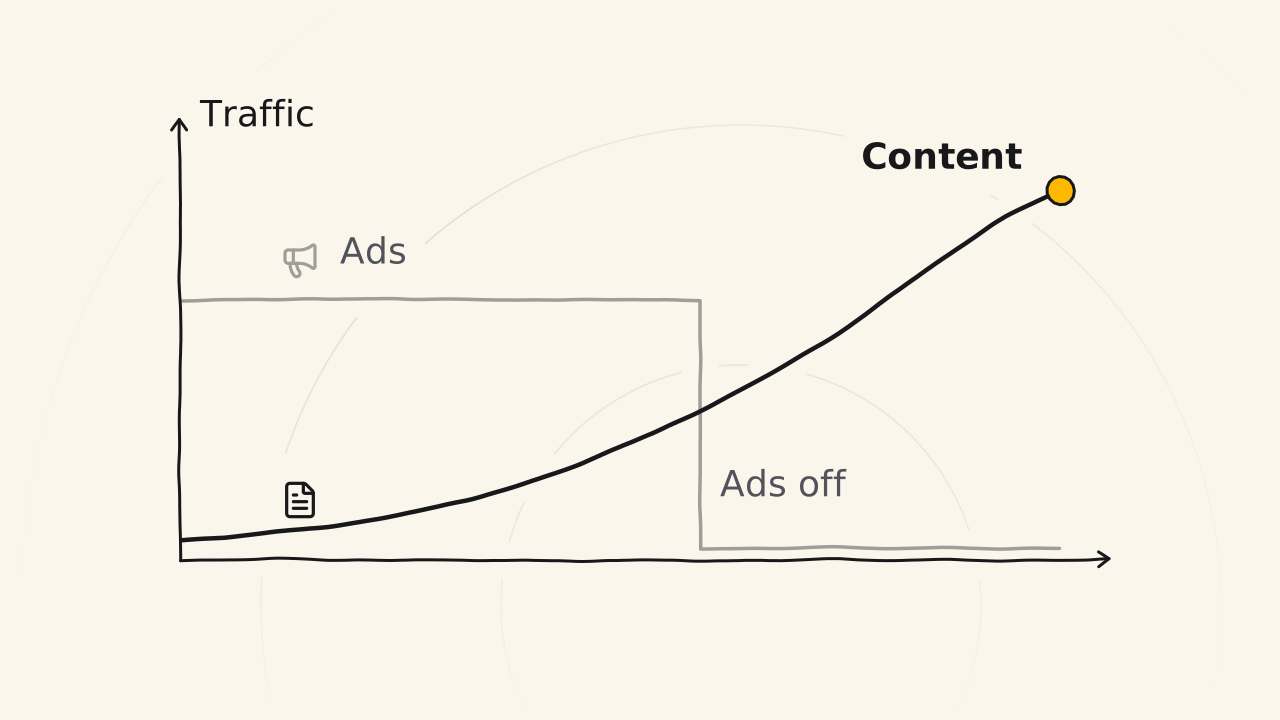
Every ad budget runs out at some point. The question is who still finds you then.
Running ads brings traffic while the campaign runs. For a site with only a sales page, turning the ads off stops the traffic too. If the campaign collected emails or a customer list, that part stays with you.
Write to Sell builds a content asset on your website. When the ads are off, your posts still bring people who search. There are two kinds of posts:
- Seasonal or trend posts. Their readers fade once you stop writing for a long time and fall behind the trend.
- Posts that solve a problem. People keep reading them until the problem is gone, or the fix has been replaced.
The price is that you have to keep writing. Stop for too long and the trend posts grow old.
Who sets the rules?
Ads and posts both live on someone else’s platform, but how much you depend on it differs.
Running ads follows the platform’s policies. A sensitive product, or just an ad that gets flagged or reported, can get an account restricted.
An account can be suspended for policy violations, and you can submit an appeal, according to Google Ads’ guide to account suspensions (opens in a new tab). To avoid it, you have to read the policies closely and know your product well enough to see what is sensitive.
The rules also change. Since 2021, Apple has made iPhone apps ask permission before tracking people across other companies’ apps and websites, and ads became harder to aim. Meta estimated this change would cut its 2022 revenue by about $10 billion, according to Meta’s Q4 2021 earnings call (opens in a new tab).
Write to Sell also depends on Google, because any website that wants to be found has to be indexed by Google. But your posts sit on your own site: nobody locks an account or takes a post down over an ad policy. The price is that Google still decides how high a post ranks, and ranking does not come right away.
Where do buyers come to understand the product?
People buy only once they understand. The question is where they come to understand.
Running ads touches the viewer’s pain in a few lines or a few seconds. A simple product can be mostly understood through one good ad. A more complex product needs a very polished ad, and the viewer still clicks through to the site to check.
Viewers leave fast when the site cannot hold them:
- The site has too little content to understand the product
- The layout is unclear, or slow on a phone
- The site does not match the ad: a beautiful ad and a plain site, or a price that does not match the ad’s promise
Write to Sell gives buyers a place to check: guides, the story of the person who made the product, posts that keep being updated. A site with fresh content shows that the maker is serious, the product is looked after, and the expertise runs deep. The price is that readers need time to read before they buy, so orders do not come right away.
What turns an ad into an order?
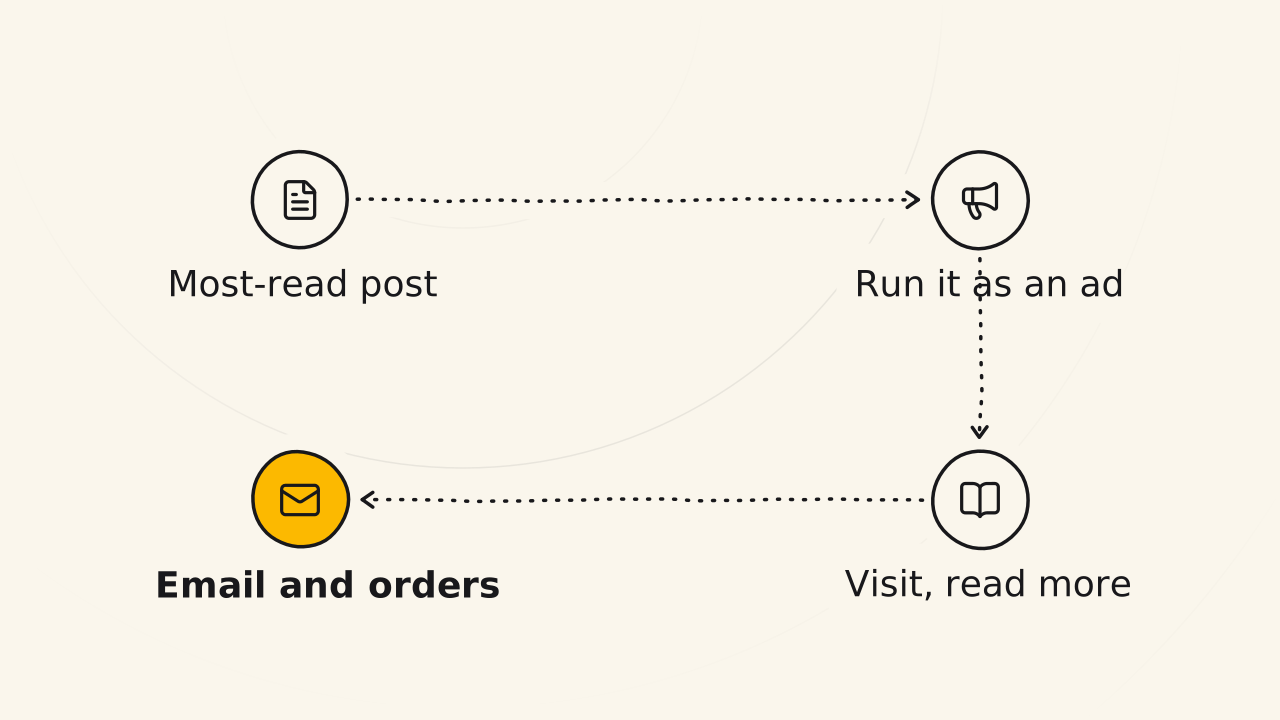
An ad brings people in, but what turns a click into an order is what they find when they arrive. So ads and posts do not force you to pick one, and they work best together:
- Content as the ground under ads. People who click an ad land on your site, read your posts and trust you more, so the ad converts better.
- Advertise posts already proven. The post with the most readers that also sells is the one that touches customers most. Running that very post as an ad is also a way to make Repurposed content, instead of running on guesswork.
- Ads collect emails, then email sells. A campaign that gives a gift for an email address leaves you a list to market to later at a lower cost.
- Ads for the peak season, content for the whole year. You run ads in the shopping season or around events, and when the ads stop, content keeps customers finding you.
Where do orders come from?
To know which way brings in revenue, you need to know where each customer comes from.
Running ads comes with a measure built in, because the ad tool counts views and clicks to charge you. Add tracking parameters (UTM) to the ad’s link, and you know which campaign and platform each visitor came from, according to Google Analytics’ guide to campaign links (opens in a new tab).
Write to Sell measures with your website’s analytics tool, such as Google Analytics: visitors from organic search, and which posts are read the most. Posts usually have no buy button, because in the Know - Trust - Love Content funnel the buy button sits on the sales page that the Love post leads to. The price is that it is hard to tie one order to one post.
Orders now or customers for years?
Each way fits a situation, depending on whether you need money now or a base that lasts.
Running ads fits when you need cash flow now, already know how to run ads, and the cost is lower than the revenue. Then keep running them. But nothing promises revenue right away. When competitors pour into the niche, or the niche loses interest, the cost can grow past the revenue.
Write to Sell fits when you want customers to come back for years and a brand that stands firm. It is slow and hard at first, but publishing costs almost nothing, and people who find you often want to follow you or sign up for your emails.
Which asset stays with you?
Over the long run, what counts is not only revenue, but what is left when you stop.
Running ads leaves an email list or a customer list, if the campaign collected one. When you turn the ads off for good, that list stops at its last number and grows no more.
Write to Sell leaves a content asset: your posts keep bringing visitors, emails and revenue. Content built around your brand becomes a Brand asset.
The relationship with customers differs too. Running ads is like carrying flyers to every door and asking people to listen. Customers who find you on their own feel they have discovered you: they trust you more, the bond is closer to a friendship, and they often tell others about you.
Short videos are now very easy to make, and AI makes them even faster. What sets you apart is being one of a kind, and that comes from your own content. Once you have content of your own, you turn that content into videos with your own face, and you stand apart from videos made just to fill a feed.
This way is harder than pressing the button to run an ad, and that work is worth it. The Write to Sell course was built for exactly that: so customers find you on their own, even when you are not paying for every view.
Write to Sell
Own a sales machine built from your own words. Turn your posts into sales, 24/7.
I want to Write to Sell