
Repurposed content is every version made from one blog post to reach another channel: email, a Facebook or X post, a YouTube video, a short video for Shorts and Reels, a podcast, an image. Each version changes only the form, never the ideas of the post.
The blog post is the source
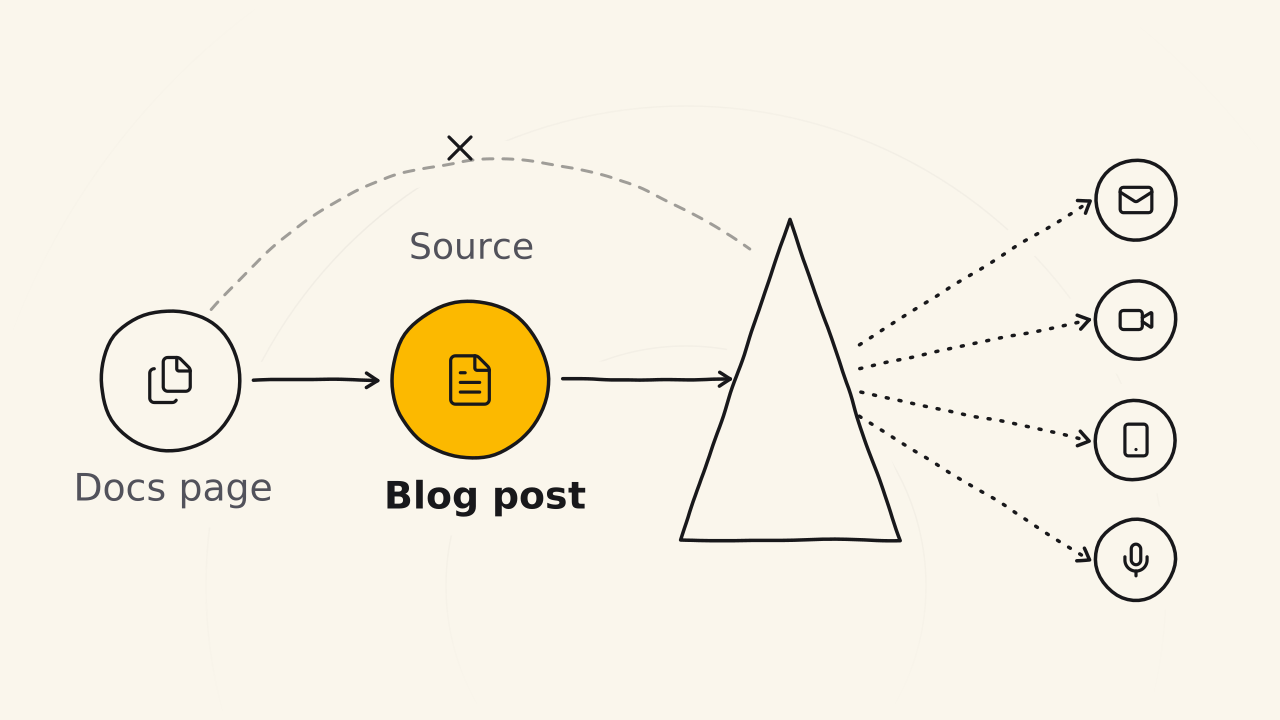
Repurposing starts from the blog post, not from the documentation. In the VOTE strategy, documentation becomes a blog post through derivation, and then the blog post goes everywhere through repurposing.
Docs pages carry no feeling
Taking a documentation page straight into repurposing gives a weak version. Documentation is the source content, and it has no feeling. Add one more cut with no feeling, and you get a post that is completely dry.
A blog post already has feeling, because it runs on the core message. When you repurpose, you only lift that feeling higher: pull out the bright points and add a little feeling to suit the channel.
No new angle
A repurposed version has no new angle, so it is not derivative content. Here you may rework the wording to fit each platform, which is forbidden in a derivative post.
| Derivative content | Repurposed content | |
|---|---|---|
| Source | A documentation page | A blog post |
| What it adds | A new angle, the core message | No new ideas, only a new form |
| Goal | Quality | Reach |
| Changing the wording | No reworking | Adjusted to suit the channel |
Be where your customers are
The goal of repurposing is more presence. A blog post is distributed only on Google, and Google no longer owns the internet: social networks and other formats have taken a share. You need a strategy to cover them.
Some of your customers:
- Like to listen to podcasts
- Need to see things
- Are in a hurry and only watch short videos
- Live in Facebook groups or online communities
People who watch YouTube would rather watch than read.
They are still your customers and still have needs. They don’t know you not because your content is weak, but because your content isn’t there on the platform they use. Each repurposed version brings the same post to one more group of customers.
Keep the idea, change words
A repurposed version keeps the ideas of the blog post exactly. A post has six ideas, you take the three brightest to social media, and those three stay as they are. You never turn an idea around 180 degrees.
A reader sees the post and clicks through to the blog. If social media says one thing and the post says another, they lose trust at once.
The wording can change to suit the group of readers you want to reach. Say your main customers are working adults, and you want to try growing a student audience: the repurposed version rewrites the language for students, and the ideas stay exactly as in the post.
Link each copy to the post
A repurposed version links back to the blog post, not to the documentation. The blog post sits inside the Know - Trust - Love Content funnel, and the funnel is what leads customers to buy.
The blog post, in turn, links to the documentation in the vault. The vault is open documentation that Google has already indexed, which means it has proven its value. A link to your own vault is both an internal link and a source: instead of citing an outside source, you cite an inside source that has been checked.
Let sent copies drift away
When a blog post is edited after publishing, leave the repurposed versions already sent alone. Social posts drift away, and so do emails: few people dig up an email from two or three months ago to read it. Your job is to publish a new post, and the new post pushes the old one down.
Only when an old version carries something too dangerous should you find it and delete it.
The blog post is different: the website is home, so the blog post is updated with the documentation when the documentation changes. Take a Black Friday promotion post from a past season: people still click the link. The post no longer shows the right price, and customers understand that. What matters is that the page on your site shows the current price.
A different idea each time
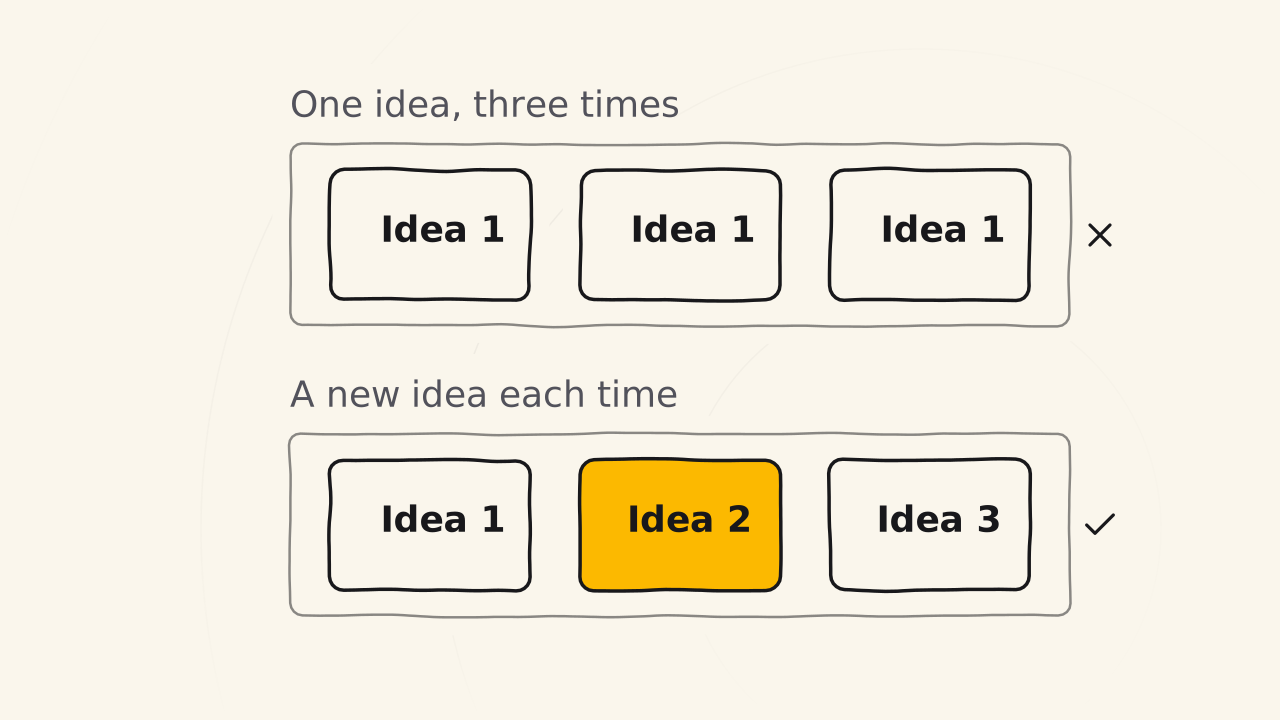
Posting one post on many platforms does not bore customers. A customer usually follows you on one channel: the one closest to them, the most convenient, the one they like best. Say you repurpose on Facebook in Vietnamese and on X in English: a person following one channel doesn’t see the other. If someone follows both, each channel helps them understand the post in one more way.
What is wrong is posting the same idea many times on the same channel. Posting one idea three times in a week on Facebook is wrong. Repurposing means posting different ideas one after another. That is why a blog post must be long enough to have many bright points.
Example of 5 copies
From one blog post, Cuong makes the repurposed versions below. Five versions from one post is normal.
| Version | What changes |
|---|---|
| Newsletter email | Gathers the post’s brightest points, with a link to the post |
| Facebook or X post | Retells one bright point, with wording adjusted to the channel |
| Long YouTube video | Turns the words into a video |
| YouTube Short, Reels | Cuts a bright point into a short video |
| Podcast | Turns the words into a voice |
| Images | Reuses the illustrations already in the post |
Related pages
- Not sending a weekly newsletter: see Send a newsletter.
- Not editing the blog post when the documentation changes: see When your product changes.
- Not explaining why a blog post must have a core message: see Core message.