
VOTE stands for Verify Once, Tell Everywhere. It is the content strategy of the Content system: every fact is verified in one place, and only then goes out to the blog, email, social media and video.
Why use the VOTE strategy?
A fact verified once keeps every later retelling true to it. Without a vault, each post starts from memory again, and that post may not be right or complete.
Quality and reach together
The VOTE strategy gives you two things a single post cannot. Derivation keeps the quality: the blog post is told from your own source with your current view, so it stays fresh and never duplicates the docs page. Repurposing brings the reach: Google no longer owns the internet, and customers on YouTube, on Facebook and in their inbox all meet the same post.
With written posts alone, you lose the customers on other platforms. They still have the need, they just never hear of your content.
Steady work without burnout
The VOTE strategy keeps you from burning out, because you always know the flow of your content. Social media is work everyone has to do, and it drains energy when it does not run along your main work. Posting from a blog post is like picking flowers on your way, much easier than going out of your way to pick them and coming back.
You also run out of ideas less often. The Truth vault rests on your Digital brain and Capture and Share, so when the vault is fed regularly, the topics to write about are always there. Running out of ideas is usually a sign that the vault is running dry.
3 Stages of the VOTE strategy
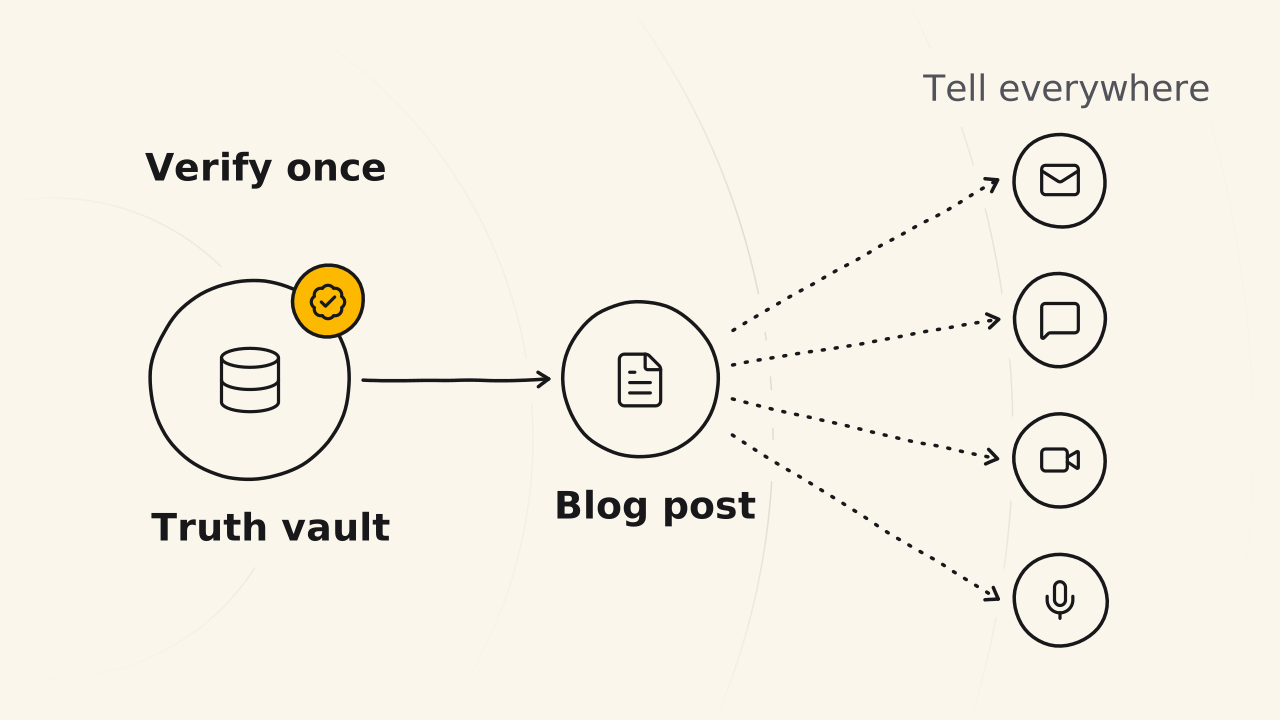
The VOTE strategy has three stages, in this order. Each stage takes the output of the one before it as its source, so no stage can be skipped.
| Stage | Input | Output |
|---|---|---|
| 1. Verify in the vault | What you have done and learned | A verified docs page |
| 2. Derive into a blog post | One or a few docs pages | A blog post with a core message |
| 3. Repurpose everywhere | The blog post | Email, social posts, video |
1. Verify every fact once
The first stage is to build your Truth vault with great care and detail. This is where you put in the most effort. Everything that belongs to your brand goes into the vault:
- What you have done
- Brand assets
- Products
- Guides
You verify them here, once.
The vault is represented by your Entity docs, the public docs that customers and Google can read.
2. Derive the blog post
The second stage turns docs pages into a post. You do not copy one page over. You take related pages, sometimes three pages on one problem, and write one post. That post is derivative content of the docs.
A derived post needs a soul that docs do not have, and that is the core message. The core message names the customer’s pain, gives your method and your solution, and shows the result your customers get.
3. Repurpose the post everywhere
The third stage starts from the blog post, not from the docs. The post is:
- Reshaped into an email
- Cut into pieces for social media
- Turned from text into a YouTube video
- Cut at its best points into short videos for Shorts or Reels
Each of these is repurposed content.
The goal of this stage is wider reach: getting your content onto the platforms your customers already use. A blog post is only distributed on Google. A customer who likes podcasts, short videos or Facebook groups will never meet your content if it only exists as text.
You verify what you say
Verifying once means you verify it yourself. When you run a business alone, you are responsible for every item in the vault. The Truth vault comes from your own strength: what you say, write and learn.
Gaps with the outside world. The part to check most closely is whatever involves a third party. What you believe may have drifted. For example, Google’s algorithm has changed and you have not noticed. Your job is to check again and again what you believe to be true.
This checking is no longer hard. The newest AI, especially Google’s AI Overview, helps you recheck what you say about third parties.
Your own views. What is your opinion, your own conclusion, has no outside source to check against. You review it again and again, confirm that it is yours and that you really do it that way. You also check whether anything is missing.
Facts reach the vault first
As a rule, a fact that is not in the vault yet is not told yet, on the blog or in email. When you plan the posts you are about to write, you already know what each post must settle: the concept, the method, the reason, the names and the related entities. These go into the vault first, so you have time to dig deep.
Writing straight away without the vault easily gives you an uncertain post: not sure it is right, not sure it is complete. In the vault you check again and again. Outside it, even when you check, you easily miss something.
The vault is also easier to split than a post. A blog post often runs to 3,000 words, while a docs page is usually 800 to 1,000 words and digs into each idea. When you sit down to write, the material is already there, so you are not writing from a blank page or from gut feeling.
One vault page, many copies
One page in the vault gives at least one blog post. From that post come many variations, as many as you choose to make.
| Step | Count |
|---|---|
| Docs page in the vault | 1 |
| Derived blog post | 1 |
| Repurposed versions of the blog post | 5 to 10 |
A post with 7 highlights can give 4 social posts:
- A highlight for foreign readers goes to X
- One for Vietnamese readers goes to Facebook
- One that suits video becomes a YouTube video
- A short one becomes a Reel
Ads are derivative too
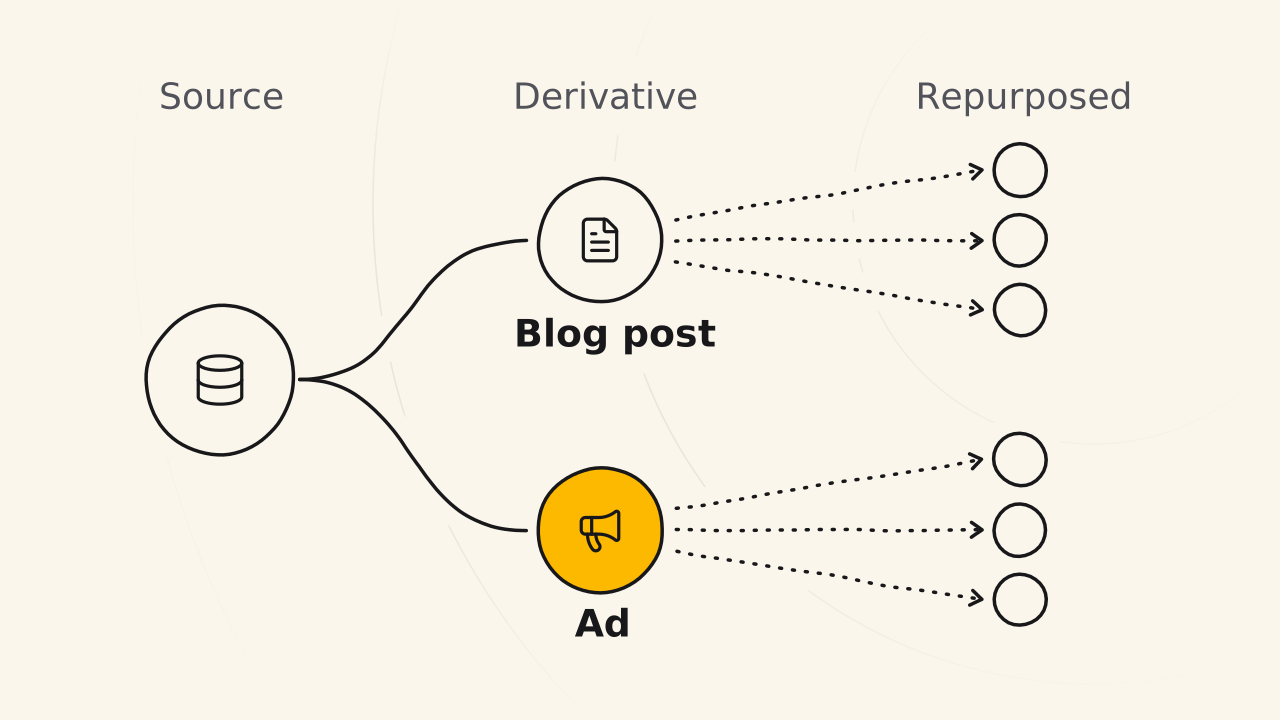
Content for ads is not a repurposed version of the blog. It is another derivative of the vault, redesigned to sell: you pull out the ingredients, the highlights and the customer feedback, all of which sit in the vault.
When that ad runs on Gmail, YouTube, your website and Facebook, the versions on each platform are the repurposed ones. All content has only three roles:
- Original content lives in the vault
- Derivative content is written from the original for a goal of its own
- Repurposed content widens the reach of the derivative
Related pages
- It does not explain why people come before the algorithm: see Philosophy.
- It does not choose which post to write first for buyers: see the Content funnel.
- It does not show how to get a post to each channel: see Content distribution.