
Content distribution is the last output of the Content system. The Publishing process makes one work: a post. Content distribution gets that work to customers.
Why does content distribution matter?
A finished post is a work, but a work nobody knows about does nothing. A blog post is only distributed on Google, and Google no longer owns the internet: social media, video and email have taken their share.
Your customers are on the platforms they use every day. They have the need, but they never hear of your content, not because it is weak but because it is not there. Content distribution takes the post to those places.
Deliver the finished post
Distribution is the delivery step. You email customers so they know there is a new post. You share it in a Facebook group so the people there know you have something good on a topic.
How it differs from publishing
The Idea - Write - Edit process aims at one thing: a finished post. Content distribution starts once the post is done, and its goal is to get the post to customers.
| Publishing process | Content distribution | |
|---|---|---|
| Goal | Make a post | Get the post to customers |
| Output | A post on the blog | Email, social posts, video, newsletter |
| Can you edit it? | Edit until you press publish | Once sent, you do not go back to edit |
2 kinds of copies
Every copy you put out is one of two kinds. A blog post retold from the docs is derivative content. An email, a social post or a video made from a blog post is repurposed content.
When you post elsewhere, whether you link back to the post depends on the platform, its culture and your audience. Even inside one platform the rules split: a Facebook fan page and a personal Facebook profile need different handling.
The “Tell everywhere” half of VOTE
Content distribution is the “Tell everywhere” half of the VOTE strategy. The “Verify once” half lives in the Truth vault. Once the facts are checked and the post is written, you start telling it everywhere your customers are.
Telling everywhere means distributing in every place:
- The blog on Google
- Video on YouTube
- Reels and posts on Facebook
- Posts on X
- Email in the inbox
Each place is just another way to tell the same post, and that post retells facts already checked in the vault.
Because what you tell was checked before, distribution does not check the facts again. Its job is to pick the right channel, the right highlight and the right words for the people in that channel.
Starts right after the Edit step
Distribution starts right after the Edit step. The Edit step ends when you press publish, and from then on the post moves to distribution.
The blog post goes first, and the repurposed copies follow. Editing and then posting straight to Facebook with no blog post is backwards: you forget that your website is home, and the post on your own home must come first. It is also easier to repurpose after deriving, because you pull highlights from a finished post.
You also know the kind of every copy before you start making it: original content, derivative content or repurposed content.
The 4 channels Cuong uses
| Channel | Made for | Kind of content |
|---|---|---|
| Blog | All customers, through Google | Derivative content |
| X | Readers abroad | Repurposed content |
| Readers in Vietnam | Repurposed content | |
| People who signed up for the newsletter | Repurposed content |
Most email is repurposed, like a weekly email that sums up the week’s posts. Some platforms send a whole derivative post by email. That is an exception that belongs to each platform.
This delivery step is where AI does very well: turning a post into an email, cutting a highlight into a social post, changing the words to fit each channel.
Once sent, it cannot change
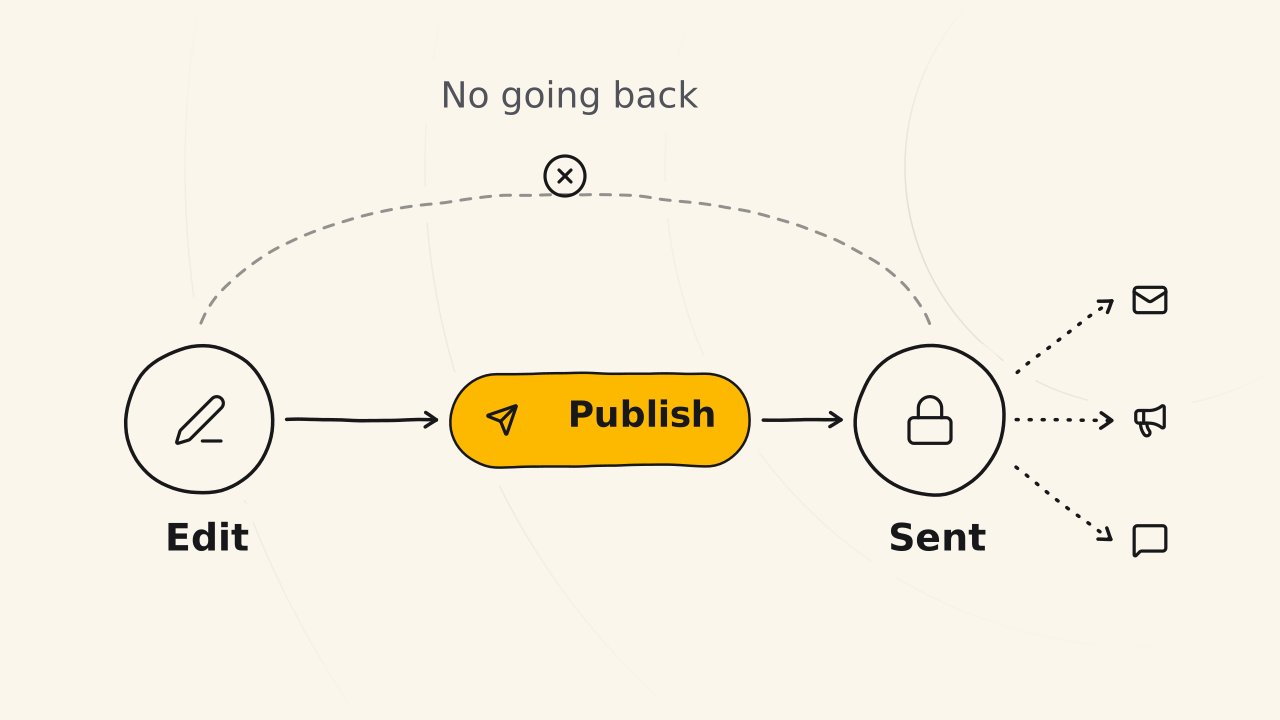
Distribution does not go back to edit the work. Once the post is closed and delivered, it is gone. You do not go back to the Edit step after delivery.
Many limits are the platform’s own rules, not your choice:
- A sent email sits in the customer’s inbox. You cannot take it back, and sending a fix means sending two emails.
- A running ad must be stopped before you can edit it.
- A post on X can be edited only for a short time. Some forums lock editing after about 15 days, depending on the platform.
- A Facebook post has already been seen. If you delete it, people may still have taken a screenshot.
So the post must be edited with great care before distribution. The send button and the post button are the last place to check again and again.
Related pages
- This page does not cover how to write and edit a post before publishing. See The Edit step.
- This page does not cover what to do when a fact in the vault changes. See When your product changes.
- This page does not cover which post to write for which layer. See Content funnel.