
How is derivative content different from repurposing?
Tell derivative content and content repurposing apart by the job each one does, so your blog post brings a fresh angle and reaches customers on every channel.

On this page
You finish a docs page, like it, and copy it whole onto your blog to get one more post. Or you write a careful blog post, then leave it sitting on your website while your customers scroll YouTube and Facebook.
Both mistakes come from the same place, which is that you mix up derivative content with content repurposing. Derivative content adds an angle so the post gets better, and repurposing changes the form so the post goes further. Mix up these two jobs, and you end up copying yourself.
Mixing up the two jobs breaks the post
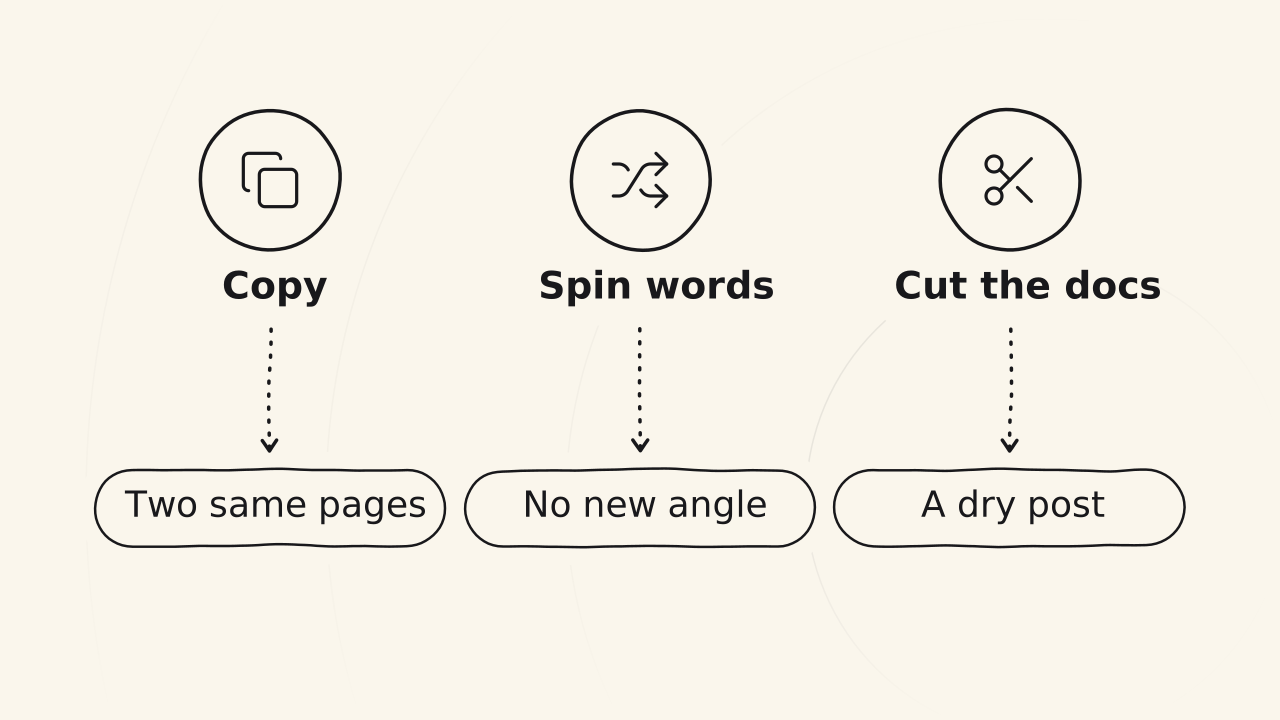
Each mix-up breaks a post in its own way. Here are the three I see most often.
-
The first is copying a docs page onto the blog. When you do not know how to make derivative content, you clone your own source of truth. You get two pages that say the same thing, sometimes three, and I see that as dangerous. Readers have no reason to read both pages.
-
The second is rehashing the words and calling it a new post. You swap words for synonyms, flip sentences around, and rewrite it to look a little different. The post looks derivative, but it brings no new angle. Rehashing words is a repurposing technique, and using it in a derivative post puts it in the wrong place.
-
The third is taking a docs page as is and posting it on social media. A docs page is written to be correct, so it has no feeling. Chop up something with no feeling, and you get a very bad post. A blog post is different: it already has feeling, and the repurposed version only needs to turn that feeling up.
The common way out there is to write once and then chop it up for many places. At first glance the two ways look alike, but that is only repurposing. There is no derivative step yet.
In my early days, I also used my blog as a storeroom, meaning each job I finished became a post. As the posts piled up, the content got scattered, and a new post written a few years later repeated an old one without my knowing. Since then, I make the docs first and let the blog post retell them, as in the post How are business docs different from notes and a blog?.
What is derivative content?
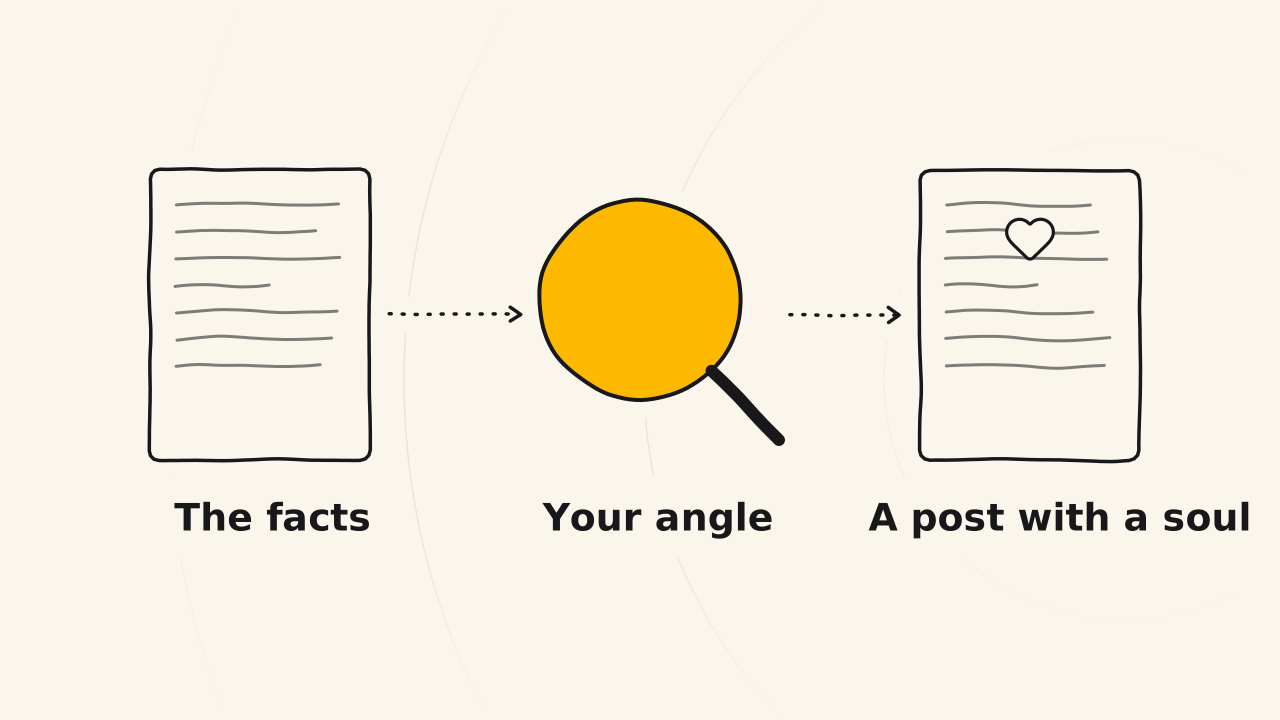
Derivative content is a blog post that retells the truth from one or a few docs pages, with a new angle. The docs page keeps the checked truth. The blog post stands on that truth and looks at it again from the customer’s side.
I did not make up the word “derivative.” It comes from clause 8, Article 4 of Vietnam’s Law on Intellectual Property (opens in a new tab). There, a derivative work is a translation, adaptation, rework, conversion, compilation, annotation or selection. Each one stands on an existing work and adds a new creative part to it. Derivative content works the same way. It has a source, and it has a new part the source does not have.
The source is you
Usually, derivative content comes from outside sources, such as news from official channels, posts by other experts, many sources put together. The writer adds their own experience and field, then turns it into an angle that serves customers.
In my Content system, the source is your own docs. You treat your docs page as the official source, then bring your angle to it. An official source from a big name is open to a great many people. Your source exists in only one copy, and you are the first to touch it, so a derivative post from it is one of a kind by nature.
Because the source is you, you must check the source with great care before you write. Docs pages are often split small and point to each other, so one problem may sit across three pages. When I write a blog post, I gather all three pages to serve one post.
The soul of the post
A docs page has no soul, and it does not need one. Docs are simple, lean, correct and easy to check. The soul of a blog post is its core message, something a docs page never carries.
A core message always has a customer in it. You name their pain, offer your method, and show the result they get. Around that message, the blog post adds things the docs do not have:
- The behind-the-scenes story of what you did
- Stories that carry your own brand
- Real use cases that fill the blind spots in the docs
The docs say what the truth is, and the blog post shows how that truth gets used.
The angle in the post is today’s angle, because you keep learning and changing. That keeps a derivative post fresh, the kind of content Google loves, and the goal of derivative content is quality.
What is content repurposing?
Content repurposing is changing the form of a blog post to take it to another channel, while the ideas stay the same. Repurposing starts from the blog post, not the docs page.
A blog post is only spread through Google, and Google no longer owns the internet. Social media, video and email have split the pie.
People who listen to podcasts, people who need pictures, people in a rush who only have time for short videos, people in Facebook groups, any of them could be your customer. They do not skip you because your post is bad. They have just never met that post in the places they go. The goal of repurposing is reach.
I distribute my content through four channels:
- Blog
- X for readers abroad
- Facebook for readers in Vietnam
- Email sent with Blueky (opens in a new tab)
From one blog post, I make an email, a Facebook post, a long YouTube video, a YouTube Short, Reels, a podcast and images. Five versions from one post is normal.
Take a post with seven highlights, meaning its seven best ideas, as an example. I pick four ideas and send each one to the channel that fits it:
- An idea that fits readers abroad: post it on X
- An idea that fits readers in Vietnam: post it on Facebook
- An idea that is best told on video: make it a YouTube video
- A short idea: make it a Reel
The pictures and words change for the people on each channel, but the idea stays the same. A reader who sees a social post, clicks through to the blog, and finds two ideas that clash will stop trusting you.
Quality and reach
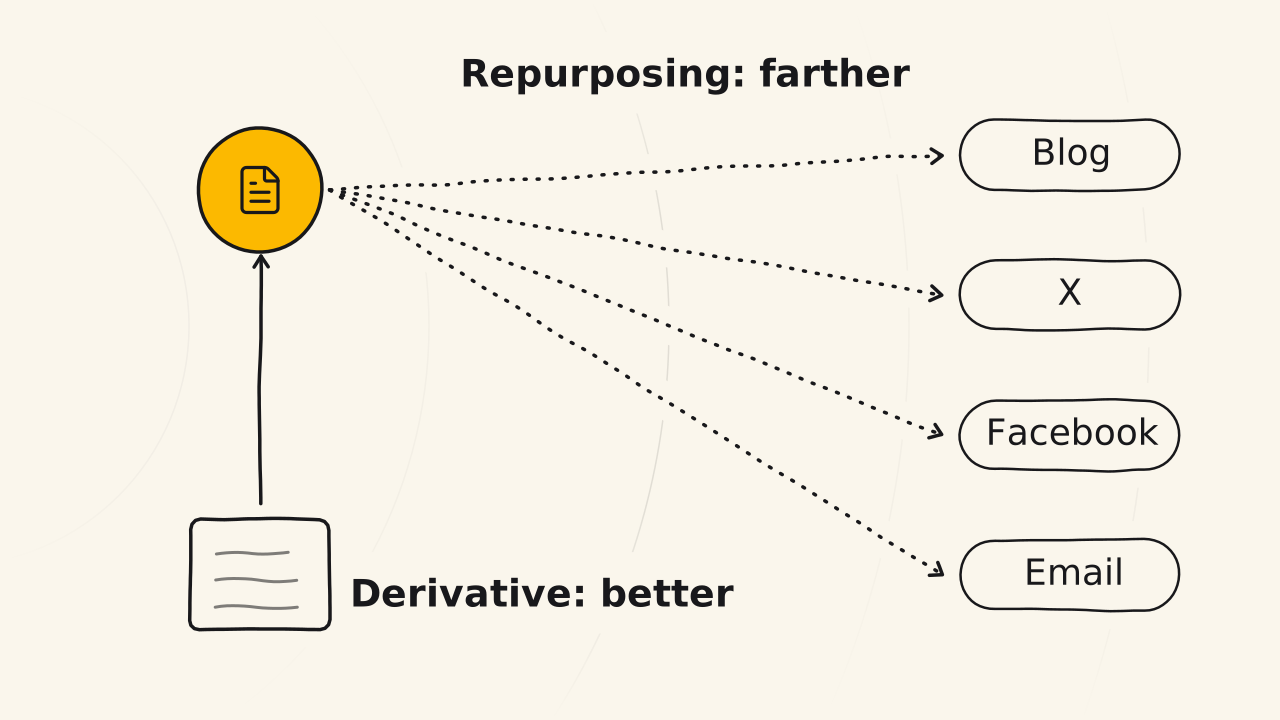
A post needs both quality and reach, but each one comes from a different job. Derivative content makes the post better. Repurposing takes that post to more people.
| Derivative content | Content repurposing | |
|---|---|---|
| Comes from | One or a few docs pages | A published blog post |
| Adds | An angle and a core message | No new ideas |
| Makes the post | Better | Go further |
| Lives on | The blog on your website | Email, social media, video, podcasts |
| Changes the words | No rehashing words | Words tuned to each channel |
This line holds for other work too. Ads are another derivative version of the vault, and the ad versions on each platform are repurposing, as the VOTE strategy describes. When the docs change a fact, the derivative post gets fixed to match the vault, and the repurposed versions already sent are left to drift away.
The new angle test
To know whether a version is derivative or repurposed, ask yourself one question. Does this version have a new angle? If it has a new angle and a clear core message, it is derivative content. If not, it is repurposing, no matter how long it is.
Five versions split from one blog post bring no new angle, so they are repurposing. They need pull, highlights and stories told around those highlights, not another core message.
Change channels without repeating ideas
The same post showing up on many channels does not bore customers. Most customers pick only one channel to follow you, the one that feels close and easy for them. People who follow me on Facebook in Vietnamese do not see my posts on X in English, and the other way around.
The words change for the readers of each channel. Say your main customers are working people, but you want to try winning over students too. Then the version for students changes how it talks, and the ideas stay as in the original post.
Try writing a derivative post
Two matching pages on Google, or a good post that no one sees, both come from lumping two jobs into one. Pull the two jobs apart, and you know when you need to add an angle and when you only need to change the form.
The first step is to learn how to write blog posts from docs that do not put you to sleep, starting from your own docs page.