
A sales funnel is where customers read the page, pay and get a paid product. Its goal is to close orders, so you make sales without closing every single order by hand.
What does a sales funnel include?
When the sales funnel works, customers read the page and buy. The funnel has the part customers see, the automation behind it, and the emails that go out together with it.
Payment and delivery
A sales funnel has 2 things customers see:
- Payment, where the customer pays for the product.
- Delivery, where the product reaches the customer after they pay.
Behind those 2 things is the automation, which handles the cases where customers stop halfway or need more care:
- Abandoned cart: a customer reaches the payment step and does not pay, and the system reminds them to come back.
- Post-sale care: emails sent after the customer buys, to lower the refund rate.
The steps to build the funnel, from the product and payment to the 3 pages, are in Build a sales funnel.
A funnel always has a pair
Every funnel always has one pair made of the funnel and its automation. The funnel is the part for customers, who see it and walk through it. The automation sits inside the funnel, and it is your own part.
The pair is the same in both funnels, the gift funnel and the sales funnel. The gift funnel has automation for gifts, and the sales funnel has automation for sales. When you build a funnel, you build its automation too.
Emails after the customer buys
The automation of the sales funnel sends post-sale emails in order:
- A how-to-use email for the product, the first email you need.
- A story email.
- An email asking for feedback from the customer.
Besides the automatic emails, you send campaign emails to everyone at once, for example:
- Black Friday and your own sales and promotions.
- 20 November and other holidays in Vietnam.
- Shopping holidays and double-date sales days.
Compared to the gift funnel
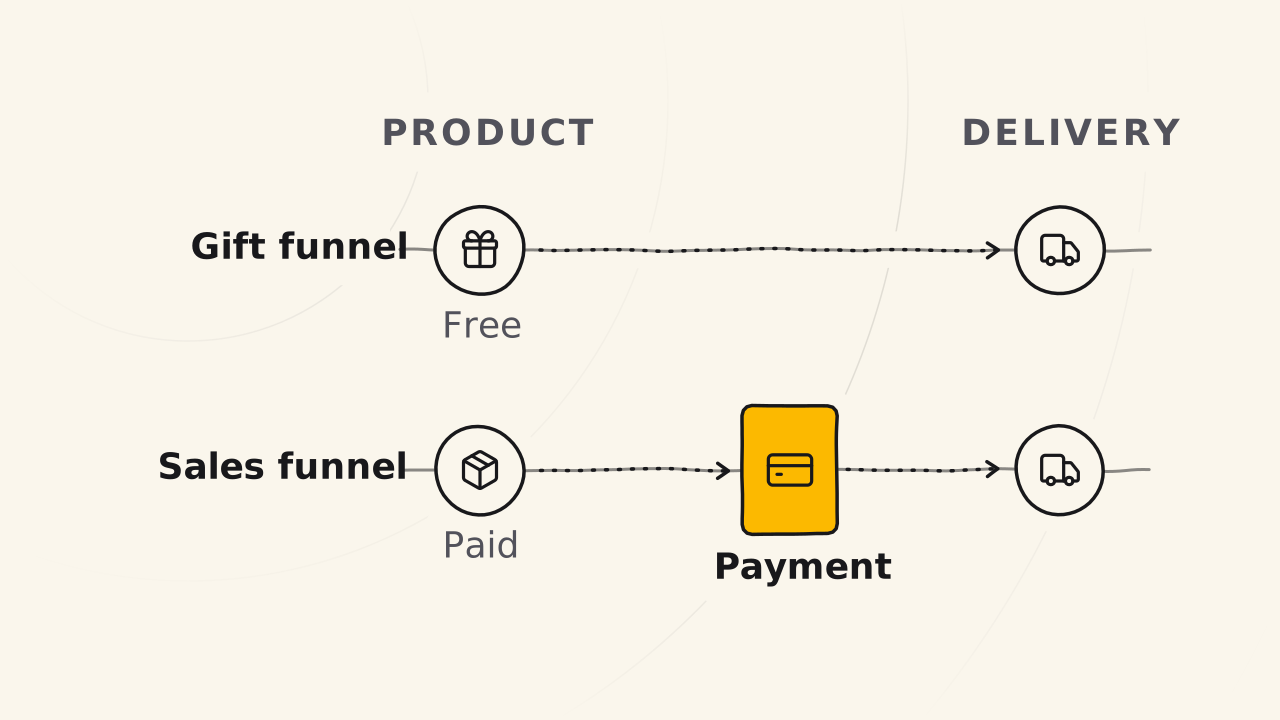
The sales funnel goes through all the same steps as the gift funnel. Each funnel always holds one product, and the product is delivered in the same way. A paid product reaches the customer the same way a free product does. The difference is in the product and in payment.
| Gift funnel | Sales funnel | |
|---|---|---|
| Product | Free, split from the core product | Paid |
| Payment | None | Yes |
| Goal | Build an email list | Close orders |
| First email | How to use the gift | How to use the product |
Because it has a payment step, the sales funnel needs a payment gateway and abandoned cart reminders, 2 things the gift funnel does not have.
It sells while you are away
The sales funnel works even when you are not there at all. Customers read the page, click buy, pay and get the product, and the automation handles all the care after that.
Following the gift funnel
People who reach the sales funnel have usually gone through the gift funnel and the posts of the content system first. So the sales funnel sits behind the gift funnel, and the 2 funnels follow each other.
With a content system in place, the conversion rate of the sales funnel is much higher than when your website has nothing on it. Readers have met your posts before they reach the product page, so they already understand the product before they are invited to buy it.
The funnel measures its own conversion
Conversion inside the sales funnel, from the product page to payment, is measured by the tools built into the funnel. You do not need Google Analytics for this part.
Google Analytics measures the outside part, namely how many people go from the content funnel to the sales funnel and which page customers leave most. How to read it is in the section “Measure conversion in stage 3” of the Google Analytics page.
Once you understand both funnels, the next job is to build the sales funnel on your website.
Related pages
- Setting up the product, payment gateway and 3 pages: see Build a sales funnel.
- Trying a real payment before you open to customers: see Test a funnel.