
An idea is a passage you said in a recording or wrote down, not yet turned into a docs page. Before the idea goes into the Truth vault, you find the sentences in it that talk about the outside world, like a price, a number or a date. Then you check each one against the vault and against a primary source on the web.
The Truth vault only records what has been checked. A derivative post takes its facts from the vault and only links back, without proving them again. So one wrong sentence in the vault is wrong in every post that uses it.
What you need
- The idea word for word, exactly as you said or wrote it. A retold version can add a reason you never gave, or even turn the meaning around.
- The docs page on the same topic in the vault, because the vault is what you compare against first.
- A fact log that records each checked sentence with its verdict, its source and the date you checked it. A sentence already in the log and still in date is reused, not searched again.
Tell the kinds of ideas apart
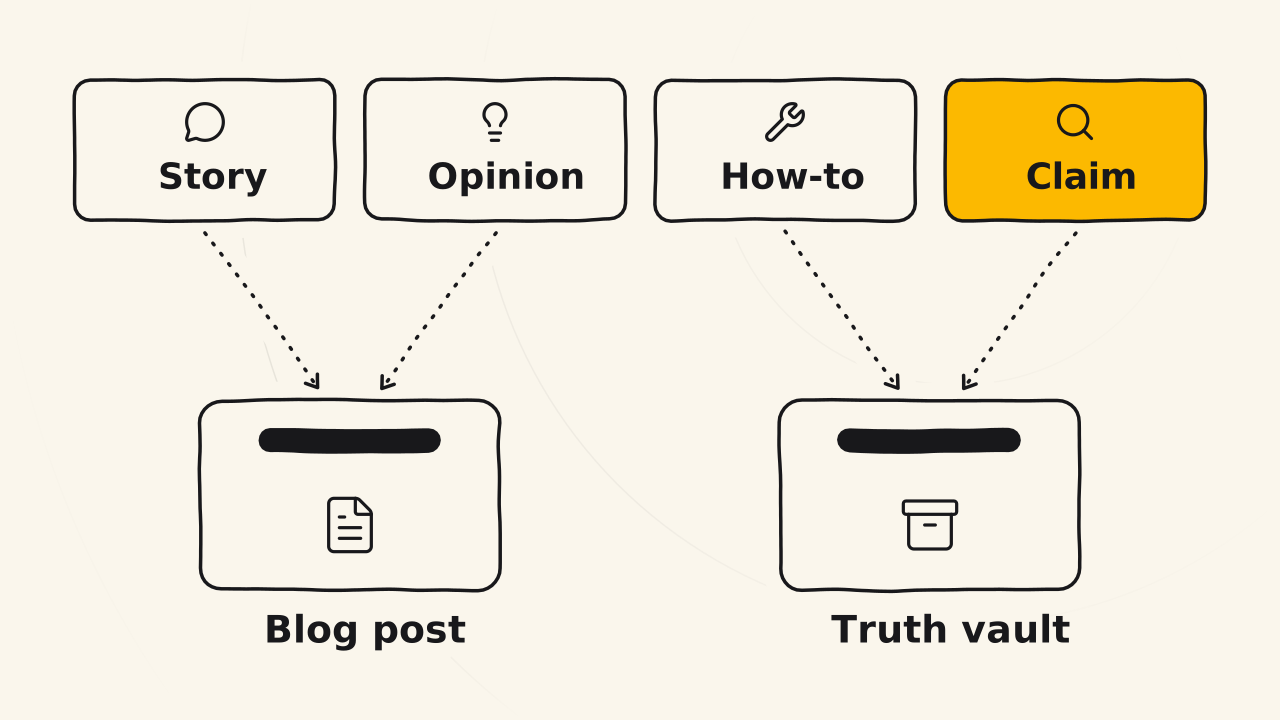
An idea is one point with its reason and example, about 40 to 200 words. The kind of idea decides where it goes first, and whether it needs a check on the web.
| Kind of idea | What it is | Goes first to | How to check it |
|---|---|---|---|
| Story | Something you lived through | Blog post | Read it again, no web check |
| Opinion | Your point of view | Blog post | Read it again, no web check |
| How-to | How you do a task | Truth vault | Compare it with the vault |
| Claim | A fact about the outside world, like a price, a tool or a number | Truth vault | Compare it with the vault, then with a primary source on the web |
Reading it again means checking that the passage holds one whole thought and is clear. A passage cut off in the middle, or one where you can’t tell what “it” points to, is kept back as unclear, with a note on what is unclear.
A sentence is a claim when it is about the outside world, something the reader can check somewhere else. A sentence about what you did, the result you got or what you think is not a claim, because public information can’t check it.1 Claims are then split by how much checking they need.2
| Kind of claim | How to spot it | What to do |
|---|---|---|
| Price | A price, a plan, a limit, a feature that may have changed | Check it, it expires after 90 days |
| Fact | History, a definition, a number, a date, a study, a quote from someone else, how a platform works | Check it, it expires after 365 days |
| Cause | A line saying one thing leads to another, like “post often and you reach the top” | Find a source that proves that exact link, not just that the two things happen together. If there is none, say it as your own experience, or say it more softly |
| General | A line like “most people…” or “Google now…” with no number, source or experience of yours behind it | Find a source behind it, or say it more softly if there is none |
| Prediction | A line about the future, like “next year Google will…” | Don’t record it in the vault, because the vault never records what has not happened yet |
| Just a name | A tool, a company, a person, a well-known term | Check it only when you are unsure |
Check one claim
This separates facts about the outside world from your own experience, then checks only the part that can be wrong.
Pull out and pick the claims
A long passage often holds only one or two sentences about the outside world, and only those need a source. Copy each one out as its own idea, word for word, and note which passage it came from. Keep for checking only the sentences that hurt the reader when wrong, which means a Price, a Fact, a Cause or a General claim. Skip a sentence that just names something, unless you are unsure. You will have a short list. A post usually ends up with 4 to 6 sentences.
Compare with the vault, then find the source
The vault holds facts you have already checked, so comparing with it first takes the least work. A sentence that goes against the vault is held back, with a note on which page says otherwise. A sentence that matches the vault is done, and its source is that page. Group the sentences the vault does not cover by source, for example every sentence about one tool. Then search once per group and open one primary page, such as the pricing page, the vendor’s own docs or the study itself. Prefer primary sources, then trusted press. Never use a roundup page or an AI summary.3 Note the page’s date, because tools and prices change. Each sentence will have one source page you opened.
Record the verdict in the log
A sentence you record never has to be searched again. Write the sentence in plain words with its number, the verdict, the link and the date you checked. Also note its kind, price or fact, because the kind sets when it expires. An expired sentence leaves the vault on its own until you check it again. Never record a verdict from memory without opening the source page. You will have a log the next post can reuse.
Handle each verdict
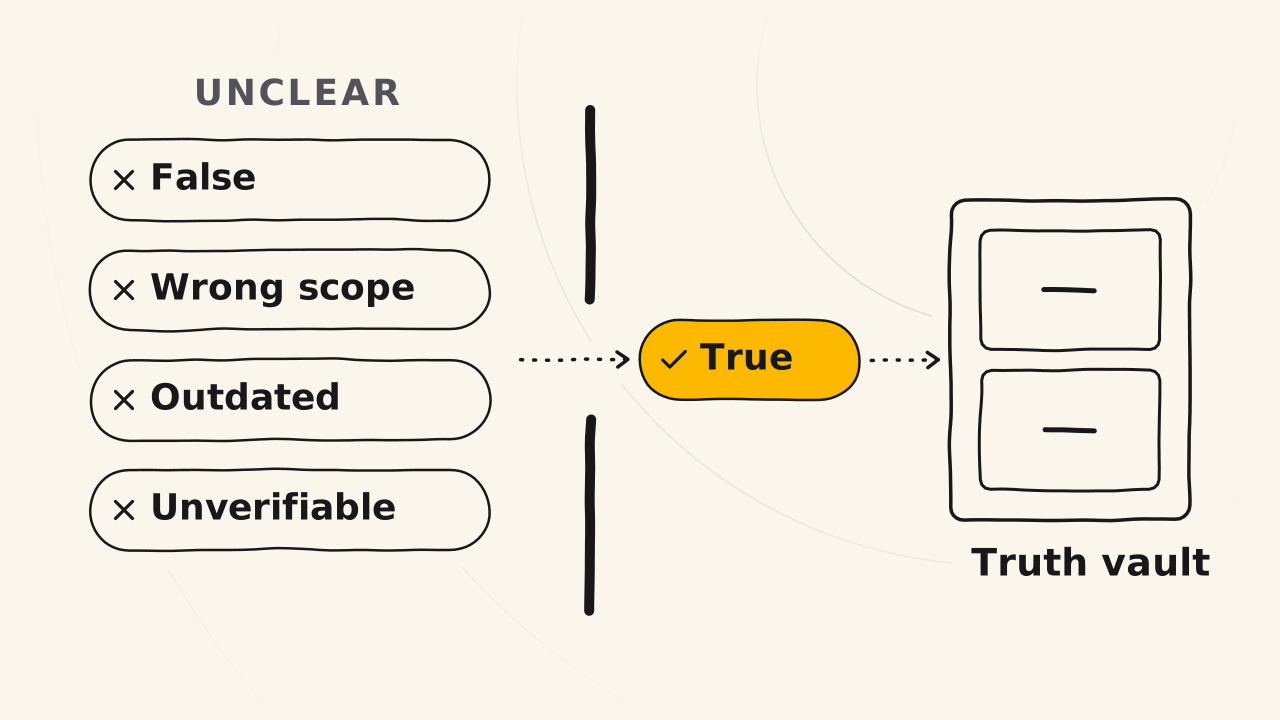
Each sentence gets exactly one verdict. Only a True verdict lets the idea go on into the vault. The other four keep the passage out of the vault as unclear, with a note on which sentence has the problem.
| Verdict | What it means | What to do |
|---|---|---|
| True | The source says what your sentence says | The passage is approved, and the source shows in the References list at the end of the docs page |
| False | The source says something else | Fix the sentence in your own words from what the source says, with its link |
| Wrong scope | True, but narrower, for example true for one year or one device only, or a relative number read as an absolute one | Fix the sentence to the right scope, with its link |
| Outdated | It was true once and has changed since | Fix the sentence to what is true today, with its link |
| Unverifiable | No reliable source found | Cut the sentence, say it as your own experience if that is what it is, or find a source |
Never treat an Unverifiable sentence as True.
Signs an idea is ready
- The passage is whole and clear, and you know what every “it” and “this” points to.
- Every claim has a True verdict, a source page you opened and a check date still in date.
- The idea agrees with every docs page in the vault, and does not clash with another idea.
- If one thing is missing, the idea stays out of the vault with a note on what is missing, to look at again next time.
When checking goes wrong
An idea that is not ready is not deleted. It stays out of the vault until you decide.
You know the source is old
For example, a tool raised its limit after its docs page was written. When you know this, your word is the standard. Fix the sentence in the fact log, then find the docs pages that still carry the old fact and fix them too, the same way as when your product changes.
An idea turns out wrong later
An error found after writing still goes back to the original idea. Record the new verdict for the sentence, set its passage back to unclear, then fix every post and page that used the idea. The wrong sentence does not reach any more posts.
Two ideas clash
Both ideas leave the vault until you choose. You keep one idea, fix one in your own words, or drop the wrong one. An idea you have not answered stays out of the vault with its note, to be asked again next time.
When this guide does not fit
An idea that is only a plan or a wish, not done yet, does not need a check to enter the vault, because the vault only takes work you have done. Write it in your Digital brain. An idea that does not fit the vault’s brand stays there too.
Related pages
- Not how to write a docs page from a checked idea: see Customer questions.
- Not why posts link to the vault: see Source of evidence.
- Not what gets recorded in the vault: see Entity docs.